
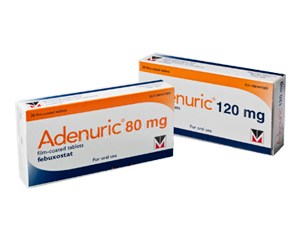
Adenuric
View Options
This website provides general information about medicines for educational purposes only. Always consult your doctor or pharmacist before taking any medication.
Choose Your Medicine
Select dosage and quantity
Online Consultation
Reviewed by a qualified physician
Fast, Discreet Delivery
Delivered to your door
Medical Information
About This Medicine
Adenuric is a prescription medicine containing febuxostat, a xanthine oxidase inhibitor used for the long-term treatment of chronic hyperuricaemia (raised uric acid levels in the blood) in adults with gout. It represents a pharmacological advance over older gout treatments, offering an alternative to allopurinol, particularly for patients who cannot tolerate allopurinol or in whom that medicine fails to adequately lower uric acid levels to target.
Gout and Uric Acid
Gout is caused by the deposition of monosodium urate crystals in joints and surrounding tissues, resulting from persistently elevated blood uric acid concentrations. Acute gout attacks cause sudden onset of severe joint pain, swelling, redness, and warmth, most commonly affecting the big toe, ankles, knees, or wrists. Without long-term urate-lowering therapy, attacks become more frequent, tophi (chalky deposits of urate crystals under the skin) may develop, and chronic joint damage can occur. Lowering serum uric acid to below the saturation threshold (generally below 360 micromol/L) causes crystals to dissolve gradually and prevents new crystal formation, reducing the frequency and severity of attacks over time.
How Adenuric Works
Adenuric reduces the production of uric acid by blocking xanthine oxidase, the enzyme responsible for the final steps of uric acid synthesis from purines. Unlike allopurinol, which is a purine analogue that inhibits xanthine oxidase non-selectively, febuxostat is a non-purine selective inhibitor of xanthine oxidase, which means it inhibits both oxidised and reduced forms of the enzyme with high potency and selectivity.
Important Limitations
Adenuric must not be started during an acute gout attack, as initiating urate-lowering therapy at this time can prolong or worsen the attack. Prophylactic anti-inflammatory treatment, typically with colchicine or a non-steroidal anti-inflammatory drug, is recommended for at least the first six months of Adenuric therapy to reduce the frequency of gout flares triggered by the mobilisation of urate crystals during treatment.
Usage & Dosage
Starting Adenuric Treatment
Never start Adenuric during an acute gout attack. Wait until the attack has completely resolved before beginning treatment. Starting urate-lowering therapy during a flare can worsen or prolong the attack.
Adenuric (febuxostat) tablets are taken once daily by mouth, with or without food. The 80 mg tablet is the recommended starting dose. If the target serum uric acid (below 6 mg/dL or 360 micromol/L) is not reached after two to four weeks, the dose may be increased to 120 mg once daily.
Prophylactic Anti-Inflammatory Treatment
During the first six months of Adenuric therapy, gout flares are common as urate crystals mobilise. Your doctor will usually prescribe a low dose of colchicine or an NSAID to take alongside Adenuric to prevent these flares. Do not stop Adenuric if a flare occurs, continue treatment and treat the flare separately as directed.
The recommended starting dose of Adenuric for chronic hyperuricaemia in gout is 80mg once daily. If serum uric acid levels remain above the target of 360 micromol/L (6 mg/dL) after two to four weeks, the dose may be increased to 120mg once daily.
Renal impairment: No dose adjustment is required for mild to moderate renal impairment (creatinine clearance 30-89 mL/min). Data for severe renal impairment (creatinine clearance below 30 mL/min) are limited, and Adenuric should be used with caution in this group.
Hepatic impairment: For mild hepatic impairment (Child-Pugh Class A), no dose adjustment is needed. For moderate hepatic impairment (Child-Pugh Class B), febuxostat exposure is increased, and a maximum dose of 80mg daily is recommended. Adenuric is not recommended in severe hepatic impairment (Child-Pugh Class C), as data are insufficient.
Elderly patients do not require dose adjustment based on age alone. Adenuric is not approved for use in patients under 18 years of age. Monitoring of liver function tests is recommended during treatment, particularly in patients with pre-existing hepatic conditions.
Side Effects
Common Side Effects
Adenuric is generally well tolerated. The most frequently reported side effects include:
- Gout flares, particularly during the first weeks and months of treatment as urate crystals begin to dissolve and mobilise
- Liver function test abnormalities (elevated transaminases), which are usually mild and reversible
- Nausea, diarrhoea, and abdominal discomfort
- Headache
- Oedema (peripheral swelling) and fluid retention
- Rash or skin reactions
Serious Side Effects
A number of more serious adverse effects require medical attention:
- Cardiovascular events: Post-marketing data and a clinical trial (CARES study) suggested a possible increased risk of cardiovascular death with febuxostat compared to allopurinol in patients with a history of major cardiovascular disease. Patients with a history of heart attack, stroke, or unstable angina should discuss this risk specifically with their doctor before starting Adenuric.
- Severe hypersensitivity reactions including Stevens-Johnson syndrome and anaphylaxis, which are rare but potentially life-threatening
- Serious liver injury, which is rare but has been reported; patients with unexplained nausea, jaundice, dark urine, or abdominal pain should seek immediate medical review
- Severe skin reactions requiring urgent medical attention
Warnings & Precautions
Cardiovascular Risk
Adenuric carries an important cardiovascular warning. A large clinical trial found a higher rate of cardiovascular deaths with febuxostat than with allopurinol in patients with a history of major cardiovascular disease. While subsequent analyses have been debated, regulatory authorities recommend that Adenuric should be used with caution in patients with established cardiovascular disease. For patients with a history of heart attack, heart failure, or stroke, a careful benefit-risk discussion with the prescribing doctor is essential before starting treatment.
Hypersensitivity and Liver Monitoring
Patients who develop any signs of a severe allergic reaction or skin condition during treatment, such as a spreading rash, blistering, or mucous membrane involvement, should stop Adenuric immediately and seek urgent medical attention. Liver function should be monitored periodically during treatment. Patients should be advised to report symptoms of liver problems, including unusual fatigue, loss of appetite, right-sided abdominal pain, dark urine, or jaundice, without delay.
Adenuric is not recommended during pregnancy or breastfeeding. It should not be used in patients also receiving azathioprine or mercaptopurine, as inhibition of xanthine oxidase by febuxostat markedly increases blood levels of these medicines, creating significant toxicity risk. Alcohol should be consumed in moderation, as it raises uric acid levels and may counteract the therapeutic benefit of Adenuric.
Contraindications
Adenuric is contraindicated or must be avoided in the following situations:
- Hypersensitivity to febuxostat or any excipient in the product
- Concomitant use with azathioprine, mercaptopurine, or didanosine, as xanthine oxidase inhibition dramatically increases their toxicity
- Active acute gout attack (treatment must not be initiated during an attack)
- Severe hepatic impairment (Child-Pugh Class C)
- Pregnancy and breastfeeding
- Children and adolescents under 18 years of age
- Patients with a history of major cardiovascular events where the benefit-risk assessment does not favour use
- Known hypersensitivity reaction history to allopurinol does not in itself contraindicate febuxostat, but careful monitoring is warranted as cross-reactivity in severe reactions has been reported rarely
- Patients with rare hereditary problems of galactose intolerance or Lapp lactase deficiency (relevant to the tablet excipients)
Frequently Asked Questions
Can I take Adenuric during a gout attack?
Why am I having more gout attacks since starting Adenuric?
Is Adenuric safe if I have heart disease?
How long do I need to take Adenuric?
What is the target uric acid level when taking Adenuric?
Dr. Ross Elledge
General Practitioner · General & Family Medicine
Verified Healthcare Professional
TopDoctors Profile