
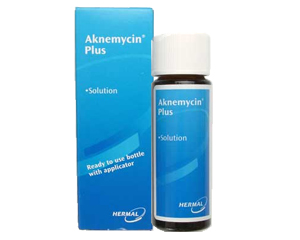
Aknemycin Plus
View Options
This website provides general information about medicines for educational purposes only. Always consult your doctor or pharmacist before taking any medication.
Choose Your Medicine
Select dosage and quantity
Online Consultation
Reviewed by a qualified physician
Fast, Discreet Delivery
Delivered to your door
Medical Information
About This Medicine
Aknemycin is a topical antibiotic preparation containing erythromycin, used for the treatment of acne vulgaris. Available as both a solution and an ointment, it is applied directly to affected areas of skin on the face, back, chest, and shoulders to reduce bacterial colonisation and inflammation associated with acne. Aknemycin is particularly suited to patients with mild to moderate inflammatory acne, where the formation of papules, pustules, and comedones is primarily driven by bacterial activity.
Acne and Its Causes
Acne vulgaris is an extremely common skin condition affecting a large proportion of adolescents and a significant number of adults. It arises from the interplay of several factors: excess sebum production by sebaceous glands, abnormal shedding of skin cells within hair follicles leading to blockages (comedones), colonisation of the follicle by Cutibacterium acnes (formerly known as Propionibacterium acnes), and the subsequent immune response that causes inflammatory lesions. Without effective treatment, acne can cause considerable psychological distress and may result in permanent scarring.
How Aknemycin Targets Acne
Aknemycin works primarily by reducing the population of Cutibacterium acnes bacteria on and within the skin. Erythromycin penetrates into the follicle and inhibits bacterial protein synthesis, reducing bacterial numbers and subsequently decreasing the pro-inflammatory molecules they produce. This results in a reduction in papules and pustules over several weeks of consistent use. Aknemycin may also have some direct anti-inflammatory properties beyond its antibacterial action.
Setting Realistic Expectations
Aknemycin is not an overnight treatment. Patients typically begin to see meaningful improvement after six to eight weeks of consistent daily use, with maximum benefit usually achieved at 12 weeks. It is most effective as part of a broader acne management strategy that may include non-comedogenic skincare products, a topical retinoid, or benzoyl peroxide.
Usage & Dosage
How to Apply Aknemycin
Cleanse the skin gently and pat dry before applying Aknemycin. Apply a thin layer of the solution or ointment to the affected areas using a clean fingertip or cotton pad. Wash your hands thoroughly after application. Apply once or twice daily as directed, consistently at the same times each day.
Avoid contact with the eyes, inside of the nose, mouth, and mucous membranes. If accidental contact occurs, rinse thoroughly with water.
Duration of Treatment and Resistance
Continue using Aknemycin for the full recommended period, even if the skin appears to improve before 12 weeks. Where possible, combine Aknemycin with benzoyl peroxide, which reduces the risk of antibiotic resistance developing. Prolonged antibiotic monotherapy beyond three months is generally discouraged.
Aknemycin is applied topically to the affected areas of skin once or twice daily, as directed by a prescriber or in line with product labelling. The solution formulation is typically applied with a small applicator or cotton ball, while the ointment is spread as a thin film.
There are no systemic dose adjustments required based on renal or hepatic impairment, as systemic absorption of erythromycin from topical acne formulations is negligible. Elderly patients may use the standard adult regimen without adjustment, though skin may be more sensitive and a once-daily application is often appropriate as a starting point.
Treatment should generally be continued for a minimum of eight weeks to assess response, with a full 12-week course often needed for maximum benefit. If no improvement is seen after 12 weeks, review by a clinician is recommended to consider alternative or additional treatments. Long-term antibiotic use beyond three months should be evaluated carefully in terms of benefit versus resistance risk, and benzoyl peroxide should be incorporated as a resistance-limiting strategy where possible.
Side Effects
Common Side Effects
Aknemycin is generally well tolerated. Local skin reactions are the most frequently reported effects and include:
- Mild stinging, burning, or tingling immediately after application
- Skin dryness, peeling, or flaking at the application site
- Mild erythema (redness) of the treated skin
- Itching or a sensation of tightness
- Oiliness or greasiness, particularly with the ointment formulation
These effects are usually temporary and diminish as the skin adjusts to treatment. Using a non-comedogenic moisturiser can help manage dryness and irritation.
Serious Side Effects
Serious adverse effects from topical erythromycin are rare but can include:
- Allergic contact dermatitis, characterised by spreading redness, intense itching, and vesicle formation beyond the application site, which requires discontinuation of the product
- Superinfection with resistant bacteria or fungi, particularly with prolonged use
- Rare systemic hypersensitivity reactions if significant absorption occurs in patients with extensive application to broken skin
- Emergence of erythromycin-resistant Cutibacterium acnes populations, which may complicate future antibiotic treatment choices for acne or other infections
If the acne worsens significantly, new types of lesions appear, or skin reactions extend beyond the treated area, consult a dermatologist or GP for reassessment.
Warnings & Precautions
Antibiotic Resistance
The routine prolonged use of topical antibiotics in acne management is associated with the development of antibiotic-resistant Cutibacterium acnes strains, which can complicate future treatment and contribute to broader antibiotic resistance problems. To mitigate this risk, Aknemycin should ideally be used in combination with benzoyl peroxide rather than as monotherapy, and treatment duration should be limited to the minimum effective period. Do not use both topical and oral erythromycin simultaneously.
Skin Sensitivity and Eye Contact
Avoid applying Aknemycin to the areas around the eyes, lips, and inside the nose, as these are particularly sensitive. Do not apply the solution or ointment to large areas of broken or severely inflamed skin, as increased absorption may occur. Aknemycin may bleach coloured fabrics and bed linen, particularly the solution formulation; patients should be aware of this and take precautions.
Aknemycin is generally not recommended during pregnancy without medical advice, as systemic erythromycin is classified as a category B drug, and topical use, while associated with negligible absorption, should still be discussed with a clinician. During breastfeeding, application to the chest and breast area should be avoided to prevent infant exposure.
Contraindications
Aknemycin is contraindicated or should be avoided in the following situations:
- Known hypersensitivity to erythromycin, other macrolide antibiotics, or any excipient in the formulation
- Application to mucous membranes, eyes, or inside the nose
- Use in patients with a known history of allergic contact dermatitis to the product or its components
- Simultaneous use of other topical antibiotics on the same treatment area (risk of reduced efficacy and increased resistance selection)
- Concurrent use of oral erythromycin for acne or other conditions without explicit prescriber approval
- Extensive application to large areas of broken or inflamed skin, where significant systemic absorption could occur
- Patients with a history of erythromycin-resistant acne documented on previous skin swabs, for whom an alternative agent should be selected
- Children under 12 years of age should use this product only under medical supervision
Frequently Asked Questions
How long does Aknemycin take to work on acne?
Can I use Aknemycin with other acne treatments?
Will Aknemycin bleach my clothes or bedding?
Is it safe to use Aknemycin if I am pregnant?
Why might my acne become resistant to Aknemycin over time?
Dr. Ross Elledge
General Practitioner · General & Family Medicine
Verified Healthcare Professional
TopDoctors Profile