
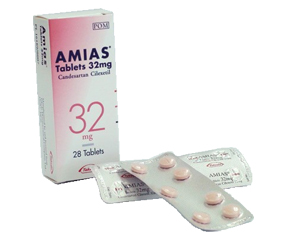
Amias
View Options
This website provides general information about medicines for educational purposes only. Always consult your doctor or pharmacist before taking any medication.
Choose Your Medicine
Select dosage and quantity
Online Consultation
Reviewed by a qualified physician
Fast, Discreet Delivery
Delivered to your door
Medical Information
About This Medicine
Amias is a prescription medicine containing candesartan cilexetil, an angiotensin II receptor blocker (ARB) used to treat high blood pressure (hypertension) and heart failure. It is widely prescribed across the UK as an effective and well-tolerated alternative to ACE inhibitors, particularly for patients who develop ACE inhibitor-related cough. Amias is available in tablets ranging from 4mg to 32mg and is taken once daily, making it a convenient long-term treatment option.
Hypertension and Cardiovascular Risk
High blood pressure is one of the most prevalent cardiovascular risk factors in the UK, affecting approximately one in three adults. Left untreated, persistent hypertension significantly increases the risk of heart attack, stroke, kidney disease, and heart failure. Effective antihypertensive therapy reduces these risks substantially, and ARBs such as candesartan are recommended by UK clinical guidelines (NICE) as a first-line or second-line treatment depending on age, ethnicity, and co-existing conditions.
Treating Heart Failure with Amias
In addition to hypertension, Amias is used in adults with heart failure and reduced left ventricular ejection fraction (HFrEF) who are intolerant of ACE inhibitors or in combination with an ACE inhibitor when beta-blockers cannot be tolerated. In heart failure, candesartan reduces the burden on the heart by blocking the vasoconstrictive and aldosterone-stimulating effects of angiotensin II, leading to vasodilation, reduced blood pressure, and less fluid retention. Clinical trials have shown that candesartan reduces hospitalisation for heart failure and cardiovascular mortality in this population.
Starting Amias and Long-Term Management
Amias is a long-term treatment for both hypertension and heart failure, and its protective benefits accumulate over time. Blood pressure should be monitored regularly, and the dose adjusted to achieve target levels. Renal function, electrolytes, and blood pressure should also be monitored periodically, particularly in patients with heart failure, renal impairment, or diabetes.
Usage & Dosage
How to Take Amias
Swallow Amias (candesartan) tablets whole with a glass of water, with or without food. Take at the same time each day, morning dosing works well for most people.
The usual starting dose for high blood pressure is 4 mg to 8 mg once daily. The dose may be increased every four weeks based on blood pressure response, up to a maximum of 32 mg once daily. Blood pressure lowering builds up gradually over the first few weeks, so do not be concerned if results are not immediate.
Do not stop Amias suddenly or without medical advice, even if you feel well. High blood pressure rarely causes symptoms, and stopping treatment will allow blood pressure to rise again and increase the risk of heart attack and stroke.
For hypertension: the recommended starting dose is 8mg once daily in most patients. The dose may be increased to 16mg and then to a maximum of 32mg once daily based on blood pressure response at intervals of four weeks. In patients with intravascular volume depletion (e.g., those taking high-dose diuretics), renal impairment, or hepatic impairment, a lower starting dose of 4mg once daily is recommended.
For heart failure: the recommended starting dose is 4mg once daily, titrated at intervals of at least two weeks, doubling to 8mg, then 16mg, and aiming for a target of 32mg once daily if tolerated.
Renal impairment: No initial dose adjustment is required in mild to moderate renal impairment, but renal function, potassium, and blood pressure should be monitored closely. In severe renal impairment (creatinine clearance below 15 mL/min), candesartan should be used with caution and started at the lowest available dose.
Hepatic impairment: A starting dose of 4mg is recommended in patients with moderate hepatic impairment. Amias is not recommended in severe hepatic impairment or biliary obstruction.
Elderly patients may be more susceptible to hypotension, particularly after the first dose; a starting dose of 4mg is appropriate.
Side Effects
Common Side Effects
Amias is generally well tolerated in the majority of patients. The most commonly reported side effects include:
- Dizziness or light-headedness, particularly after the first dose or following a dose increase
- Headache
- Hypotension (low blood pressure), especially in patients who are volume-depleted or are also taking diuretics
- Hyperkalaemia (raised blood potassium levels), particularly in patients with renal impairment, diabetes, or those taking potassium-sparing diuretics or potassium supplements
- Elevated serum creatinine and worsening renal function, particularly in patients with pre-existing renal disease or severe heart failure
- Mild upper respiratory infections or flu-like symptoms
- Back pain
Serious Side Effects
Although less common, the following serious adverse effects require prompt medical attention:
- Angioedema (rapid swelling of the face, lips, tongue, or throat), which is rare but potentially life-threatening and requires immediate emergency treatment
- Acute kidney injury, which may manifest as a marked decrease in urine output, swelling of the ankles, or severe fatigue
- Severe hyperkalaemia, which may cause cardiac arrhythmias and requires urgent management
- Significant hepatic impairment or liver enzyme elevation in rare cases
- Severe hypotension, particularly after the initial dose or in volume-depleted patients
Warnings & Precautions
Pregnancy Warning
Amias must not be used during pregnancy. Candesartan is teratogenic and fetotoxic. Exposure during the second and third trimesters of pregnancy is associated with oligohydramnios, foetal renal dysfunction, skull hypoplasia, limb contractures, and potentially foetal or neonatal death. Women of childbearing potential should be using effective contraception while taking Amias. If pregnancy is confirmed or planned, Amias must be stopped immediately and an alternative antihypertensive reviewed with a clinician urgently. Amias should also be avoided during breastfeeding due to potential neonatal effects.
Renal Function and Electrolyte Monitoring
Amias can impair renal function, particularly in patients with pre-existing renal artery stenosis, heart failure, or chronic kidney disease. Renal function, electrolytes (particularly potassium and sodium), and blood pressure should be checked before starting and periodically during treatment. Concurrent use with potassium-sparing diuretics, potassium supplements, or other medicines that raise potassium (such as ACE inhibitors or NSAIDs) increases the risk of dangerous hyperkalaemia. NSAIDs such as ibuprofen may also reduce the antihypertensive effect of Amias and impair renal function; their regular use should be avoided.
Contraindications
Amias is contraindicated or must not be used in the following situations:
- Hypersensitivity to candesartan cilexetil or any excipient in the formulation
- Pregnancy (second and third trimesters; avoid throughout pregnancy where possible)
- Breastfeeding
- Severe hepatic impairment or cholestasis (biliary obstruction)
- Concurrent use with aliskiren (a direct renin inhibitor) in patients with diabetes mellitus or renal impairment (creatinine clearance below 60 mL/min)
- Severe renal impairment (creatinine clearance below 15 mL/min) without specialist supervision
- Bilateral renal artery stenosis or unilateral renal artery stenosis in a single functioning kidney (risk of acute renal failure)
- Significant hyperkalaemia (serum potassium above 5.5 mmol/L) not corrected before starting treatment
- Children under 1 year of age (safety not established)
- Concurrent dual RAAS blockade with both an ACE inhibitor and an ARB is generally not recommended due to increased risk of hypotension, hyperkalaemia, and renal impairment
Frequently Asked Questions
What is the difference between Amias and an ACE inhibitor?
Can I take Amias if I am pregnant or planning to become pregnant?
How long does it take for Amias to lower my blood pressure?
What should I monitor when taking Amias?
Is it safe to take Amias and ibuprofen together?
Dr. Ross Elledge
General Practitioner · General & Family Medicine
Verified Healthcare Professional
TopDoctors Profile