
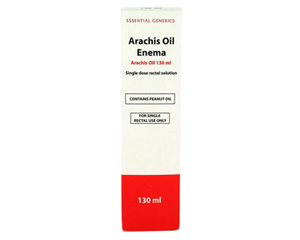
Arachis Oil
View Options
This website provides general information about medicines for educational purposes only. Always consult your doctor or pharmacist before taking any medication.
Choose Your Medicine
Select dosage and quantity
Online Consultation
Reviewed by a qualified physician
Fast, Discreet Delivery
Delivered to your door
Medical Information
About This Medicine
Arachis oil enema is a rectal preparation used to soften and lubricate hardened faecal matter in the management of faecal impaction and severe constipation. It is a warm, oily enema administered directly into the rectum and lower bowel, where it works by penetrating and softening compacted stool, making it easier to pass. Arachis oil is derived from peanuts (groundnuts) and is used in medicine for its lubricating and stool-softening properties.
What Conditions It Treats
Arachis oil enema is indicated primarily for faecal impaction, a condition in which hard, dry stool becomes lodged in the rectum and cannot be passed by normal bowel movements. It is also used to prepare the lower bowel before certain diagnostic procedures or surgical operations on the colon and rectum. In the management of severe constipation that has not responded to dietary measures, increased fluid intake, or oral laxatives, an arachis oil enema may be used to provide mechanical relief by directly softening the impacted mass. It is particularly useful in elderly patients and those who are debilitated or bed-bound, who are at high risk of faecal impaction.
How It Works and Who Should Not Use It
The enema works by being retained in the rectum for at least 30 minutes (ideally several hours or overnight) to allow the warm oil to penetrate the hardened stool, breaking it up and lubricating the bowel wall. This facilitates easier evacuation, often followed by the administration of a stimulant or phosphate enema to complete emptying. Arachis oil enema must not be used in anyone with a known allergy to peanuts or soya, as it contains peanut-derived oil that may trigger a severe allergic reaction, including anaphylaxis. This absolute contraindication must be confirmed before any administration.
Usage & Dosage
How to Administer an Arachis Oil Enema
Warm the enema to body temperature by placing the sealed pack in a bowl of warm water for approximately 30 minutes before use. Do not overheat. Lie on your left side with your knees drawn up toward your chest. Gently insert the nozzle into the rectum and squeeze the pack slowly and steadily to administer the oil. Withdraw the nozzle and remain lying down after administration.
Retaining the Enema
Retain the oil for as long as possible, ideally for a minimum of 30 minutes and preferably for several hours or overnight to allow full softening of impacted stool. Lying still on your left side helps retention. A stimulant enema or oral laxative may be prescribed to follow on and complete bowel emptying.
If the enema cannot be retained or is only partially administered, inform your healthcare provider. Seek immediate medical attention if you experience severe abdominal pain, vomiting, or no passage of wind, as these may indicate bowel obstruction.
The standard dose of arachis oil enema for adults is one 130 ml enema, administered rectally. It is typically given as a single dose, though a second enema may be administered after medical assessment if the first is insufficient to fully disimpact the bowel.
For elderly patients, the standard adult dose is used, but extra care is taken given the increased risk of impaction and the need for gentle handling. Elderly individuals may retain the enema for longer without discomfort, which can improve efficacy.
Arachis oil enema may be used in children, including infants, when faecal impaction is confirmed, but the dose should be adjusted according to the child's age and size, and administration should always be performed or supervised by a healthcare professional. Smaller enema preparations may be used in paediatric practice.
There are no specific dose adjustments for renal or hepatic impairment, as systemic absorption is negligible. However, any patient with abdominal pain, distension, nausea, or clinical signs suggesting bowel obstruction should be assessed by a doctor before an enema is given, as these conditions may represent contraindications to rectal treatment.
Side Effects
Arachis oil enema is generally well tolerated when used appropriately, as it works by local mechanical action without pharmacological effects.
Common Side Effects
The following effects are associated with rectal administration and are generally transient:
- Rectal discomfort or mild cramping during or shortly after administration
- A sensation of urgency or need to evacuate before the intended retention time
- Minor perianal irritation or oiliness
- Mild abdominal bloating or discomfort
- Incomplete retention of the enema in some patients
- Temporary anal leakage of oil after administration
Serious Side Effects
Serious adverse effects are rare but must be recognised and acted upon promptly:
- Anaphylactic reaction in patients with peanut or soya allergy: this is a medical emergency presenting with difficulty breathing, swelling of the face or throat, rapid heartbeat, and collapse. Immediate emergency services should be called.
- Rectal bleeding: if bleeding occurs during or after enema administration, this requires prompt medical assessment as it may indicate mucosal trauma or an underlying rectal condition
- Worsening abdominal pain or distension, which may indicate bowel obstruction or perforation
- Electrolyte disturbances: rare with arachis oil, but may occur in patients requiring repeated enemas alongside other bowel interventions
Report any unexpected or severe reactions to a healthcare professional without delay.
Warnings & Precautions
Peanut and Soya Allergy Warning
Arachis oil enema must never be administered to any person with a known or suspected allergy to peanuts (groundnuts) or soya. Peanut and soya proteins are structurally similar, and cross-reactivity is well recognised. Even small quantities of peanut-derived oil can trigger a severe, potentially life-threatening anaphylactic reaction in sensitised individuals. Before any administration, a thorough allergy history must be taken. If there is any doubt, the enema should not be given and an alternative bowel management strategy should be used, such as a sodium phosphate enema or manual evacuation under appropriate circumstances.
Bowel Obstruction and Pregnancy
Arachis oil enema must not be used if there is any clinical suspicion of bowel obstruction, intestinal perforation, acute inflammatory bowel disease, or recent colorectal surgery. Symptoms such as severe abdominal pain, distension, vomiting, or the absence of bowel sounds should prompt urgent medical assessment rather than the use of a rectal preparation. The use of arachis oil enema during pregnancy should be discussed with a midwife or obstetrician, particularly in the third trimester, as stimulation of the rectum can theoretically increase uterine activity. Enemas are best avoided in the late stages of pregnancy unless medically indicated. During breastfeeding, the enema is considered safe given the absence of systemic absorption.
Contraindications
Arachis oil enema is contraindicated in the following situations:
- Known or suspected allergy to peanuts (groundnuts) or soya products
- Known bowel obstruction or suspected intestinal perforation
- Active acute inflammatory bowel disease (Crohn's disease, ulcerative colitis) affecting the rectum or colon
- Recent colorectal or anal surgery
- Rectal bleeding of unknown cause
- Severe rectal inflammation or proctitis
- Anal fissures or haemorrhoids with significant bleeding
- Acute abdominal conditions of uncertain cause
- Nausea, vomiting, or severe abdominal cramps without diagnosis
- Use in premature infants without specialist neonatal guidance
Frequently Asked Questions
How long should I keep an arachis oil enema in before evacuating?
Can I use an arachis oil enema if I am allergic to nuts?
Does an arachis oil enema work immediately?
Is an arachis oil enema available to buy over the counter?
What happens after I use an arachis oil enema?
Dr. Ross Elledge
General Practitioner · General & Family Medicine
Verified Healthcare Professional
TopDoctors Profile