
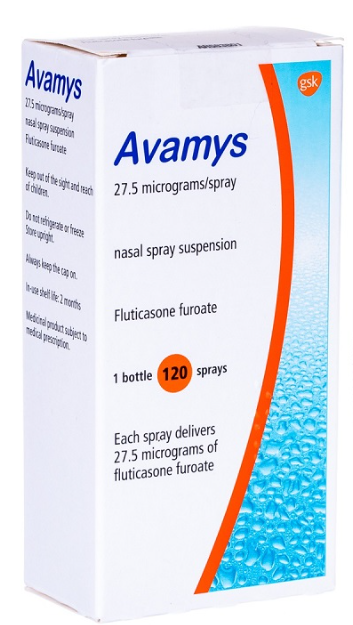
Avamys
View Options
This website provides general information about medicines for educational purposes only. Always consult your doctor or pharmacist before taking any medication.
Choose Your Medicine
Select dosage and quantity
Online Consultation
Reviewed by a qualified physician
Fast, Discreet Delivery
Delivered to your door
Medical Information
About This Medicine
Avamys is a prescription nasal spray containing fluticasone furoate, an inhaled corticosteroid used to prevent and relieve the symptoms of allergic rhinitis. It is indicated for both seasonal allergic rhinitis (hay fever) and perennial allergic rhinitis (year-round nasal allergies) in adults and children aged 6 years and over. Avamys provides effective relief of nasal symptoms including congestion, sneezing, itching, and rhinorrhoea, and also helps reduce eye symptoms such as itching and watering that are associated with allergic rhinitis.
How Avamys Treats Allergic Rhinitis
Allergic rhinitis occurs when the nasal mucosa is exposed to allergens such as pollen, house dust mites, pet dander, or moulds, triggering an IgE-mediated immune response. This cascade leads to the release of histamine, prostaglandins, leukotrienes, and other inflammatory mediators that cause the hallmark symptoms of nasal congestion, sneezing, and itching. Fluticasone furoate, the active corticosteroid in Avamys, reduces this inflammatory response by binding to glucocorticoid receptors within the nasal mucosal cells. This inhibits the production and release of inflammatory mediators, reducing congestion, secretion, and mucosal oedema over time.
Advantages of Avamys
Avamys contains fluticasone furoate, which is distinct from the fluticasone propionate found in other nasal corticosteroid sprays. Fluticasone furoate has a high affinity for the glucocorticoid receptor and an enhanced topical potency compared to some other intranasal corticosteroids. It has very low systemic bioavailability after intranasal administration, making it safe for regular use with minimal systemic corticosteroid effects. Clinical evidence supports its efficacy in relieving both nasal and ocular symptoms of allergic rhinitis from as early as the first day of treatment, with optimal benefit achieved after several days of consistent use.
Usage & Dosage
How to Use Avamys Nasal Spray
Prime Avamys before first use by pressing down six times until a fine mist appears. If unused for five or more days, re-prime with one spray. Blow your nose gently, then tilt your head slightly forward. Direct the nozzle slightly away from the nasal septum (the centre wall), press the pump once while breathing in gently through the nose, and repeat in the other nostril.
The standard adult starting dose is two sprays per nostril once daily (110 mcg/day). Once well controlled, reduce to one spray per nostril once daily. Avamys works best with regular daily use, start treatment a few days before your allergy season begins for best results.
For adults and adolescents aged 12 and over, the recommended starting dose of Avamys is two sprays in each nostril once daily (110 mcg total daily dose). Once symptoms are controlled, the maintenance dose may be reduced to one spray per nostril once daily (55 mcg daily).
For children aged 6 to 11 years, the recommended dose is one spray per nostril once daily (55 mcg total daily dose). This dose should be used consistently and children using intranasal corticosteroids should have their height monitored over time, as prolonged use of inhaled corticosteroids may affect growth velocity, though the systemic exposure from Avamys is very low.
For children under 6 years of age, Avamys is not recommended.
Elderly patients can use the standard adult dose without adjustment. No clinically significant pharmacokinetic differences have been identified in elderly subjects.
No dose adjustment is required for patients with mild-to-moderate renal or hepatic impairment. Avamys is metabolised primarily by CYP3A4 and excreted mainly in the faeces. In severe hepatic impairment, fluticasone furoate exposure may be increased; use with caution and under medical supervision.
Avamys should be used at the lowest effective dose to control symptoms. Reassess the need for ongoing treatment regularly, particularly in children and patients with mild intermittent symptoms.
Side Effects
Avamys is very well tolerated by the majority of users, with most side effects being localised to the nasal passages and related to the physical administration of the spray.
Common Side Effects
The following local side effects are the most frequently reported with Avamys:
- Nosebleeds (epistaxis): the most common side effect, usually mild and self-limiting
- Nasal discomfort, burning, or stinging after spraying
- Nasal dryness or crusting
- Headache
- Sneezing immediately after application
- Nasal ulceration with prolonged use (less common)
- Unpleasant taste or smell after administration
Serious Side Effects
Serious systemic side effects are rare given the very low systemic bioavailability of fluticasone furoate but may occur with prolonged high-dose use:
- Adrenal suppression: unlikely at standard doses but theoretically possible with prolonged very high-dose use, particularly in children or if combined with other corticosteroid preparations; symptoms include fatigue, weakness, and low blood pressure
- Growth retardation in children: monitor height in children using nasal corticosteroids long-term
- Nasal septum perforation (rare): presents as a persistent, progressive sensation of dryness and crusting, or visible hole in the nasal septum; seek ENT review if suspected
- Cataracts or glaucoma with very prolonged high-dose corticosteroid use: rare with intranasal administration but possible in individuals with risk factors
- Severe allergic reaction: angioedema, bronchospasm, rash (rare)
Warnings & Precautions
Nasal Bleeding and Septal Precautions
Epistaxis (nosebleeds) is the most commonly reported adverse effect of Avamys. Mild nosebleeds are usually self-limiting and do not require treatment to be stopped. However, if you experience frequent, heavy, or prolonged nosebleeds, or if you notice persistent nasal crusting, dryness, or pain, inform your doctor, as these can occasionally be signs of nasal ulceration or, rarely, septal perforation. The spray nozzle should be directed away from the nasal septum to reduce the risk of mucosal trauma. Patients who have had recent nasal surgery or trauma should not use nasal sprays until healing is complete.
Children's Growth, Systemic Corticosteroids, and Drug Interactions
Children using Avamys regularly should have their height measured periodically by their doctor. While the systemic exposure from fluticasone furoate intranasal spray is very low, the use of multiple corticosteroid products (including inhaled corticosteroids for asthma, topical skin steroids, and oral steroids) in combination can lead to additive systemic corticosteroid effects and hypothalamic-pituitary-adrenal (HPA) axis suppression. Avamys should be used with caution alongside potent CYP3A4 inhibitors such as ritonavir and ketoconazole, which can increase fluticasone plasma levels and enhance systemic corticosteroid effects. Avamys is not expected to affect a patient's ability to drive. During pregnancy, it should only be used if clearly needed, and breastfeeding women should seek advice before use, though systemic absorption is extremely low.
Contraindications
Avamys is contraindicated in the following circumstances:
- Hypersensitivity to fluticasone furoate or any excipient in the formulation
- Children under 6 years of age
- Untreated nasal infection (bacterial, fungal, or viral) in the nasal passages; treat the infection before commencing corticosteroid therapy
- Active or quiescent tuberculosis of the respiratory tract
- Recent nasal surgery or nasal injury (until healing is complete)
- Use with ritonavir or other potent CYP3A4 inhibitors unless the benefit clearly outweighs the risk of increased systemic fluticasone exposure
- Patients with known galactose intolerance, Lapp lactase deficiency, or glucose-galactose malabsorption (formulation contains lactose)
- Untreated glaucoma (use with caution; not absolute but requires ophthalmological monitoring)
Frequently Asked Questions
How long does it take for Avamys to work?
Can children use Avamys?
Is Avamys a steroid spray? Are there any long-term risks?
Can I use Avamys during pregnancy?
Why do I keep getting nosebleeds when using Avamys?
Dr. Ross Elledge
General Practitioner · General & Family Medicine
Verified Healthcare Professional
TopDoctors Profile