
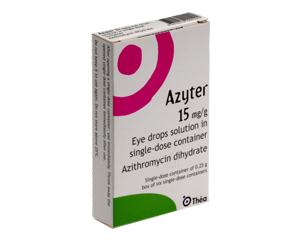
Azyter
View Options
This website provides general information about medicines for educational purposes only. Always consult your doctor or pharmacist before taking any medication.
Choose Your Medicine
Select dosage and quantity
Online Consultation
Reviewed by a qualified physician
Fast, Discreet Delivery
Delivered to your door
Medical Information
About This Medicine
Azyter is a prescription antibiotic eye drop preparation containing azithromycin 15 mg/g in a unit-dose format, used to treat purulent bacterial conjunctivitis (acute infective conjunctivitis) in adults and children aged one year and over. It is also used in the treatment of trachoma, a serious chronic eye infection caused by Chlamydia trachomatis that remains one of the leading preventable causes of infectious blindness worldwide. Azyter is manufactured by Thea Pharmaceuticals and offers the convenience of a short three-day treatment course.
How Azyter Works
Azithromycin, the active ingredient in Azyter, is a macrolide antibiotic that kills bacteria by binding to the 50S ribosomal subunit of bacterial cells, thereby inhibiting protein synthesis and preventing the bacteria from reproducing. It is active against a broad spectrum of organisms commonly responsible for conjunctivitis, including Staphylococcus aureus, Streptococcus pneumoniae, Haemophilus influenzae, and Chlamydia trachomatis.
The formulation uses a distinctive ophthalmic vehicle containing medium-chain triglycerides, which allows azithromycin to penetrate the conjunctival tissues effectively and maintain therapeutic concentrations for extended periods following each application. This prolonged tissue retention is the reason the full treatment course requires only two drops per day for three days rather than the more frequent dosing schedules typical of older topical antibiotics.
Clinical Use
Azyter is indicated for confirmed or clinically suspected bacterial conjunctivitis presenting with mucopurulent discharge, conjunctival redness, and lid swelling. It is not appropriate for viral conjunctivitis, which accounts for a substantial proportion of red-eye presentations and resolves without antibiotics. Correct diagnosis is important before prescribing any topical antibiotic. Azyter is also used in trachoma programmes where it can treat active infection and reduce transmission within communities.
Usage & Dosage
How to Apply Azyter Eye Drops
Wash your hands thoroughly. Tilt your head back, pull the lower eyelid gently down to form a small pocket, and instil one drop into the affected eye. After application, close the eye gently and press lightly on the inner corner of the eye for one to two minutes to maximise local contact and minimise systemic absorption.
Remove contact lenses before applying the drops and wait at least 15 minutes before reinserting them. Each single-use vial contains enough solution for both eyes. Discard the vial after use, do not save remaining solution, as the preparation contains no preservative.
Dosing Schedule
Apply one drop to the affected eye(s) twice daily (morning and evening) for three consecutive days. Complete the full course even if symptoms improve after the first day.
The recommended dose of Azyter is one drop instilled into the affected eye(s) twice daily for three days. This applies to adults, the elderly, and children aged one year and over. There is no established safety and efficacy data for use in children under one year of age.
No dose adjustment is required for elderly patients. The systemic absorption of azithromycin from ophthalmic administration is minimal (plasma concentrations are well below those achieved with oral dosing), which means that renal or hepatic impairment is unlikely to significantly affect ocular efficacy or safety. However, caution is advised in patients with severe hepatic disease because azithromycin (even from ophthalmic use) can theoretically contribute to hepatic burden.
Each unit-dose vial is intended for single use only. Both eyes can be treated from the same vial at a single application. No dose modification is needed based on the severity of infection; the three-day course is appropriate for both mild and moderate bacterial conjunctivitis.
Side Effects
Azyter is generally well tolerated, with most reported side effects being mild and limited to the eye.
Common Side Effects
The following are reported by at least 1 in 100 patients using Azyter:
- Eye irritation or burning sensation immediately after instillation
- Eye discomfort or stinging on application
- Blurred vision (transient, lasting a few minutes after each dose)
- Eye pruritus (itching of the eye or eyelid)
- Conjunctival hyperaemia (redness of the white of the eye)
- Watering or increased lacrimation following instillation
These effects are usually mild, short-lived, and do not require stopping the drops.
Serious Side Effects
The following reactions are rare but require medical evaluation:
- Severe allergic reaction or anaphylaxis: difficulty breathing, swelling of the face, lips, or eyelids, or a widespread skin rash, stop the drops and seek emergency medical help immediately
- Severe eye pain or a marked increase in eye redness: may indicate a worsening infection, corneal ulceration, or a different diagnosis requiring urgent review
- Prolonged or worsening symptoms beyond the three-day treatment course: may suggest a non-bacterial cause (such as viral or allergic conjunctivitis) or antibiotic resistance
- Skin reactions around the eye, including contact dermatitis
Warnings & Precautions
Allergic Reactions and Cross-Sensitivity
Azyter must not be used by patients with a known allergy to azithromycin or any other macrolide antibiotic (such as erythromycin or clarithromycin), as cross-reactivity can occur. Before starting treatment, patients should inform their prescriber of any previous antibiotic allergies, particularly to this drug class.
Contact Lenses
Azyter unit-dose vials do not contain benzalkonium chloride or other preservatives, which makes them safer for contact lens wearers than many preserved ophthalmic preparations. However, contact lenses should be removed before instilling the drops and should not be reinserted for at least 15 minutes afterwards. It is also advisable not to wear contact lenses during active bacterial conjunctivitis, as lens wear can worsen infection and delay healing.
Driving and Machinery
Azyter may cause transient blurring of vision immediately after instillation. Patients should wait until their vision has fully cleared before driving or operating machinery. This effect typically resolves within a few minutes.
Pregnancy and Breastfeeding
Systemic azithromycin has been used in pregnancy without evidence of harm to the foetus, and given the very low systemic absorption from ophthalmic drops, Azyter is considered acceptable to use during pregnancy and breastfeeding if clinically indicated. However, as with all medicines, the benefit-risk balance should be discussed with a prescriber.
Contraindications
Azyter must not be used in the following circumstances:
- Known hypersensitivity to azithromycin or any other macrolide antibiotic
- Known hypersensitivity to any excipient in the Azyter formulation
- Children under one year of age (safety and efficacy not established)
- Patients with a confirmed viral cause of conjunctivitis (such as herpes simplex virus keratitis), as antibiotics are ineffective and may delay appropriate antiviral treatment
- Use in the ear or by any route other than topical ophthalmic application
Frequently Asked Questions
How quickly does Azyter work for bacterial conjunctivitis?
Can Azyter be used in children?
Is Azyter the same as oral azithromycin tablets?
Can I wear contact lenses while using Azyter?
Dr. Ross Elledge
General Practitioner · General & Family Medicine
Verified Healthcare Professional
TopDoctors Profile