
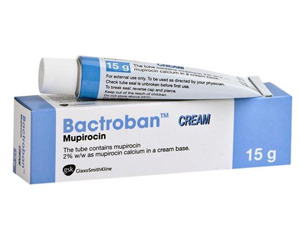
Bactroban
View Options
This website provides general information about medicines for educational purposes only. Always consult your doctor or pharmacist before taking any medication.
Choose Your Medicine
Select dosage and quantity
Online Consultation
Reviewed by a qualified physician
Fast, Discreet Delivery
Delivered to your door
Medical Information
About This Medicine
Bactroban is a topical antibiotic preparation manufactured by GlaxoSmithKline, available as a 2% cream and a 2% ointment. Its active ingredient is mupirocin, a naturally derived antibiotic originally isolated from the bacterium Pseudomonas fluorescens. Bactroban is used to treat bacterial skin infections including impetigo, folliculitis (infection of hair follicles), and superficial skin wounds that have become secondarily infected. It is also widely used in healthcare settings for the decolonisation of the nasal passages in patients and healthcare workers who carry meticillin-resistant Staphylococcus aureus (MRSA), a process that reduces the risk of spreading this resistant organism in hospital environments.
Why Bactroban Is Effective Against Skin Infections
Bactroban is particularly valuable because it targets bacteria at a unique enzymatic step not shared by other antibiotic classes, meaning there is little cross-resistance between mupirocin and systemic antibiotics such as penicillins, cephalosporins, or macrolides. This makes it especially useful for treating infections caused by strains that have developed resistance to more commonly used agents, including MRSA.
Impetigo, one of the most common indications for Bactroban, is a highly contagious superficial skin infection that most often affects young children. It typically presents as golden-crusted sores or fluid-filled blisters on the face, around the nose and mouth, or on the limbs. Early topical treatment with Bactroban can clear the infection rapidly and avoid the need for oral antibiotics in many cases.
Forms and Settings of Use
Bactroban is available in two formulations: the cream is generally preferred for moist or weeping skin lesions, while the ointment is better suited to drier skin conditions and nasal application. A specific nasal ointment formulation (Bactroban Nasal) contains 2% mupirocin calcium and is applied inside the nostrils for MRSA eradication protocols. Both formulations are applied directly to the affected area and work locally without significant systemic absorption.
Usage & Dosage
Applying Bactroban to Skin Infections
For impetigo or infected wounds, apply Bactroban (mupirocin) cream or ointment to the affected area three times daily for up to 10 days. Clean the skin gently with mild soap and warm water and pat dry before application. Apply a small amount to cover the affected area. The treated area may be covered with a light dressing if needed.
Avoid scratching the lesions and do not share towels, flannels, or clothing during treatment to prevent spreading the infection. Good hand hygiene is essential throughout.
MRSA Nasal Decolonisation
Apply a small amount of Bactroban Nasal ointment to the inside of each nostril twice daily for five days. Press the nostrils together gently for one minute to distribute the ointment.
For skin infections, Bactroban 2% cream or ointment is applied three times daily (morning, afternoon, and evening) for up to 10 days. The treatment area should be reassessed after three to five days, and if there is no clinical improvement within that time, a swab should be taken for culture and sensitivity testing to guide further management.
For MRSA nasal decolonisation with Bactroban Nasal, a small amount is applied to each nostril twice daily for five days as part of a coordinated decolonisation protocol.
No formal dose adjustment is necessary for elderly patients or those with renal or hepatic impairment using topical mupirocin, because systemic absorption through intact skin is very low (typically less than 1% of the applied dose). However, caution is warranted when applying Bactroban to large, broken, or extensively burned areas, where absorption may be higher. The preparation is generally safe for use in children of all ages, including neonates, with the same dosing schedule as adults.
Side Effects
Bactroban is generally well tolerated when applied topically to intact or broken skin. Side effects are mostly local reactions at the application site.
Common Side Effects
The following reactions are reported in at least 1 in 100 users:
- Burning or stinging sensation at the application site
- Itching (pruritus) of the treated skin
- Skin redness or erythema around the treated area
- Dryness or flaking of the skin at the site of application
- Mild local irritation during the first few applications
- Folliculitis (paradoxical skin follicle irritation in some patients)
These local reactions are usually mild and transient, and do not require stopping treatment.
Serious Side Effects
The following are uncommon but require medical assessment:
- Severe allergic contact dermatitis: significant worsening of redness, blistering, or swelling, distinct from the infection being treated, indicates sensitisation to mupirocin and requires discontinuation
- Systemic allergic reaction or anaphylaxis: extremely rare given low systemic absorption, but any sign of widespread rash, breathing difficulty, or throat swelling demands immediate medical attention
- Superinfection: prolonged use may allow resistant organisms or fungi to overgrow, indicated by a change in the appearance of the infection or failure to respond to treatment
- Mupirocin-resistant MRSA: emerging resistance has been documented with prolonged or repeated use; treatment courses beyond 10 days are not recommended
Warnings & Precautions
Avoiding Resistance
Bactroban should not be used for longer than 10 days at a time for skin infections, and it should not be used repeatedly or prophylactically on open wounds, as extended use is associated with the development of mupirocin-resistant strains of Staphylococcus aureus, including MRSA. If the infection does not respond within five to seven days, a skin swab for culture and sensitivity testing should be performed to check for resistant organisms.
Eyes and Mucous Membranes
Bactroban must not be applied near the eyes, inside the mouth, or onto mucous membranes (except as specifically directed when using the Bactroban Nasal formulation inside the nostrils for MRSA protocols). If accidental contact with the eyes occurs, rinse thoroughly with water.
Pregnancy and Breastfeeding
There are no adequate studies of mupirocin in pregnant women. Given the minimal systemic absorption from topical application, it is generally considered low risk during pregnancy and breastfeeding, but this should be discussed with a prescriber. If applying near the nipple during breastfeeding, care should be taken to remove any residue before feeding.
Drug Interactions
There are no clinically significant systemic drug interactions with topical mupirocin given its minimal absorption. However, Bactroban ointment is oil-based and should not be used with dressings or materials that could be damaged by polyethylene glycol (the ointment base), particularly in patients with renal impairment.
Contraindications
Bactroban must not be used in the following circumstances:
- Known hypersensitivity or allergic reaction to mupirocin or polyethylene glycol (ointment base)
- Known hypersensitivity to any other excipient in the formulation
- Application to the eyes or inside the ear canals (not formulated for these uses)
- Use as a general-purpose wound dressing for non-infected wounds
- Application to very large areas of broken or burned skin without specialist medical supervision (risk of systemic polyethylene glycol absorption)
- Prolonged use beyond 10 days for skin infection treatment without reassessment by a clinician
Frequently Asked Questions
How long does Bactroban take to clear impetigo?
Can Bactroban be used on infected cuts or grazes?
What is Bactroban used for in hospitals?
Is Bactroban cream or ointment better for impetigo?
Is Bactroban available over the counter in the UK?
Dr. Ross Elledge
General Practitioner · General & Family Medicine
Verified Healthcare Professional
TopDoctors Profile