
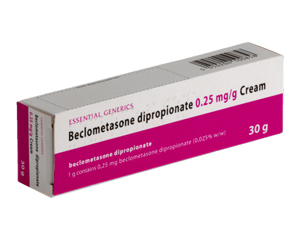
Beclometasone
View Options
This website provides general information about medicines for educational purposes only. Always consult your doctor or pharmacist before taking any medication.
Choose Your Medicine
Select dosage and quantity
Online Consultation
Reviewed by a qualified physician
Fast, Discreet Delivery
Delivered to your door
Medical Information
About This Medicine
Beclometasone (also written as beclomethasone) is a synthetic corticosteroid with potent anti-inflammatory properties, used across several medical conditions and available in multiple formulations. It is best known as an inhaled corticosteroid (ICS) for the prevention and management of asthma, where it is marketed under brand names including Clenil Modulite and Qvar. Beclometasone is also formulated as a nasal spray for the treatment of allergic rhinitis (hay fever), where it is available both on prescription and over the counter as brands such as Beconase and Nasobec.
Asthma Management
In asthma, inhaled beclometasone acts as a preventer medicine, reducing airway inflammation and preventing asthma attacks. It is not a reliever and does not provide immediate symptom relief during an acute attack; patients must continue using a short-acting bronchodilator (such as salbutamol) for acute symptoms. Beclometasone inhalers are available in various strengths, from 50 micrograms per actuation up to 250 micrograms per actuation, allowing dose titration based on the severity of asthma. Qvar uses a hydrofluoroalkane (HFA) propellant and extrafine particle technology that deposits the drug deeper in the lungs than older formulations, meaning lower doses are required to achieve the same therapeutic effect.
Allergic Rhinitis and Nasal Use
When used as a nasal spray, beclometasone reduces inflammation in the nasal passages, relieving symptoms of sneezing, nasal congestion, and runny nose associated with seasonal and perennial allergic rhinitis. The nasal spray works locally and has minimal systemic absorption at recommended doses, making it suitable for long-term use. It is one of the most effective treatments for allergic rhinitis and is recommended as a first-line option in clinical guidelines.
Mechanism of Action
Beclometasone exerts its effects by binding to intracellular glucocorticoid receptors, which then regulate the transcription of genes involved in the inflammatory cascade. This leads to reduced production of pro-inflammatory cytokines, prostaglandins, and leukotrienes, and decreased recruitment of inflammatory cells such as eosinophils and mast cells to the airways and nasal mucosa.
Usage & Dosage
Using a Beclometasone Inhaler for Asthma
Beclometasone inhalers are preventer medicines and must be used every day, even when no asthma symptoms are present. Use at the same time(s) each day as prescribed, typically twice daily. Shake the inhaler well before use, exhale fully, then inhale slowly and steadily while pressing the canister. Always rinse your mouth with water and spit out after each use to prevent oral thrush. Never stop your beclometasone inhaler suddenly without medical advice.
Using a Beclometasone Nasal Spray
Blow your nose gently before use. Prime the pump before first use. Tilt your head slightly forward, spray into one nostril while breathing in gently through the nose, then repeat in the other nostril. Regular daily use is required, full effect on nasal symptoms may take one to two weeks to develop.
For asthma, the dose of beclometasone dipropionate varies considerably by formulation and patient age. In adults, standard doses range from 100 to 400 micrograms per day, divided into two doses. In more severe asthma, doses up to 2000 micrograms per day may be used, though this is associated with greater systemic exposure. Children typically require lower doses in the range of 50 to 200 micrograms per day.
Qvar (extrafine beclometasone) is approximately twice as potent per microgram as older formulations such as Clenil Modulite; switching between these products requires careful dose recalculation by a prescriber.
For allergic rhinitis, the standard adult dose is two sprays into each nostril twice daily (total 400 micrograms/day), or one spray into each nostril up to four times daily. Once symptoms are controlled, the dose may be reduced to the minimum effective level.
Elderly patients do not generally require dose adjustment, but the lowest effective dose should always be used. Significant renal or hepatic impairment does not necessitate formal dose adjustment for inhaled or intranasal beclometasone given low systemic absorption.
Side Effects
Beclometasone is well tolerated at standard doses, particularly when good inhaler technique is used.
Common Side Effects
The following are commonly reported with inhaled beclometasone:
- Oral candidiasis (thrush), white patches in the mouth and throat; reduced by rinsing after each use
- Hoarseness or dysphonia (voice changes)
- Sore throat or throat irritation
- Cough following inhalation
- Epistaxis (nosebleeds) and nasal irritation with nasal spray formulations
- Headache
Serious Side Effects
The following require medical evaluation and are more likely with high doses or prolonged use:
- Adrenal suppression: long-term high-dose use may suppress the hypothalamic-pituitary-adrenal axis, reducing the body's ability to respond to physiological stress, important in surgical or emergency settings
- Reduction in bone mineral density with very prolonged high-dose use, increasing fracture risk
- Growth retardation in children using high doses over extended periods, the lowest effective dose should always be used
- Paradoxical bronchospasm: worsening wheeze or breathlessness immediately after inhaling, discontinue and use a bronchodilator immediately if this occurs
- Cataracts and raised intraocular pressure with high-dose prolonged use
Warnings & Precautions
Oral Candidiasis and Inhaler Technique
The most common complication of inhaled beclometasone is oral thrush (candidiasis), caused by steroid particles deposited in the mouth and throat suppressing local immunity. Rinsing the mouth with water and spitting after every use significantly reduces this risk. Use of a spacer device with pressurised inhalers also reduces oropharyngeal deposition and lowers the risk of thrush and voice changes.
Systemic Steroid Risks at High Doses
Although inhaled beclometasone has much lower systemic effects than oral steroids, patients using high doses over prolonged periods may experience clinically meaningful adrenal suppression. Patients who have been receiving high-dose inhaled corticosteroids should carry a steroid emergency card and may require supplemental corticosteroids during periods of significant physiological stress, surgery, or serious illness. Do not stop the inhaler abruptly if it has been used at high doses for a prolonged period.
Drug Interactions and Pregnancy
Potent CYP3A4 inhibitors such as ritonavir, cobicistat, and ketoconazole can significantly increase systemic exposure to beclometasone and may cause adrenal suppression. Beclometasone has been used in pregnancy for asthma management, and the benefit of maintaining asthma control generally outweighs the small theoretical risks; uncontrolled asthma in pregnancy poses a greater risk to the foetus. Breastfeeding is generally considered safe at standard doses.
Contraindications
Beclometasone must not be used in the following circumstances:
- Known hypersensitivity to beclometasone dipropionate or any excipient in the formulation
- As the sole treatment for an acute asthma attack (a reliever bronchodilator must be used)
- As a first-line reliever inhaler (Bactroban is a preventer, not a reliever)
- Active or untreated respiratory tuberculosis (pulmonary TB), as steroids may worsen the infection
- Untreated fungal, bacterial, or viral infections of the respiratory tract
- Beclometasone nasal spray should not be used in patients with nasal polyps that are large enough to obstruct the nasal passages without first seeking ENT assessment
Frequently Asked Questions
What is the difference between Clenil and Qvar beclometasone inhalers?
Why do I need to rinse my mouth after using a beclometasone inhaler?
Can beclometasone nasal spray be bought without a prescription?
Is beclometasone safe to use during pregnancy?
How long does it take for a beclometasone inhaler to work?
Dr. Ross Elledge
General Practitioner · General & Family Medicine
Verified Healthcare Professional
TopDoctors Profile