
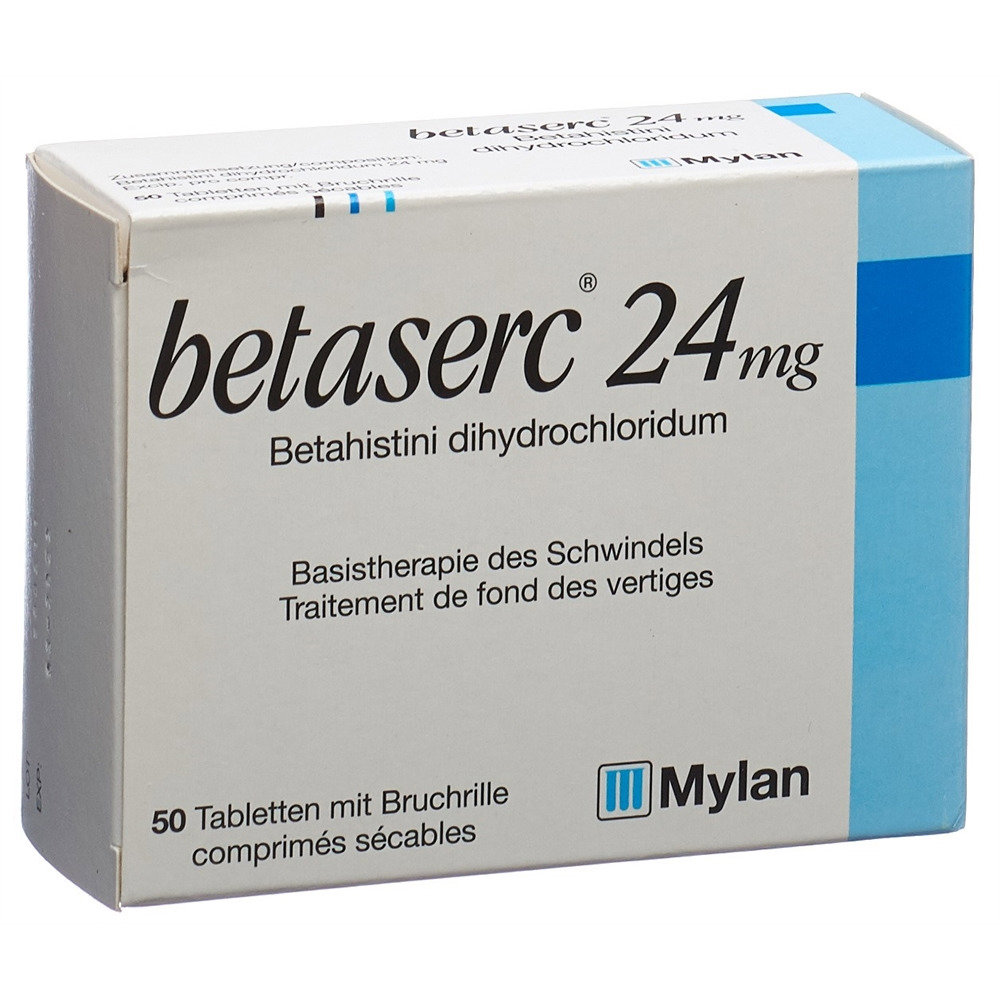
Betaserc
This website provides general information about medicines for educational purposes only. Always consult your doctor or pharmacist before taking any medication.
Choose Your Medicine
Select dosage and quantity
Online Consultation
Reviewed by a qualified physician
Fast, Discreet Delivery
Delivered to your door
Medical Information
About This Medicine
Betaserc contains betahistine, a histamine analogue used for the treatment of Meniere's disease and its associated symptoms of vertigo, tinnitus, hearing loss, and nausea. It is one of the few medications specifically developed for vestibular disorders.
How does betahistine work in Meniere's disease?
Betahistine acts on histamine H1 and H3 receptors in the inner ear and the vestibular nuclei of the brain. It improves microcirculation in the inner ear and reduces endolymphatic pressure, which is thought to be the underlying abnormality in Meniere's disease. By acting on H3 autoreceptors, it also modulates histamine release in the vestibular centres, reducing the intensity and frequency of vertigo attacks.
What can patients expect?
Betahistine is primarily effective at reducing the frequency and severity of vertigo episodes. Its effects on tinnitus and hearing loss are more variable. The full benefit may take several weeks to months of regular use to become apparent, and treatment is usually long-term.
Usage & Dosage
How to Take Betaserc
Take Betaserc (betahistine) with food to reduce the chance of stomach upset. Swallow the tablet whole with water. Betahistine is typically taken three times daily, and consistent regular use is important for achieving the best results. Take doses at evenly spaced intervals throughout the day — for example, with breakfast, lunch, and the evening meal.
Common doses are 8 mg or 16 mg three times daily, up to a maximum of 48 mg daily. Your doctor will find the dose that keeps your symptoms under control.
Long-term Treatment
Betaserc is usually taken long-term for Menière's disease. The medication works preventively and may take several weeks to months to show its full benefit in reducing the frequency of vertigo attacks. Do not stop it suddenly without speaking to your doctor — symptoms may return.
Start at 16 mg three times daily. The dose may be adjusted between 24 and 48 mg daily, divided into three doses. Some patients benefit from higher doses up to 48 mg three times daily, though this is off-label.
Side Effects
Common Side Effects
Betaserc is generally well tolerated. The most frequently reported side effects include:
- Nausea
- Headache
- Indigestion (dyspepsia)
- Abdominal bloating or discomfort
Taking Betaserc with food significantly reduces nausea.
Less Common Effects
Skin rash, urticaria (hives), and itching have been reported occasionally. In rare cases, allergic reactions can occur — stop the medicine and seek medical attention if you develop a significant rash, swelling of the face, or breathing difficulty. Betahistine has weak histamine-like activity, so people with asthma or peptic ulcers should discuss this with their doctor before starting treatment, though serious interactions at standard doses are uncommon.
Warnings & Precautions
Use with caution in patients with peptic ulcer disease (active or historical), as betahistine can increase gastric acid secretion. Caution also in asthma and phaeochromocytoma.
Driving
Meniere's disease itself can impair the ability to drive. Patients should not drive during or immediately after vertigo attacks, regardless of medication.
Contraindications
Contraindicated in phaeochromocytoma and known hypersensitivity to betahistine or any excipient.
Frequently Asked Questions
Does betahistine cure Meniere's disease?
Dr. Ross Elledge
General Practitioner · General & Family Medicine
Verified Healthcare Professional
TopDoctors Profile