
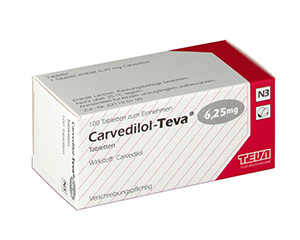
Carvedilol
This website provides general information about medicines for educational purposes only. Always consult your doctor or pharmacist before taking any medication.
Choose Your Medicine
Select dosage and quantity
Online Consultation
Reviewed by a qualified physician
Fast, Discreet Delivery
Delivered to your door
Medical Information
About This Medicine
Carvedilol is a non-selective beta-blocker with additional alpha-1 blocking activity, giving it vasodilating properties that distinguish it from older beta-blockers. It is one of only three beta-blockers with proven mortality benefit in heart failure (alongside bisoprolol and sustained-release metoprolol succinate).
How does carvedilol differ from other beta-blockers?
By blocking alpha-1 receptors in addition to beta-1 and beta-2 receptors, carvedilol dilates blood vessels while slowing the heart. This means it lowers blood pressure without the cold extremities and peripheral vasoconstriction typical of pure beta-blockers. It also has antioxidant properties, though the clinical significance of this is debated.
Carvedilol in heart failure
The COPERNICUS and COMET trials demonstrated that carvedilol reduces mortality and hospitalisations in heart failure with reduced ejection fraction. In COMET, carvedilol was shown to be superior to short-acting metoprolol tartrate for survival, though it is considered broadly equivalent to bisoprolol and sustained-release metoprolol succinate.
Usage & Dosage
How to Take Carvedilol
Always take carvedilol with food. Taking it with a meal slows absorption and reduces the risk of dizziness or a sudden drop in blood pressure. Swallow tablets whole with water. The tablets are taken twice daily for both heart failure and high blood pressure.
For high blood pressure, treatment typically starts at 12.5 mg twice daily, increasing to 25 mg twice daily after two weeks if well tolerated. For heart failure, the starting dose is much lower — 3.125 mg twice daily — and is doubled every two weeks as tolerated, up to a maximum of 25 mg twice daily (or 50 mg twice daily in heavier patients).
Heart Failure Titration
During dose increases for heart failure, your doctor will check your blood pressure, heart rate, and symptoms at each visit. Do not increase the dose if you have worsening breathlessness, significant slowing of the heart (bradycardia), or symptomatic low blood pressure. A temporary increase in your diuretic dose may be needed if fluid retention develops during titration. Do not stop carvedilol suddenly — reduce the dose gradually under medical supervision.
Hypertension: start at 12.5 mg once daily, increase to 25 mg once daily, then 25 mg twice daily if needed. Heart failure: start at 3.125 mg twice daily, titrate to a target of 25 mg twice daily (50 mg twice daily if body weight exceeds 85 kg).
Side Effects
Common Side Effects
- Dizziness or light-headedness
- Fatigue
- Low blood pressure (hypotension), particularly on standing
- Slow heart rate (bradycardia)
- Diarrhoea
- Nausea
- Visual disturbance
During Heart Failure Treatment
Fluid retention and worsening breathlessness can occur during the dose titration phase when starting carvedilol for heart failure. This is usually manageable with a short-term adjustment to diuretic doses. If you have asthma or chronic obstructive pulmonary disease, discuss this with your doctor before taking carvedilol, as beta-blockers can worsen airway narrowing in some people.
Warnings & Precautions
Do not stop carvedilol abruptly. Taper over at least two weeks to prevent rebound tachycardia and angina. In heart failure, dose adjustments should only be made by the prescribing team.
Liver function
Rarely, carvedilol can cause hepatic dysfunction. Monitor liver function if symptoms of hepatitis develop (jaundice, dark urine, malaise).
Contraindications
Contraindicated in decompensated heart failure requiring inotropes, severe bradycardia, second or third-degree heart block, cardiogenic shock, severe hepatic impairment, asthma or severe bronchospasm, and known hypersensitivity to carvedilol.
Frequently Asked Questions
Can I take carvedilol if I have mild asthma or COPD?
Dr. Ross Elledge
General Practitioner · General & Family Medicine
Verified Healthcare Professional
TopDoctors Profile