
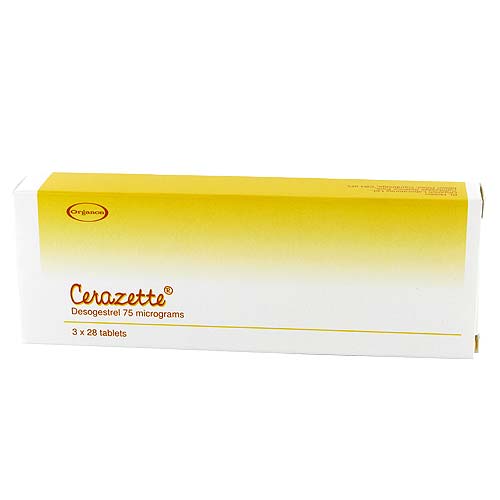
Cerazette
View Options
This website provides general information about medicines for educational purposes only. Always consult your doctor or pharmacist before taking any medication.
Choose Your Medicine
Select dosage and quantity
Online Consultation
Reviewed by a qualified physician
Fast, Discreet Delivery
Delivered to your door
Medical Information
About This Medicine
Cerazette is a progestogen-only contraceptive pill (POP, sometimes called the mini-pill) containing desogestrel 75 micrograms. It is taken daily to prevent pregnancy and offers several advantages over older progestogen-only pills, most notably a 12-hour window for late tablet taking (compared to the 3-hour window of traditional POPs), making it more forgiving in everyday use.
How Cerazette Differs from Other Progestogen-Only Pills
Traditional progestogen-only pills work primarily by thickening the cervical mucus to prevent sperm from reaching an egg, and they require strict adherence to a 3-hour daily window. Cerazette, by contrast, contains a higher dose of desogestrel that is sufficient not only to thicken cervical mucus but also to inhibit ovulation in the majority of cycles. This dual mechanism makes Cerazette more similar in effectiveness to combined oral contraceptives, with a failure rate of less than 1% with perfect use, while still being free of oestrogen and therefore suitable for women in whom oestrogen-containing contraception is contraindicated.
Who Is Cerazette Suitable For?
Cerazette is an excellent contraceptive option for women who cannot take oestrogen, including those with a history of migraine with aura, poorly controlled hypertension, a history of thromboembolic events (blood clots), or significant cardiovascular risk factors. It is also widely used as a contraceptive of choice during breastfeeding, as progestogen-only pills do not impair milk production in the way that combined pills containing oestrogen can. Women who experience side effects such as nausea or breast tenderness on combined pills often find that Cerazette is better tolerated. Women who smoke, particularly those over 35, who are advised against the combined pill, may also use Cerazette safely. The most important thing to be aware of before starting Cerazette is that irregular or unpredictable bleeding is common, particularly in the first few months.
Usage & Dosage
How to Take Cerazette
Take one Cerazette (desogestrel 75 mcg) tablet every day at approximately the same time each day, with no pill-free breaks. Each 28-tablet pack is taken continuously and a new pack is started the day after finishing the previous one.
Cerazette can be started at any point in your cycle if you are reasonably sure you are not pregnant. Starting on day 1 to 5 of your period gives immediate protection. Starting at any other time means you should use condoms for the first two days. The timing window for Cerazette is generous compared to other progestogen-only pills — a tablet is still effective if taken within 12 hours of the usual time.
Missed Tablets
If more than 12 hours have passed since your usual time, take the missed tablet as soon as you remember and use condoms for the next two days. Continue the rest of the pack as normal. If you vomited within two hours of taking a tablet, it may not have been fully absorbed — treat this in the same way as a missed tablet.
The dose of Cerazette is one tablet (75 micrograms of desogestrel) taken orally every day without a break between packs. There is only one available strength and dose for this preparation.
When switching from a combined oral contraceptive pill to Cerazette, start Cerazette the day after taking the last active tablet of the combined pill (or on the day of removing a patch or ring). No additional contraceptive precautions are needed if switching in this way.
When switching from another progestogen-only pill, start Cerazette the day after finishing the last pack of the old pill, with no break.
After childbirth, Cerazette can be started from day 21 after delivery, providing immediate contraceptive protection. If started later than day 21, additional contraception should be used for the first two days. During breastfeeding, it is generally recommended to start no earlier than three weeks after delivery; your doctor or midwife will advise the most appropriate timing.
Side Effects
Common Side Effects
- Irregular menstrual bleeding, including spotting, frequent bleeding, or infrequent bleeding
- Absence of periods (amenorrhoea) in around 20% of users
- Acne or oily skin
- Mood changes, including low mood
- Decreased libido
- Headache
- Nausea
- Breast tenderness
Changes to Bleeding Patterns
Changes to your period are the most common reason women stop taking Cerazette. Irregular or unpredictable bleeding is normal in the first few months and often settles over time. If bleeding becomes very heavy, prolonged, or painful, speak to your doctor. The complete absence of periods is also normal and not a sign that anything is wrong — but if you are concerned or unsure whether you might be pregnant, take a pregnancy test.
Warnings & Precautions
Irregular Bleeding
Irregular or unpredictable menstrual bleeding is the most common reason women stop using Cerazette. Changes to the bleeding pattern are expected and do not indicate that the pill is not working. However, if you experience unusually heavy bleeding, prolonged bleeding, or bleeding that is accompanied by pelvic pain, you should consult your doctor to rule out other causes such as an infection or an ectopic pregnancy.
Medications That May Affect Cerazette
Certain medicines can reduce the effectiveness of Cerazette by increasing the speed at which the body metabolises desogestrel. These include enzyme-inducing drugs such as rifampicin, rifabutin, certain anticonvulsants (carbamazepine, phenytoin, phenobarbital, primidone, topiramate, oxcarbazepine), and some antiretroviral drugs used to treat HIV. St John's Wort (Hypericum perforatum), a herbal supplement, can also reduce contraceptive efficacy. If you are prescribed any of these medicines, additional contraceptive precautions will be needed; discuss this with your prescriber.
Breast Cancer Risk
A small increase in the relative risk of breast cancer has been observed in users of progestogen-only pills, similar to that associated with combined oral contraceptives. The absolute risk increase is small and diminishes after stopping the pill. Women with a current or recent history of breast cancer should not use Cerazette.
Contraindications
Cerazette must not be used in women with any of the following:
- Current or past breast cancer or any oestrogen- or progestogen-sensitive malignancy
- Undiagnosed vaginal bleeding (investigation should precede starting contraception)
- Severe hepatic impairment or liver tumours (benign or malignant)
- Known hypersensitivity to desogestrel or any excipient in the tablet
- Suspected or confirmed pregnancy
- Active or recurrent venous thromboembolism (DVT or PE) that is not receiving anticoagulation treatment
- Arterial or cardiovascular disease (use with caution - a specialist assessment may permit use in some cases)
- Current use of hepatitis C combination therapy with ombitasvir/paritaprevir/ritonavir (due to risk of elevated liver enzymes)
Frequently Asked Questions
Will Cerazette stop my periods?
Can I take Cerazette if I have migraines with aura?
Does Cerazette protect against sexually transmitted infections?
How soon will I become fertile again after stopping Cerazette?
Is Cerazette safe to take while breastfeeding?
Dr. Ross Elledge
General Practitioner · General & Family Medicine
Verified Healthcare Professional
TopDoctors Profile