
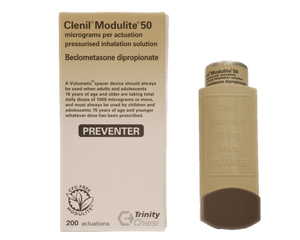
Clenil Modulite
View Options
This website provides general information about medicines for educational purposes only. Always consult your doctor or pharmacist before taking any medication.
Choose Your Medicine
Select dosage and quantity
Online Consultation
Reviewed by a qualified physician
Fast, Discreet Delivery
Delivered to your door
Medical Information
About This Medicine
Clenil Modulite is a pressurised metered-dose inhaler (pMDI) containing beclometasone dipropionate, an inhaled corticosteroid used as a preventer therapy in the long-term management of asthma. Unlike reliever inhalers, which provide immediate relief during an asthma attack, Clenil Modulite works by reducing inflammation in the airways over time, helping to prevent symptoms such as wheezing, breathlessness, chest tightness, and coughing.
How Clenil Modulite Works
Beclometasone dipropionate is a potent glucocorticoid that acts directly on the cells lining the airways of the lungs. It suppresses the release of inflammatory mediators, reduces the accumulation of eosinophils and other immune cells in the bronchial mucosa, and decreases mucus production. This sustained anti-inflammatory action makes the airways less reactive to common triggers such as exercise, cold air, pollen, and dust mites. Because this effect builds gradually, patients must use Clenil Modulite regularly every day, even when they feel well, to maintain good asthma control.
Available Strengths and CFC-Free Formulation
Clenil Modulite is available in four strengths: 50 mcg, 100 mcg, 200 mcg, and 250 mcg per actuation. The inhaler uses a hydrofluorocarbon (HFC) propellant rather than the older chlorofluorocarbon (CFC) propellants, making it more environmentally friendly. The formulation also delivers a finer particle size than many older beclometasone inhalers, which allows deeper lung deposition at lower doses. For this reason, prescribers and patients should be aware that Clenil Modulite is not interchangeable on a microgram-for-microgram basis with CFC-containing beclometasone inhalers without medical review.
Using Clenil Modulite Alongside Other Treatments
Clenil Modulite is often prescribed as part of a stepwise approach to asthma management. It may be used alone at low doses in mild persistent asthma or combined with long-acting bronchodilators such as salmeterol or formoterol in more severe disease. Patients should always carry a short-acting beta-2 agonist reliever inhaler (such as salbutamol) for breakthrough symptoms. If symptoms require the reliever inhaler more than twice per week, this is a sign that asthma control is suboptimal and the preventer regimen should be reviewed by a clinician. Rinsing the mouth and gargling with water after each dose is strongly recommended to prevent oral candidiasis (thrush) and reduce systemic absorption.
Usage & Dosage
Taking Clenil Modulite Correctly
Clenil Modulite must be used regularly, exactly as prescribed, even when asthma symptoms are not present. It is not a reliever and will not provide immediate relief during an asthma attack. The inhaler should be primed before first use by releasing two puffs into the air, and re-primed if it has not been used for more than 7 days.
To use the inhaler correctly, shake it well, breathe out gently, place the mouthpiece in the mouth and form a tight seal with the lips, then inhale slowly and deeply while pressing down on the canister. Hold the breath for about 10 seconds, then breathe out slowly. If a second puff is required, wait 30 seconds before repeating. After use, always rinse the mouth with water and spit it out to reduce the risk of oral thrush. The plastic actuator should be cleaned weekly by removing the canister and rinsing the actuator under warm running water.
Missed Doses
If a dose is missed, take it as soon as it is remembered. However, if it is nearly time for the next scheduled dose, skip the missed dose and continue with the regular schedule. Do not take a double dose to make up for a missed one. If doses are frequently missed, asthma control may deteriorate. Patients who notice worsening symptoms or increased reliance on their reliever inhaler should contact their doctor or asthma nurse promptly.
Doses of Clenil Modulite are tailored to the severity of asthma and the patient's response to treatment.
Adults and adolescents (12 years and over): The usual starting dose is 200 mcg twice daily, which may be increased to 400 mcg twice daily in moderate-to-severe asthma. Some patients with mild asthma may be adequately controlled on 100 mcg twice daily. The maximum recommended daily dose is 1,000 mcg per day, though doses above 400 mcg per day should generally be managed under specialist supervision.
Children (5 to 11 years): The usual dose is 100 mcg twice daily. If symptoms are not controlled, this may be increased to a maximum of 200 mcg twice daily. Clenil Modulite is not licensed for use in children under 5 years.
When asthma has been well controlled for at least three months, the dose may be stepped down gradually to the lowest effective maintenance dose. Dose reductions should be made under medical supervision and the patient should be monitored for any deterioration in control. In patients who require more than 400 mcg per day, a spacer device is recommended to improve lung deposition and reduce oropharyngeal deposition.
Side Effects
Common Side Effects
Most patients using Clenil Modulite tolerate it well, and side effects are generally mild when the inhaler is used correctly. Common side effects include:
- Oral thrush (candidiasis) - white patches in the mouth or throat, which can be reduced by rinsing the mouth after each dose
- Hoarseness or changes in voice (dysphonia)
- Throat irritation or dry mouth
- Coughing immediately after inhalation
- Mild headache
- Sneezing or nasal irritation if drug is inadvertently inhaled nasally
- Upper respiratory tract infections
Serious Side Effects
Serious side effects are uncommon at recommended doses but become more likely at higher doses or with prolonged use. Seek medical advice if any of the following occur:
- Adrenal suppression - particularly at high doses or in children; symptoms include extreme tiredness, weakness, and dizziness, especially during illness or surgery
- Reduced bone mineral density with prolonged high-dose use, increasing the risk of osteoporosis
- Cataracts or raised intraocular pressure (glaucoma) with long-term high-dose treatment
- Growth retardation in children receiving long-term high-dose inhaled corticosteroids
- Paradoxical bronchospasm - a sudden worsening of wheezing immediately after inhaler use; discontinue and use a reliever inhaler if this occurs
Warnings & Precautions
Important Precautions Before Using Clenil Modulite
Clenil Modulite is a preventer inhaler and must never be used to relieve sudden breathlessness or an acute asthma attack. Patients must always have access to a fast-acting reliever inhaler. If asthma symptoms are worsening or the reliever inhaler is needed more frequently, medical advice should be sought urgently.
Patients who are being transferred from oral or high-dose inhaled corticosteroids to Clenil Modulite may have suppressed adrenal function. During periods of physiological stress such as surgery, serious illness, or trauma, additional corticosteroid cover may be required. Patients who have been on high-dose inhaled steroids for prolonged periods should carry a steroid warning card. Any systemic corticosteroid withdrawal must be carried out gradually under medical supervision.
Use in Special Populations
Clenil Modulite should be used with caution in patients with active or quiescent pulmonary tuberculosis, as corticosteroids may reactivate latent infections. In patients with diabetes, inhaled corticosteroids can occasionally cause small increases in blood glucose levels, particularly at higher doses. Clenil Modulite can be used during pregnancy when asthma control is necessary, as poorly controlled asthma poses greater risks to mother and foetus than the medication itself; however, the lowest effective dose should be used. Breastfeeding is not contraindicated. Elderly patients and children are more susceptible to systemic effects and should be monitored for bone density and growth, respectively.
Contraindications
Clenil Modulite is contraindicated in the following circumstances:
- Known hypersensitivity or allergy to beclometasone dipropionate or any excipient in the formulation
- Hypersensitivity to HFC-134a propellant
- Treatment of acute asthma attacks or status asthmaticus (a reliever inhaler is required instead)
- Not licensed for children under 5 years of age
- Use as a standalone treatment in severe acute asthma without systemic corticosteroid cover
- Patients with untreated fungal, bacterial, or viral infections of the respiratory tract where corticosteroid use could worsen the infection
Frequently Asked Questions
How long does Clenil Modulite take to work?
Can I use Clenil Modulite during pregnancy?
Why do I need to rinse my mouth after using Clenil Modulite?
Is Clenil Modulite the same as other beclometasone inhalers?
What should I do if I accidentally use too much Clenil Modulite?
Dr. Ross Elledge
General Practitioner · General & Family Medicine
Verified Healthcare Professional
TopDoctors Profile