
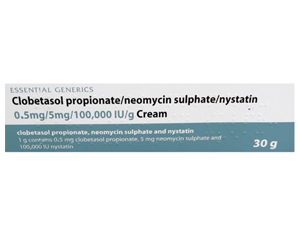
Clobetasol with Neomycin and Nystatin
View Options
This website provides general information about medicines for educational purposes only. Always consult your doctor or pharmacist before taking any medication.
Choose Your Medicine
Select dosage and quantity
Online Consultation
Reviewed by a qualified physician
Fast, Discreet Delivery
Delivered to your door
Medical Information
About This Medicine
Clobetasol-neomycin-nystatin cream is a triple-combination topical preparation containing three active ingredients that together address the three common elements of complicated inflammatory skin conditions: inflammation, bacterial infection, and fungal infection. This combination product is equivalent in composition to preparations such as Trimovate cream, and is prescribed when a skin condition is thought to involve more than one of these pathological processes simultaneously.
The Three Active Ingredients
The cream contains clobetasol propionate, a very potent (Class IV) topical corticosteroid, alongside neomycin sulphate, an aminoglycoside antibacterial, and nystatin, a polyene antifungal. Clobetasol works by suppressing the inflammatory and immune responses in the skin, rapidly reducing redness, swelling, itch, and exudate. Neomycin provides antibacterial cover against common Gram-positive and Gram-negative skin pathogens such as Staphylococcus aureus and various coliforms. Nystatin is active against Candida species and other yeasts, preventing or treating superficial fungal infections that commonly complicate inflamed or macerated skin.
Clinical Indications
This combination is particularly useful in conditions where the diagnosis is uncertain or where mixed aetiology is suspected - for instance, an eczematous patch that has become secondarily infected with bacteria or colonised by Candida, or intertrigo in skin folds that involves both microbial and inflammatory components. Other indications include infected or superinfected seborrhoeic dermatitis and inflammatory skin conditions that have not responded to a single-component preparation.
Duration of Use
Because clobetasol propionate is the most potent class of topical corticosteroid available, this cream should be used for the shortest possible time and application should be limited to the affected areas only. Prolonged use, particularly on the face, flexures, or in children, significantly increases the risk of skin atrophy, striae (stretch marks), and systemic corticosteroid absorption. Treatment should be reviewed regularly by a clinician to ensure the combination product remains appropriate as the condition evolves.
Usage & Dosage
How to Apply the Cream
Apply a thin layer of the cream to the affected skin area once or twice daily, as directed by your doctor. Wash your hands before and after application. Do not cover the treated area with an occlusive dressing (such as cling film or a tight bandage) unless specifically instructed, as this substantially increases the absorption of the corticosteroid and raises the risk of side effects.
Apply gently and rub in smoothly, avoiding the eyes, mucous membranes, and uninvolved skin. This cream contains a potent corticosteroid (clobetasol), an antibiotic (neomycin), and an antifungal (nystatin). It is prescribed for short-term use only and is not intended for prolonged treatment.
Duration of Use
Do not use continuously for more than four weeks without medical review. On the face, armpits, groin, or under dressings, limit use to five to seven days. If there is no improvement within seven to fourteen days, contact your doctor to reassess the diagnosis.
The cream is applied topically and there are no systemic dosing regimens in the conventional sense. Standard prescribing guidance recommends:
Adults: Apply a thin layer to the affected area once or twice daily. The quantity used should be the minimum required to cover the affected skin. As a guide, one fingertip unit (approximately 0.5 g) covers an area roughly equivalent to two adult palms.
Children: Clobetasol propionate is not recommended for routine use in children. If used in children under specialist supervision, application should be limited to very small areas for very short periods, and the child must be monitored closely for signs of adrenal suppression.
Elderly patients: Elderly skin is thinner and more susceptible to corticosteroid-induced atrophy. The minimum effective amount should be used and treatment duration should be kept as short as possible.
Total use of clobetasol propionate from all sources should not exceed 50 g per week in adults. The cream should not be applied to the face, groin, or axillae unless specifically directed, and should never be used near or around the eyes.
Side Effects
Common Side Effects
Local skin reactions are the most frequently reported effects with this combination cream:
- Burning, stinging, or tingling on application, especially on inflamed or broken skin
- Skin dryness or peeling
- Itching at the application site
- Mild redness
With Prolonged Use
Clobetasol is a very potent corticosteroid, and skin thinning (atrophy), stretch marks, and increased skin fragility can develop with prolonged or excessive use. Neomycin (the antibiotic component) can cause allergic contact dermatitis in some people. If your skin becomes more irritated rather than better after starting this cream, stop using it and see your doctor — this may indicate a contact allergy to neomycin.
Warnings & Precautions
Potent Corticosteroid Risks
Clobetasol propionate is the most potent class of topical corticosteroid and should only be used when specifically prescribed for this purpose. It should not be used on the face, genitalia, or in skin folds unless under specialist supervision, as these areas absorb the drug more readily. Prolonged use on any area can cause irreversible skin thinning, striae, and visible blood vessels (telangiectasia). Children absorb corticosteroids proportionally more than adults due to their higher skin surface area to body weight ratio, and systemic effects including adrenal suppression are a real risk.
Infection Masking and Neomycin Sensitisation
The corticosteroid component can mask or modify the clinical appearance of infections, making them harder to diagnose and treat. If the clinical picture is not improving or is worsening after a week of treatment, the diagnosis should be reconsidered and microbiological sampling undertaken. Neomycin is a well-recognised contact allergen - if the skin condition appears to worsen or spread during treatment, the possibility of neomycin contact allergy should be considered and patch testing arranged. In such cases the preparation should be discontinued. This cream should not be used in or around the external ear canal if the eardrum may be perforated.
Contraindications
This combination cream is contraindicated in the following situations:
- Known hypersensitivity to clobetasol propionate, neomycin, nystatin, or any excipient
- Untreated primary bacterial skin infections (such as impetigo) where systemic antibiotics may be needed
- Viral skin infections including herpes simplex and varicella (chickenpox)
- Acne vulgaris and rosacea (corticosteroids can worsen both)
- Perioral dermatitis
- Skin ulcers or wounds where absorption would be excessive
- Widespread use in children without specialist supervision
- Application to the face, groin, or axillae without specialist direction
- Perforated eardrum if used in the ear canal
- Pregnancy (particularly first trimester) and breastfeeding without specialist advice
Frequently Asked Questions
What skin conditions is clobetasol-neomycin-nystatin cream used for?
Can I use this cream on my face?
How long can I use this cream for?
Why has my skin condition become worse since using this cream?
Dr. Ross Elledge
General Practitioner · General & Family Medicine
Verified Healthcare Professional
TopDoctors Profile