
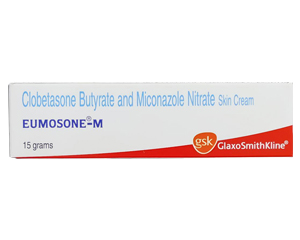
Clobetasone Butyrate
View Options
This website provides general information about medicines for educational purposes only. Always consult your doctor or pharmacist before taking any medication.
Choose Your Medicine
Select dosage and quantity
Online Consultation
Reviewed by a qualified physician
Fast, Discreet Delivery
Delivered to your door
Medical Information
About This Medicine
Clobetasone butyrate is a moderately potent topical corticosteroid used in the treatment of inflammatory skin conditions including eczema, contact dermatitis, and seborrhoeic dermatitis. Available as a 0.05% cream (commonly known by the brand name Eumovate), it occupies an important middle ground in the spectrum of topical corticosteroid potency - more effective than hydrocortisone 1% but significantly less potent than stronger agents such as betamethasone valerate or clobetasol propionate.
Role in Eczema and Dermatitis Management
Clobetasone butyrate is widely used in the management of mild to moderate inflammatory skin conditions that have not responded adequately to hydrocortisone 1%, which is available without prescription. It is particularly useful for conditions that require a reliable anti-inflammatory effect but where the risks of more potent corticosteroids need to be minimised - for example, in areas of thin or sensitive skin, in patients prone to corticosteroid-induced side effects, or when a longer maintenance course is anticipated.
Use on the Face and in Children
One of the key advantages of clobetasone butyrate over more potent corticosteroids is its relative safety profile, which makes it more suitable for cautious use on the face and in children. While it should still be used sparingly and for as short a time as possible in these populations, clinical guidelines recognise that the risk of skin atrophy, adrenal suppression, and other systemic effects is substantially lower than with higher-potency agents. Short courses under medical supervision are generally considered appropriate when the benefit outweighs the risk.
Stepped Approach to Topical Corticosteroid Use
Clobetasone butyrate forms part of the stepped approach to topical corticosteroid prescribing advocated in UK dermatology guidelines. The principle is to use the lowest potency corticosteroid that adequately controls the condition, reserving more potent agents for flares that do not respond to milder treatments. Once a flare is controlled with clobetasone butyrate, emollient therapy should be continued as the cornerstone of long-term skin management, with the corticosteroid used intermittently or proactively as directed by the prescriber.
Usage & Dosage
How to Apply Clobetasone Butyrate Cream
Apply a thin layer of clobetasone butyrate cream to the affected skin and rub in gently. It is usually applied once or twice daily. Wash your hands before and after application, unless your hands are the area being treated. Use sparingly — a small amount covers more area than you might expect, and using too much does not improve the effect but does increase the risk of side effects.
As a helpful guide, use the fingertip unit method: one fingertip unit (the amount from fingertip to the first crease) covers roughly two adult palm-sized areas. Keep within this range.
Short Courses Work Best
Clobetasone butyrate is a moderately potent steroid. Use it for the shortest time needed to bring the skin condition under control, typically five to fourteen days for a flare. Once the skin has improved, stop or step down to a less potent cream for maintenance. Do not use on the face without medical guidance, and avoid the armpits and groin unless specifically prescribed.
Clobetasone butyrate 0.05% cream is for topical use only. There is no systemic dosing regimen.
Adults: Apply a thin layer to affected areas once or twice daily. The total amount applied per week should be kept to the minimum effective quantity. In practice, most adults with localised eczema use 15 to 30 g per week or less.
Children (2 years and over): Can be used with caution under medical supervision. The same principle of the minimum effective amount for the shortest possible time applies. Children have a higher surface area to body weight ratio and are therefore at greater risk of systemic absorption.
Children under 2 years: Not recommended without specialist supervision.
Face: Short courses under medical supervision are more acceptable with clobetasone butyrate than with more potent corticosteroids, but facial use should still be limited to the minimum necessary and avoided in periorbital areas where glaucoma or cataract risk is of concern.
The cream should not be used continuously for more than 4 weeks without reassessment by a clinician. If the condition does not respond within 2 weeks, the diagnosis and treatment plan should be reviewed.
Side Effects
Common Side Effects
When used correctly — sparingly, on limited areas, for short courses — side effects are uncommon. Those that do occur are usually mild and local:
- Mild burning, stinging, or itching on initial application
- Skin dryness at the treated site
- Mild local thinning of the skin with extended or repeated use
With Prolonged Use
Do not use clobetasone butyrate for prolonged periods without clinical review, as continuous steroid use on the same area can cause progressive skin thinning, stretch marks, and increased blood vessel visibility. These effects are more likely on the face, neck, armpits, and groin, and in skin folds. If your skin condition does not respond after two weeks, see your doctor — a different treatment or stronger prescription may be needed.
Warnings & Precautions
Avoiding Prolonged Use and Overuse
Clobetasone butyrate should be used for the shortest time needed to control the skin flare. It should not be used as a daily moisturiser or applied to normal skin. Continuous use beyond 4 weeks significantly increases the risk of skin atrophy and other local side effects. In patients who require frequent courses, a proactive (intermittent) use plan should be discussed with a dermatologist - typically applying the cream on 2 days per week to previously affected areas to prevent relapse.
Use in Children and on the Face
Although clobetasone butyrate is considered relatively safe compared to potent corticosteroids, it should still be used cautiously in children and on the face. Parents should be advised to apply only the amount their child's doctor has recommended and not to use the cream as a routine measure for all skin rashes. Use near the eyes should be avoided due to the risk of raised intraocular pressure and cataract formation with repeated periorbital application. If a skin condition in a child does not respond within 2 weeks, specialist review should be sought rather than increasing the dose or switching to a more potent preparation without guidance.
Contraindications
Clobetasone butyrate 0.05% cream is contraindicated in the following situations:
- Known hypersensitivity to clobetasone butyrate or any excipient in the formulation
- Primary bacterial skin infections (impetigo, erysipelas) where systemic antibiotics are required
- Viral skin infections including herpes simplex, chickenpox (varicella), and shingles
- Fungal skin infections (tinea, candidiasis) - corticosteroids alone will worsen these
- Acne vulgaris
- Rosacea and perioral dermatitis
- Children under 1 year without specialist supervision
- Application to large areas of skin, under occlusion, or for extended periods without medical review
Frequently Asked Questions
Is clobetasone butyrate safe to use on the face for eczema?
How does clobetasone butyrate differ from hydrocortisone 1%?
Can I use clobetasone butyrate cream during pregnancy?
How long does it take for clobetasone butyrate to work on eczema?
Dr. Ross Elledge
General Practitioner · General & Family Medicine
Verified Healthcare Professional
TopDoctors Profile