
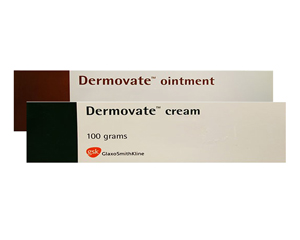
Dermovate
View Options
This website provides general information about medicines for educational purposes only. Always consult your doctor or pharmacist before taking any medication.
Choose Your Medicine
Select dosage and quantity
Online Consultation
Reviewed by a qualified physician
Fast, Discreet Delivery
Delivered to your door
Medical Information
About This Medicine
Dermovate is a very potent topical corticosteroid preparation containing clobetasol propionate 0.05%, used to treat severe inflammatory and pruritic skin conditions that have not responded adequately to less potent steroids. It is available as a cream, ointment, and scalp application, and is one of the strongest topical steroids available on prescription in the UK. Dermovate is intended for short-term use only, typically for no longer than four weeks at a time, under medical supervision.
Conditions Treated
Dermovate is prescribed for a range of severe skin conditions, most commonly resistant plaque psoriasis, severe eczema (atopic, discoid, or contact dermatitis), lichen planus, lichen simplex chronicus, and other chronic inflammatory dermatoses that have failed to improve with moderate to potent corticosteroids. The scalp application formulation is specifically designed to penetrate the hair-bearing areas of the scalp affected by psoriasis or seborrhoeic dermatitis.
Mechanism of Action
Clobetasol propionate exerts its anti-inflammatory effect by binding to intracellular glucocorticoid receptors, suppressing the production and release of inflammatory mediators including cytokines, prostaglandins, and leukotrienes. This leads to reduction of erythema, oedema, scaling, and pruritus in affected skin. The very high potency of clobetasol propionate means it is highly effective but also carries a greater risk of systemic and local adverse effects compared with weaker topical steroids, making careful use and strict adherence to application guidelines essential.
The ointment formulation is generally preferred for dry, scaly, or thickened skin lesions, whilst the cream may be more suitable for moist or oozing areas or for patients who prefer a less occlusive texture. The choice between formulations should be guided by the nature of the lesion and patient preference.
Usage & Dosage
Dermovate should be applied sparingly to the affected area once or twice daily, as directed by the prescribing clinician. The general principle when using any potent topical steroid is to use the smallest effective amount for the shortest duration necessary.
Application Guidelines
Apply a thin layer of cream or ointment to the affected skin and rub in gently. Hands should be washed after application unless the hands themselves are the area being treated. Dermovate must not be applied to the face, groin, axillae, or other flexural areas, as these are sites of thin skin with higher absorption rates and a greater propensity for local adverse effects including skin atrophy and striae.
For the scalp application, part the hair, apply small drops of the lotion directly to the affected areas of the scalp, and massage in gently. Avoid contact with the eyes. If large quantities are being applied, covering the head with a shower cap overnight can enhance penetration, but this increases systemic absorption and should only be done if specifically directed.
Occlusion and Course Length
Dermovate should not be used under occlusive dressings routinely, as this dramatically increases systemic absorption. Treatment should not exceed four consecutive weeks without a medical review. After a course of Dermovate, stepping down to a less potent topical steroid is often advisable to maintain control and reduce the risk of rebound flares.
Dermovate cream, ointment, or scalp application should be applied in a thin layer to the affected area once or twice daily. The prescribing clinician will determine the frequency based on the severity of the condition and the site being treated.
As a practical guide, one fingertip unit (FTU) of cream or ointment is approximately 0.5 g and is sufficient to cover an area roughly equivalent to two adult palms. For most inflammatory skin conditions, treatment should be limited to no more than 50 g per week of cream or ointment to reduce the risk of systemic corticosteroid effects.
In children, Dermovate should be used with even greater caution. It is not generally recommended for use in children under one year, and in older children the duration and quantity applied should be minimised. Young children have a higher surface area to body weight ratio, which increases the risk of significant systemic absorption.
If there is no improvement after two to four weeks of treatment, the diagnosis should be reconsidered and specialist dermatological assessment sought.
Side Effects
Dermovate is a very potent corticosteroid and carries a higher risk of both local and systemic side effects compared with weaker topical steroids. Careful adherence to application guidance is essential to minimise these risks.
Common Side Effects
- Skin thinning (cutaneous atrophy) at the site of application, particularly with prolonged use
- Telangiectasia (visible small blood vessels), bruising, and easy skin tearing
- Striae (stretch marks), which are permanent and most likely to occur in flexural areas
- Burning, itching, or stinging at the application site, particularly when first applied
- Folliculitis (inflammation around hair follicles)
- Perioral dermatitis if applied near the mouth (avoid facial use)
Serious Side Effects
- Adrenal suppression: prolonged or widespread use of Dermovate can suppress the hypothalamic-pituitary-adrenal (HPA) axis, particularly in children; this can manifest as growth retardation in children, Cushing's syndrome, hyperglycaemia, or adrenal crisis on abrupt withdrawal
- Skin infections: topical steroids can mask or exacerbate bacterial, fungal, or viral skin infections; if a skin infection develops during treatment, appropriate antimicrobial therapy must be initiated
- Contact sensitisation: allergy to the steroid itself or to excipients in the formulation can occur
- Posterior subcapsular cataracts and glaucoma: rare, associated with long-term use, particularly if applied around the eyes
Warnings & Precautions
Dermovate must be used strictly as directed. Its very high potency means there is little margin for inappropriate use, and both patients and clinicians should be fully aware of the risks associated with overuse.
Restrictions on Site of Use and Duration
Dermovate must not be applied to the face, to thin-skinned areas such as the axillae and groin, or to the genital area, where skin absorption is greatly enhanced. It should not be applied to infected skin unless the infection is also being treated with an appropriate antimicrobial agent. Treatment should not continue beyond four consecutive weeks without a medical review, and should not exceed 50 g per week. After completion of a course, gradual step-down to a less potent steroid is preferable to abrupt cessation, to prevent rebound flaring.
Systemic Absorption and Paediatric Use
The risk of significant systemic absorption is greatest in infants and young children, in whom Dermovate should be used sparingly and for as short a period as possible. Use of nappies or tight bandaging over treated areas creates an occlusive environment and markedly increases absorption in babies and toddlers. Growth and adrenal function should be monitored in children requiring repeated courses.
Patients should be advised not to use Dermovate more frequently or for longer than recommended, and not to apply it to areas of skin not affected by the condition for which it was prescribed.
Contraindications
Dermovate must not be used in the following situations:
- Known hypersensitivity to clobetasol propionate or any excipients in the formulation
- Untreated skin infections of any kind (bacterial, fungal, viral, or parasitic), including impetigo, tinea, herpes simplex, and scabies
- Application to the face, groin, or axillae
- Perioral dermatitis
- Acne vulgaris
- Rosacea
- Perianal and genital pruritus
- Napkin dermatitis in infants
- Primary cutaneous viral infections (e.g., chickenpox, shingles)
- Do not use in or around the eyes (risk of glaucoma and cataract)
Frequently Asked Questions
How long can I use Dermovate for?
Can I use Dermovate on my face?
What should I do if my skin condition does not improve with Dermovate?
Is it safe to use Dermovate during pregnancy?
Can Dermovate make skin infections worse?
Dr. Ross Elledge
General Practitioner · General & Family Medicine
Verified Healthcare Professional
TopDoctors Profile