
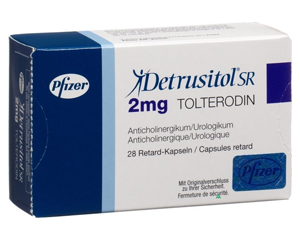
Detrusitol
View Options
This website provides general information about medicines for educational purposes only. Always consult your doctor or pharmacist before taking any medication.
Choose Your Medicine
Select dosage and quantity
Online Consultation
Reviewed by a qualified physician
Fast, Discreet Delivery
Delivered to your door
Medical Information
About This Medicine
Detrusitol is a prescription medicine containing tolterodine tartrate, an antimuscarinic (anticholinergic) agent used to treat overactive bladder (OAB). The condition is characterised by urinary urgency, with or without urge incontinence, usually accompanied by increased daytime frequency and nocturia. Detrusitol LA (long-acting) capsules contain 4 mg of tolterodine tartrate and are designed for once-daily administration, providing sustained bladder control throughout the day and night.
How Detrusitol Works
The urinary bladder is controlled by muscarinic acetylcholine receptors, particularly the M2 and M3 subtypes, which regulate detrusor muscle contraction. In overactive bladder, involuntary detrusor contractions occur during the bladder filling phase, producing sudden, difficult-to-defer urges to urinate. Tolterodine acts as a competitive antagonist at muscarinic receptors in the bladder wall, reducing the frequency and strength of these involuntary contractions. This increases bladder capacity, reduces urgency, and decreases the frequency of urination, both during the day and at night.
Treatment Context
Overactive bladder affects millions of adults in the UK and can significantly impair quality of life, disrupting sleep, limiting social activities, and affecting self-confidence. Detrusitol is used when bladder training exercises and dietary modifications alone have been insufficient to control symptoms. It is one of several antimuscarinic medicines available for OAB, and the choice between agents is usually guided by individual tolerability, particularly with regard to dry mouth, constipation, and cognitive effects. Detrusitol LA is considered to have a relatively favourable tolerability profile due to its selective action on bladder smooth muscle.
Usage & Dosage
Detrusitol LA is indicated for the treatment of overactive bladder with symptoms of urinary urgency, frequency, and urge urinary incontinence in adults. It is typically recommended after conservative measures, including bladder retraining and fluid management, have been trialled and found insufficient.
How to Take Detrusitol LA
Detrusitol LA capsules should be swallowed whole with a glass of water and may be taken with or without food. Taking the capsule at the same time each day, preferably in the morning, helps to maintain consistent plasma concentrations. The capsule must not be chewed, crushed, or divided, as this would destroy the extended-release mechanism and result in rapid, high-peak drug delivery.
Lifestyle Advice Alongside Treatment
Bladder retraining is an important complement to pharmacological therapy. Patients should be encouraged to gradually increase the interval between trips to the toilet, aiming to reduce urgency and improve bladder capacity over time. Limiting excessive fluid intake, particularly caffeine and alcohol (both bladder irritants), should be recommended. Timing of fluid intake — avoiding large amounts in the evening — can help reduce nocturia. These non-pharmacological strategies work synergistically with Detrusitol LA to provide the best overall outcomes.
The recommended dose of Detrusitol LA is one 4 mg capsule taken orally once daily. The extended-release formulation does not require twice-daily dosing as was the case with the original immediate-release tolterodine 2 mg tablets (Detrusitol standard).
In patients with significant hepatic impairment or severe renal impairment (GFR below 30 mL/min), dose reduction to 2 mg once daily (using the immediate-release formulation) is recommended, or specialist guidance should be sought. In patients known to be taking potent CYP3A4 inhibitors such as ketoconazole, itraconazole, or erythromycin, the dose should be reduced to 2 mg once daily due to increased tolterodine plasma concentrations.
A clinical response should be assessed after four to eight weeks of treatment. If the patient is not achieving adequate symptom control at 4 mg, the treatment plan should be reviewed. Some patients may benefit from dose reduction to 2 mg if side effects are troublesome.
Side Effects
Detrusitol LA has a generally favourable tolerability profile, but anticholinergic side effects can occur and may limit tolerability in some patients, particularly the elderly.
Common Side Effects
- Dry mouth — the most frequently reported adverse effect; drinking small sips of water frequently can help; sugar-free gum or lozenges may also provide relief
- Constipation — maintaining adequate fluid intake and dietary fibre is important
- Headache
- Dizziness
- Dry eyes
- Blurred vision or difficulty focusing (accommodation disturbance)
- Fatigue and somnolence
- Abdominal discomfort or dyspepsia
Serious Side Effects
Patients should seek medical advice promptly if they experience:
- Urinary retention: difficulty starting or stopping urination, or inability to pass urine — this is a potentially serious complication, particularly in men with an enlarged prostate or a history of bladder outlet obstruction
- Angioedema: swelling of the face, lips, tongue, or throat, which can affect breathing — this is rare but requires urgent medical attention
- Worsening glaucoma: Detrusitol LA must not be used in patients with uncontrolled narrow-angle glaucoma, as anticholinergic effects can raise intraocular pressure
- Cognitive effects: antimuscarinic medicines may worsen cognitive function in elderly patients or those with dementia; this should be monitored during treatment
Warnings & Precautions
Detrusitol LA should be used with caution in several patient groups, and there are specific contraindications that must be observed before prescribing.
Urinary Retention Risk
Tolterodine reduces the contractility of the detrusor muscle. In men with an enlarged prostate (benign prostatic hyperplasia) or other causes of bladder outflow obstruction, reducing detrusor contractility may precipitate acute urinary retention. Detrusitol LA is contraindicated in patients with urinary retention. Men with symptomatic BPH should be evaluated carefully before prescribing, and any obstructive symptoms should be addressed.
Glaucoma
Anticholinergic agents can precipitate acute angle-closure glaucoma in susceptible individuals by dilating the pupil and narrowing the angle between the iris and cornea. Patients with uncontrolled narrow-angle glaucoma must not use Detrusitol LA. Patients with open-angle glaucoma who are receiving treatment can generally use antimuscarinic agents, but intraocular pressure monitoring during treatment is advisable.
Cognitive and Elderly Considerations
Elderly patients, particularly those with or at risk of dementia, should be monitored for anticholinergic-related cognitive impairment during treatment. The anticholinergic burden of multiple medicines taken concurrently should be assessed. Tolterodine should be used with caution in patients with decreased gastrointestinal motility or severe constipation. Alcohol should be used cautiously, as it may increase sedative effects.
Contraindications
Detrusitol LA is contraindicated in the following situations:
- Urinary retention
- Uncontrolled narrow-angle glaucoma
- Myasthenia gravis
- Severe ulcerative colitis
- Toxic megacolon
- Known hypersensitivity to tolterodine tartrate or any excipients
- Severe hepatic impairment (without dose adjustment; specialist guidance required)
- Patients taking potent CYP3A4 inhibitors without dose reduction (risk of significantly elevated plasma levels)
- Pregnancy and breastfeeding (insufficient data; use only if essential under medical supervision)
- Gastric retention or obstructive gastrointestinal conditions
Frequently Asked Questions
How long does it take for Detrusitol LA to work?
Will Detrusitol LA affect my ability to drive?
Can I take Detrusitol LA if I have an enlarged prostate?
What can I do about the dry mouth caused by Detrusitol LA?
Are there other medicines for overactive bladder if Detrusitol LA does not suit me?
Dr. Ross Elledge
General Practitioner · General & Family Medicine
Verified Healthcare Professional
TopDoctors Profile