
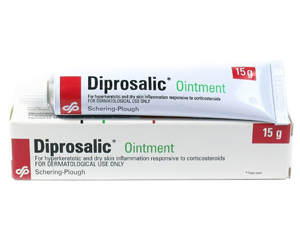
Diprosalic
View Options
This website provides general information about medicines for educational purposes only. Always consult your doctor or pharmacist before taking any medication.
Choose Your Medicine
Select dosage and quantity
Online Consultation
Reviewed by a qualified physician
Fast, Discreet Delivery
Delivered to your door
Medical Information
About This Medicine
Diprosalic is a combination topical medicine containing two active ingredients: betamethasone dipropionate, a potent corticosteroid, and salicylic acid, a keratolytic agent. Together, these two components work synergistically to address the key features of scaly, inflammatory skin conditions such as plaque psoriasis and seborrhoeic dermatitis. Diprosalic is available as an ointment for use on the skin and as a scalp application (solution) for treating affected areas of the scalp, making it a versatile option for psoriasis management.
How the Two Ingredients Work Together
Salicylic acid is a well-established keratolytic agent, meaning it softens and loosens the thickened, scaly skin that builds up in conditions such as psoriasis. By breaking down the intercellular connections within the outer layer of the skin, salicylic acid removes the scale and allows the skin to shed more normally. This also has the important practical effect of enhancing the penetration of betamethasone dipropionate into the deeper layers of the skin, where its anti-inflammatory action is needed most.
Betamethasone dipropionate is classified as a potent corticosteroid. It works by suppressing the local inflammatory response within the skin, reducing the redness, swelling, itching, and discomfort associated with psoriasis and other inflammatory dermatoses. It acts on multiple components of the inflammatory cascade, including the production of prostaglandins and cytokines that drive skin inflammation.
Clinical Uses and Dermatological Significance
Diprosalic ointment is used for thick, scaly plaques on the body, typically associated with psoriasis. The scalp application formulation is specifically designed to penetrate through hair-bearing areas and deliver treatment directly to the scalp, where psoriasis frequently causes significant discomfort and social distress. It may also be used for other scaling dermatoses, chronic eczema with lichenification, and other conditions that have not responded to milder treatments. Diprosalic is available on prescription and should only be used under the direction of a healthcare professional who can monitor for both local and systemic side effects associated with potent corticosteroid use.
Usage & Dosage
How to Apply Diprosalic
Apply Diprosalic (betamethasone dipropionate / salicylic acid) ointment in a thin layer to the affected skin areas once or twice daily as directed. Rub in gently until evenly distributed. For dry, scaly plaques, applying before bed allows it to work overnight. Wash your hands thoroughly after application unless the hands are being treated. Do not apply to broken skin, open wounds, or around the eyes.
The salicylic acid component helps to loosen and remove scaling, making the betamethasone more effective at penetrating thickened psoriatic skin.
Duration of Use
Use for the shortest time needed to bring symptoms under control. Do not apply continuously for more than four weeks without a clinical review. Diprosalic is a potent corticosteroid preparation — use on the face, armpits, or groin should only occur under direct medical supervision.
Diprosalic ointment is typically applied once or twice daily to the affected skin area. Treatment duration should be kept as short as possible; for most patients, a course of two to four weeks is appropriate before reassessment. If used on large areas of the body or under occlusion, the total weekly dose of betamethasone absorbed systemically increases significantly and the risk of adrenal suppression rises.
The scalp application is similarly applied once or twice daily. The total amount applied should be limited; in adults, no more than 60ml per week of the scalp application or 60g per week of the ointment should be used. In elderly patients, the skin is thinner and more susceptible to corticosteroid-induced atrophy, so the minimum effective dose and shortest treatment duration should be used. Diprosalic is not recommended for use in children unless prescribed by a specialist, and it is not suitable for use on the face. Following improvement, treatment should be stepped down gradually rather than stopped abruptly.
Side Effects
Common Side Effects
- Local skin irritation, burning, or stinging at the application site
- Skin dryness or peeling
- Folliculitis (inflamed hair follicles)
- Skin thinning (atrophy) with prolonged use
- Stretch marks (striae), particularly in skin folds
- Contact dermatitis (allergic reaction to one of the components)
Systemic Absorption Warning
With prolonged use over large areas, enough betamethasone can be absorbed through the skin to suppress the body's own cortisol production (adrenal suppression). This is more of a concern with occlusive dressings, use on broken skin, and in children. If you have been using Diprosalic for an extended period, do not stop suddenly — see your doctor first to taper treatment appropriately.
Warnings & Precautions
Potent Corticosteroid Cautions
Diprosalic contains a potent corticosteroid and should be used with care, particularly when applied to large areas of skin, skin folds (groin, axillae, under the breasts), the face, or occluded areas. Prolonged use in any of these locations significantly increases the risk of skin atrophy, striae, and systemic absorption leading to HPA axis suppression. Patients should not use more than the prescribed amount and should not extend treatment beyond the recommended duration without medical review.
Salicylic acid can be absorbed through the skin, particularly if applied to large areas, broken skin, or used under occlusion. In high systemic concentrations, salicylate toxicity (salicylism) can occur, presenting as tinnitus, dizziness, nausea, and hyperventilation. This risk is low with directed therapeutic use but increases if Diprosalic is applied extensively or for prolonged periods.
Infection and Skin Condition Considerations
Diprosalic should not be used on skin affected by bacterial, viral (including herpes simplex), or fungal infections unless concurrent appropriate antimicrobial treatment is given. The corticosteroid component can mask signs of infection and allow it to spread. Diprosalic must not be applied to the face without specialist instruction, as the skin is thinner and more prone to corticosteroid-induced side effects such as rosacea, perioral dermatitis, and glaucoma from absorption near the eye. Patients should notify their doctor if the skin condition worsens during treatment or if there are signs of infection.
Contraindications
- Known hypersensitivity to betamethasone dipropionate, salicylic acid, or any excipient
- Untreated skin infections (bacterial, fungal, or viral)
- Rosacea or perioral dermatitis
- Acne vulgaris
- Skin ulcers or wounds
- Application to the face, groin, or axillae without specialist supervision
- Use under occlusive dressings without medical direction
- Children under 12 years (unless specialist-directed)
- Pregnancy (particularly in the first trimester and on large surface areas)
Frequently Asked Questions
How long does it take for Diprosalic to work on psoriasis?
Can Diprosalic be used on the scalp every day?
Is Diprosalic safe to use during pregnancy?
Will Diprosalic thin my skin if I use it for a long time?
Can I use Diprosalic and a moisturiser at the same time?
Dr. Ross Elledge
General Practitioner · General & Family Medicine
Verified Healthcare Professional
TopDoctors Profile