
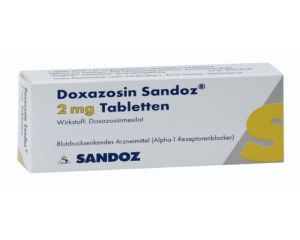
Doxazosin
View Options
This website provides general information about medicines for educational purposes only. Always consult your doctor or pharmacist before taking any medication.
Choose Your Medicine
Select dosage and quantity
Online Consultation
Reviewed by a qualified physician
Fast, Discreet Delivery
Delivered to your door
Medical Information
About This Medicine
Doxazosin is an alpha-1 adrenoceptor blocker (alpha-blocker) used to treat two distinct conditions: hypertension (high blood pressure) and benign prostatic hyperplasia (BPH), also known as an enlarged prostate. It is available as standard immediate-release tablets and as a modified-release (XL) formulation, the latter providing more consistent plasma drug levels throughout the day and a more favourable side effect profile, particularly with regard to postural hypotension.
How Doxazosin Works
Doxazosin selectively blocks alpha-1 adrenoceptors, receptors that are activated by adrenaline and noradrenaline on smooth muscle throughout the body. In blood vessels, activation of these receptors causes vasoconstriction (narrowing of blood vessels), which raises blood pressure. By blocking alpha-1 receptors in vascular smooth muscle, doxazosin allows blood vessels to relax and dilate, reducing peripheral vascular resistance and lowering blood pressure. This makes it useful as an antihypertensive agent.
In the prostate gland and the bladder neck, alpha-1 adrenoceptors mediate smooth muscle contraction that contributes to urinary outflow obstruction in men with BPH. By blocking these receptors, doxazosin relaxes the smooth muscle in the prostate and bladder neck, reducing the resistance to urinary flow and improving symptoms such as hesitancy, poor stream, incomplete bladder emptying, and nocturia. Symptomatic improvement in BPH can occur within one to two weeks of starting treatment.
Place in Therapy
For hypertension, doxazosin is generally not used as first-line treatment on its own, as evidence suggests that alpha-blockers do not reduce cardiovascular events as effectively as other drug classes such as ACE inhibitors, calcium channel blockers, or thiazide diuretics when used as monotherapy. However, it remains a useful addition to combination antihypertensive regimens, particularly in men who also have BPH, where a single medicine can address both conditions. For BPH, alpha-blockers are a cornerstone of pharmacological management, often used alongside 5-alpha reductase inhibitors in men with larger prostates.
Usage & Dosage
How to Take Doxazosin
Doxazosin standard-release tablets are taken once daily. For the first dose, taking it at bedtime is recommended to reduce the risk of a significant blood pressure drop (first-dose hypotension) and associated dizziness or fainting. After the first few doses, your body adjusts and this effect diminishes. For ongoing use, your doctor will advise the best time of day.
Doxazosin XL (modified-release) must be swallowed whole — do not chew, crush, or break it, as this releases the full dose at once and increases the risk of side effects. Take at the same time each day with a glass of liquid.
Treatment is started at a low dose (1 to 2 mg daily) and increased gradually over several weeks to the dose that adequately controls your blood pressure or urinary symptoms, typically up to 8 mg daily.
For hypertension, the starting dose is 1mg once daily for one to two weeks. The dose may be gradually increased to 2mg, 4mg, 8mg, and then 16mg once daily, based on response and tolerability. The maximum recommended daily dose for hypertension is 16mg.
For BPH, the starting dose is 1mg once daily for one to two weeks, followed by dose escalation to 2mg once daily. Further increases to 4mg and then 8mg once daily may be made at monthly intervals if needed. The maximum dose for BPH is 8mg once daily.
The doxazosin XL modified-release formulation is usually started at 4mg once daily; dose increases to 8mg once daily may be made after four weeks if symptoms are not adequately controlled. No specific dose adjustment is required for elderly patients or those with renal impairment. Patients with hepatic impairment should be treated cautiously. The XL tablet must be swallowed whole and not crushed, broken, or chewed.
Side Effects
Common Side Effects
- Dizziness and light-headedness, particularly on standing up quickly (postural hypotension)
- Headache
- Fatigue and weakness
- Swelling of the ankles or lower legs (peripheral oedema)
- Palpitations
- Nausea
- Runny nose (rhinitis)
- Drowsiness
Before Eye Surgery
Tell your surgeon or ophthalmologist that you are taking doxazosin before any eye surgery, particularly cataract surgery. Alpha-blockers can cause a condition called intraoperative floppy iris syndrome (IFIS), which the surgical team needs to know about in advance to manage safely. Do not stop doxazosin before surgery unless specifically instructed to do so by your prescriber.
Warnings & Precautions
Postural Hypotension and First-Dose Effect
One of the most clinically significant risks with doxazosin is postural hypotension -- a drop in blood pressure that occurs when moving from a sitting or lying position to standing. This effect is most pronounced with the first dose and with each dose increase. It can cause dizziness, lightheadedness, or fainting, particularly in elderly patients, those who are dehydrated, or those taking other blood pressure-lowering medicines. The first dose should be taken at bedtime to reduce this risk. Patients should be counselled to rise slowly from lying or sitting positions and to sit on the edge of the bed for a moment before standing.
The risk of postural hypotension is substantially increased when doxazosin is taken alongside phosphodiesterase-5 (PDE5) inhibitors used for erectile dysfunction, such as sildenafil (Viagra), tadalafil, or vardenafil. This combination should be avoided or used only with extreme caution and medical supervision.
Surgical Considerations and Special Populations
Patients taking doxazosin who are scheduled for cataract surgery must inform their ophthalmologist. Alpha-blockers can cause intraoperative floppy iris syndrome (IFIS), where the iris becomes floppy and prone to prolapse during surgery, significantly complicating the procedure. This risk persists even after doxazosin has been stopped, so disclosure is important regardless of when the drug was last taken. Patients with severe hepatic impairment should use doxazosin with caution. Doxazosin is not licensed for use in women for BPH; its use in women is limited to the management of hypertension.
Contraindications
- Hypersensitivity to doxazosin, other quinazolines, or any excipient
- Orthostatic hypotension -- history of significant postural hypotension
- Benign prostatic hyperplasia with concomitant upper urinary tract obstruction, chronic urinary tract infection, or bladder stones (if BPH indication)
- Breastfeeding
- History of gastrointestinal obstruction, stenosis, or severe bowel narrowing (for the XL formulation)
- Monotherapy for hypertension combined with heart failure due to mechanical obstruction (e.g., aortic stenosis)
- Scheduled cataract surgery (relative -- ophthalmologist must be informed if used)
- Concomitant use with PDE5 inhibitors (relative -- use with extreme caution)
Frequently Asked Questions
How quickly does doxazosin improve urinary symptoms from an enlarged prostate?
Can I take doxazosin with Viagra (sildenafil)?
Why does doxazosin cause dizziness when I stand up?
Does doxazosin affect sexual function?
Is it safe to stop taking doxazosin suddenly?
Dr. Ross Elledge
General Practitioner · General & Family Medicine
Verified Healthcare Professional
TopDoctors Profile