
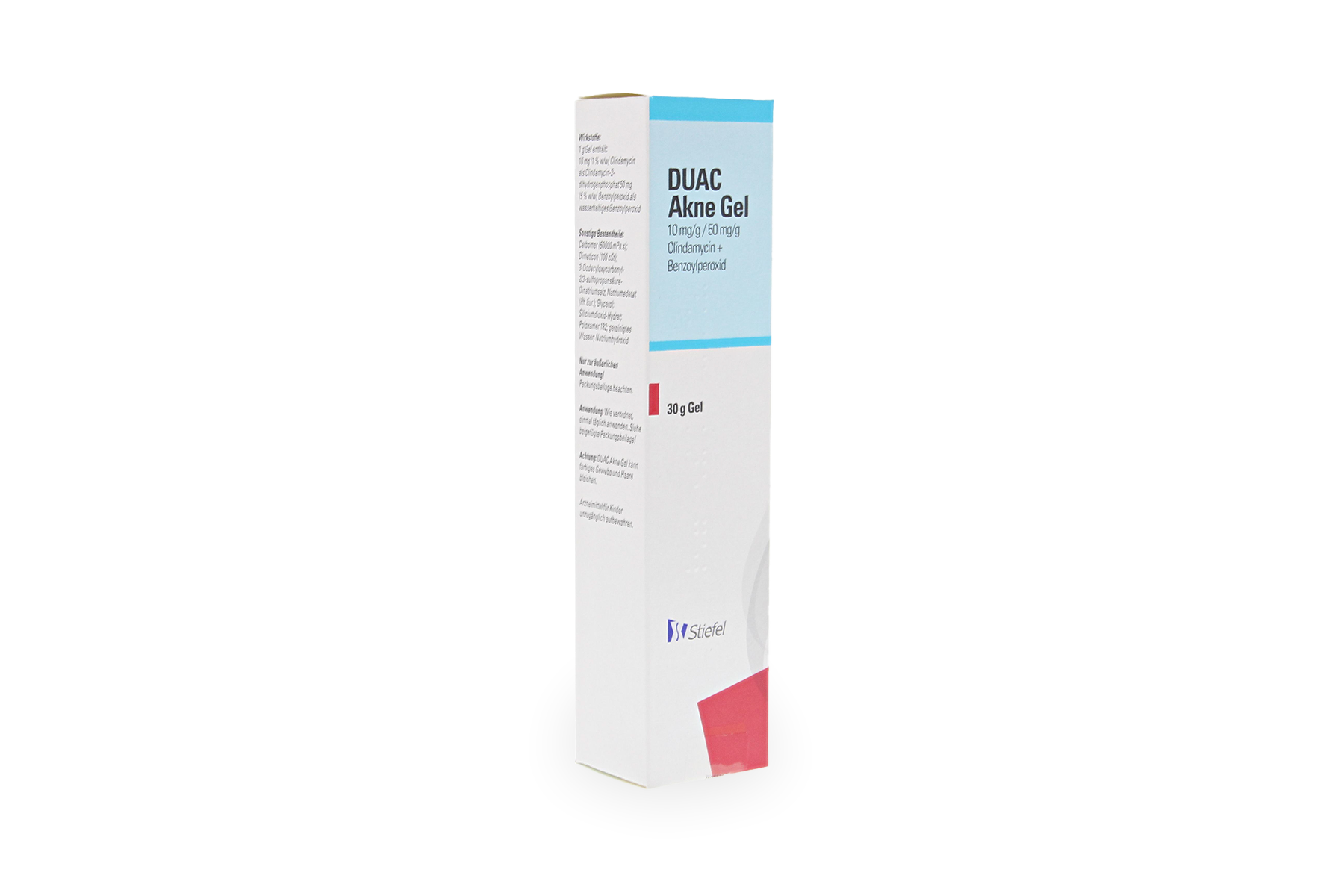
Duac
View Options
This website provides general information about medicines for educational purposes only. Always consult your doctor or pharmacist before taking any medication.
Choose Your Medicine
Select dosage and quantity
Online Consultation
Reviewed by a qualified physician
Fast, Discreet Delivery
Delivered to your door
Medical Information
About This Medicine
Duac is a topical gel used for the treatment of acne vulgaris, combining two active ingredients with complementary mechanisms of action: benzoyl peroxide 3% and clindamycin 1% (as clindamycin phosphate). This combination addresses two of the key underlying causes of acne, bacterial colonisation by Cutibacterium acnes (formerly Propionibacterium acnes) and the localised inflammation that leads to the characteristic spots, papules, and pustules of acne vulgaris.
How Duac Works
Clindamycin is a lincosamide antibiotic that inhibits bacterial protein synthesis by binding to the 50S ribosomal subunit of Cutibacterium acnes, the anaerobic bacterium that plays a central role in the development of inflammatory acne lesions. By reducing the bacterial load within the pilosebaceous unit (the hair follicle and associated sebaceous gland), clindamycin reduces the inflammatory stimulus that drives acne.
Benzoyl peroxide is a potent oxidising agent with bactericidal activity against C. acnes. Unlike antibiotics, benzoyl peroxide kills bacteria directly without inducing antibiotic resistance, an increasingly important consideration in acne management. The inclusion of benzoyl peroxide in Duac alongside clindamycin has the additional benefit of significantly reducing the risk of developing C. acnes strains that are resistant to clindamycin, which is a well-recognised problem with topical antibiotic monotherapy.
Clinical Use and Patient Profile
Duac is most effective for inflammatory acne, spots that are red, tender, or filled with pus (papules and pustules), rather than non-inflammatory comedonal acne (blackheads and whiteheads). It is prescribed for mild to moderate inflammatory acne in adults and adolescents from the age of 12. Duac is applied once daily in the evening to the entire affected area, not just to individual spots, as part of a comprehensive acne management plan that should also include appropriate skin cleansing and the use of non-comedogenic moisturisers.
Usage & Dosage
How to Apply Duac Gel
Apply Duac (clindamycin 1% / benzoyl peroxide 5%) gel once daily in the evening. Before applying, wash the affected skin with a gentle, non-abrasive cleanser and pat completely dry. Applying to damp skin increases the risk of irritation. Apply a thin layer across the entire affected area (typically the full face, rather than just individual spots), covering the forehead, cheeks, nose, and chin as needed.
Avoid contact with the eyes, mouth, and nostrils. Benzoyl peroxide can bleach hair and coloured fabrics on contact — be careful when applying near your hairline and when drying your face, and use white or light-coloured pillowcases.
Sun Exposure
Use a non-comedogenic (non-pore-blocking) sunscreen daily during treatment. Both benzoyl peroxide and clindamycin can increase sun sensitivity. Do not use Duac gel alongside other topical retinoids or benzoyl peroxide products, as this increases the risk of skin irritation without added benefit.
Duac gel is applied once daily in the evening to the affected skin. Treatment should be used for no longer than 12 weeks continuously due to the risk of inducing antibiotic resistance in C. acnes. After 12 weeks, the prescribing clinician will review the response and may continue with benzoyl peroxide alone, switch to a different formulation, or add a systemic antibiotic if needed.
The gel should be used sparingly -- a thin layer across the entire affected area is sufficient. Using more than the recommended amount does not improve efficacy and substantially increases the risk of skin irritation, dryness, and peeling. Duac is not recommended for children under 12 years. Dosage adjustment is not required for elderly patients, though acne is uncommon in this age group. If significant skin irritation occurs, treatment frequency may be reduced to alternate nights until the skin adapts. The gel should be stored in the refrigerator and used within 60 days of opening.
Side Effects
Common Side Effects
- Skin dryness and peeling (very common, especially in the first few weeks)
- Redness at the application site
- Skin irritation, burning, or stinging on application
- Itching
- Bleaching of hair and fabrics (from the benzoyl peroxide component)
Rare but Important Risk
Clostridioides difficile (C. diff) colitis has been reported in rare cases with topical clindamycin, as small amounts of the antibiotic are absorbed through the skin. This is much less likely than with oral clindamycin, but watch for persistent, watery diarrhoea and report it to your doctor if it develops. If skin irritation is severe or you develop a widespread rash or swelling, stop the gel and seek advice.
Warnings & Precautions
Antibiotic Resistance Considerations
One of the most important reasons for including benzoyl peroxide in Duac alongside clindamycin is to reduce the risk of developing resistant strains of C. acnes. Clindamycin resistance in acne bacteria has become increasingly prevalent globally, and the use of topical antibiotics alone (without benzoyl peroxide) for extended periods is a significant driver of this problem. Duac should not be used for more than 12 weeks continuously without clinical review, and it should not be used alongside other topical or systemic antibiotics unless specifically directed by a prescriber.
Duac should not be used in or near the eyes, mouth, or mucous membranes. Benzoyl peroxide can cause significant irritation and bleaching if it contacts these areas. Patients should be aware that the gel may stain or bleach clothing, bed linen, and towels, and should take appropriate precautions.
Skin Irritation and Dryness
The benzoyl peroxide component of Duac can cause significant skin dryness, peeling, and irritation, particularly in the first few weeks of use. Using a light, non-comedogenic, fragrance-free moisturiser daily can help to manage these side effects. Avoid other potentially irritating topical products such as alcohol-based toners, exfoliants, or other retinoids at the same time, as the combination can cause excessive irritation. If severe irritation occurs, reduce the frequency of application or take a short break from treatment and seek advice from your GP or dermatologist.
Contraindications
- Hypersensitivity to benzoyl peroxide, clindamycin, lincomycin, or any excipient
- History of pseudomembranous colitis or antibiotic-associated colitis
- History of regional enteritis or ulcerative colitis
- Application to the eyes, mouth, or mucous membranes
- Children under 12 years of age
- Concomitant use of other topical or systemic antibiotics targeting C. acnes (risk of resistance)
- Pregnancy and breastfeeding (use with caution -- limited data; discuss with prescriber)
Frequently Asked Questions
How long does Duac take to work for acne?
Why does Duac bleach my towels and pillowcases?
Can I use moisturiser or make-up over Duac gel?
Should I use Duac on individual spots or across my whole face?
What happens after I finish my 12-week course of Duac?
Dr. Ross Elledge
General Practitioner · General & Family Medicine
Verified Healthcare Professional
TopDoctors Profile