
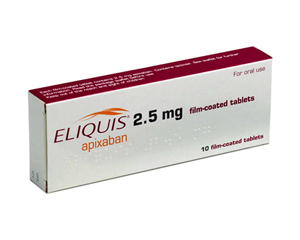
Eliquis
View Options
This website provides general information about medicines for educational purposes only. Always consult your doctor or pharmacist before taking any medication.
Choose Your Medicine
Select dosage and quantity
Online Consultation
Reviewed by a qualified physician
Fast, Discreet Delivery
Delivered to your door
Medical Information
About This Medicine
Eliquis contains apixaban, a direct oral anticoagulant (DOAC) that selectively inhibits Factor Xa, a key clotting factor in the coagulation cascade. By blocking Factor Xa, apixaban interrupts both the intrinsic and extrinsic pathways of coagulation, reducing the formation of thrombin and blood clots without requiring regular blood monitoring.
Licensed Indications
Eliquis is licensed in the UK for several indications: prevention of stroke and systemic embolism in adults with non-valvular atrial fibrillation (AF) who have one or more risk factors; treatment and prevention of recurrent deep vein thrombosis (DVT) and pulmonary embolism (PE); and prevention of VTE in adults following elective hip or knee replacement surgery.
Advantages Over Warfarin
Unlike warfarin, Eliquis does not require regular INR monitoring, has fewer food and drug interactions, and has a more predictable anticoagulant effect. It has been shown in major clinical trials (ARISTOTLE) to reduce stroke risk by 21%, major bleeding by 31%, and all-cause mortality by 11% compared to warfarin in AF patients.
Usage & Dosage
How to Take Eliquis
Swallow Eliquis tablets whole with water. They can be taken with or without food. Do not crush or split tablets. For atrial fibrillation, take 5 mg twice daily (or 2.5 mg twice daily if you meet two of the following criteria: age 80 or over, weight 60 kg or under, serum creatinine 133 micromol/L or above).
DVT/PE Treatment
For acute DVT or PE treatment, take 10 mg twice daily for the first seven days, then 5 mg twice daily. For extended prevention, the dose may be reduced to 2.5 mg twice daily. For surgical prophylaxis, take 2.5 mg twice daily starting 12–24 hours after surgery. Never stop apixaban without medical advice, as this significantly increases the risk of clotting events.
Eliquis is available in 2.5 mg and 5 mg film-coated tablets. Doses vary by indication: 5 mg twice daily for AF stroke prevention (or 2.5 mg twice daily if dose-reduction criteria apply), 10 mg twice daily for 7 days then 5 mg twice daily for DVT/PE treatment, and 2.5 mg twice daily for surgical VTE prophylaxis. A specific antidote (andexanet alfa / Ondexxya) is available for reversal in bleeding emergencies.
Side Effects
Common Side Effects
Bleeding is the most clinically important side effect of Eliquis and all anticoagulants. This includes bruising more easily than usual, prolonged bleeding from cuts, nosebleeds, and gum bleeding. These are usually minor and manageable. More serious bleeding events such as gastrointestinal bleeding (dark or bloody stools, vomiting blood) or urinary tract bleeding (blood in urine) require medical assessment.
Warning Signs Requiring Urgent Medical Attention
Seek emergency help immediately if you experience unexplained severe bleeding that does not stop, coughing or vomiting blood, sudden intense headache, neurological symptoms suggesting stroke, or signs of an adrenal bleed (severe persistent abdominal or back pain). Anaemia, thrombocytopenia, and liver enzyme elevations are occasionally reported on blood tests.
Warnings & Precautions
Never stop Eliquis abruptly without medical supervision, as this dramatically increases the risk of stroke in AF patients. If surgery or a procedure is planned, discuss timing of anticoagulation interruption with your surgeon and prescriber in advance. Eliquis is not recommended in patients with severe renal impairment (CrCl < 15 mL/min), severe hepatic impairment, or prosthetic heart valves. Avoid concurrent use of other anticoagulants or antiplatelet agents unless specifically directed. Strong inducers of CYP3A4/P-gp (rifampicin, phenytoin, carbamazepine) significantly reduce apixaban levels.
Contraindications
Contraindicated in patients with active clinically significant bleeding, hepatic disease associated with coagulopathy, prosthetic heart valves, antiphospholipid syndrome, or known hypersensitivity to apixaban. Also contraindicated in pregnancy and breastfeeding due to fetal risk.
Frequently Asked Questions
Do I need blood tests while taking Eliquis?
What should I do if I miss a dose of Eliquis?
Can I take ibuprofen or aspirin with Eliquis?
Dr. Ross Elledge
General Practitioner · General & Family Medicine
Verified Healthcare Professional
TopDoctors Profile