
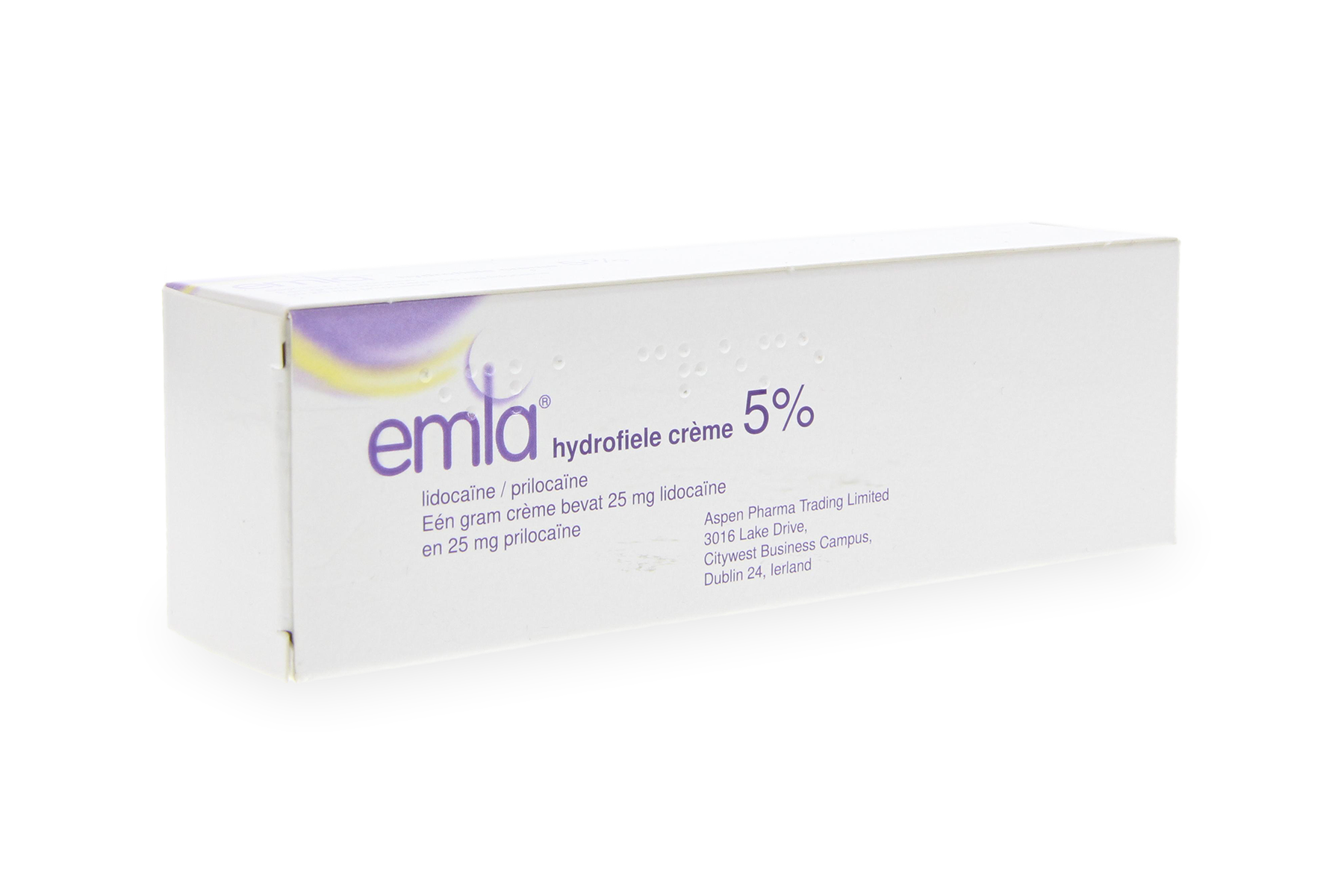
Emla Cream
View Options
This website provides general information about medicines for educational purposes only. Always consult your doctor or pharmacist before taking any medication.
Choose Your Medicine
Select dosage and quantity
Online Consultation
Reviewed by a qualified physician
Fast, Discreet Delivery
Delivered to your door
Medical Information
About This Medicine
EMLA Cream is a topical local anaesthetic preparation containing two active ingredients, lidocaine 2.5% and prilocaine 2.5%, that together form a eutectic mixture, meaning they combine to produce a mixture with a lower melting point than either component alone. This physical property allows the cream to remain in a liquid emulsion at room temperature, maximising contact with the skin surface and enhancing the depth and reliability of anaesthetic penetration into intact skin.
How EMLA Cream Works
When applied under an occlusive dressing, EMLA Cream releases lidocaine and prilocaine from the emulsion, allowing them to penetrate the skin barrier and accumulate in sufficient concentrations to block the sodium channels in sensory nerve fibres. This prevents the generation and propagation of nerve impulses, producing localised numbness of the skin and superficial subcutaneous tissues. The depth and reliability of anaesthesia depend on the application time: a minimum of 60 minutes is required for most purposes, with up to 90 minutes or longer providing deeper and more prolonged anaesthesia for more invasive procedures.
Clinical Applications
EMLA Cream has a wide range of applications in both adult and paediatric settings. It is most commonly used before venepuncture, intravenous cannulation, blood sampling, and minor skin procedures such as superficial lesion removal or curettage. It is also used before vaccination in children and in dermatological settings before split-skin grafting or wart treatment. Its ability to reliably anaesthetise intact skin makes it a valuable tool for reducing procedural pain and needle anxiety, particularly in paediatric practice.
Safety Profile
EMLA is well established as a safe and effective topical anaesthetic in both adults and children when used at recommended doses and application times. The prilocaine component carries a specific risk of methaemoglobinaemia, which is dose-dependent and most relevant in young infants and individuals with pre-existing methaemoglobinaemia or those taking certain oxidising drugs.
Usage & Dosage
EMLA Cream is applied topically to intact skin at the site where local anaesthesia is required. It must be applied well in advance of the procedure and covered with an occlusive dressing for the anaesthetic to work effectively.
Application Procedure
Apply a thick layer of EMLA Cream to the skin at the intended procedure site, typically 1 to 2 grams for a 10 cm squared area. Cover the cream completely with the occlusive adhesive film dressing provided (or a similar occlusive film). Mark the time of application. Leave in place for a minimum of 60 minutes for most minor procedures. For procedures requiring deeper anaesthesia, such as split-skin grafting, application for 90 to 120 minutes may be advised.
Just before the procedure, remove the dressing and cream, wipe the skin clean, and proceed. The skin will appear pale and blanched due to local vasoconstriction, which is expected and resolves spontaneously. Anaesthesia at the skin surface lasts for approximately one to two hours after removal.
Specific Uses
In children, EMLA Cream should be applied at home or by a nurse before vaccinations, blood tests, or cannulation. The total dose and number of application sites should be carefully limited based on the child's weight and age, as per the prescribing information. Avoid application to mucous membranes, broken skin, or the eyes.
The dose and application time for EMLA Cream depend on the patient's age, weight, and the nature of the procedure:
For adults undergoing minor procedures such as cannulation or venepuncture: apply 1.5 to 2 grams under occlusion for 60 minutes. For dermal procedures including superficial skin lesion removal: apply 2 grams per 10 cm squared under occlusion for 60 minutes, or up to 120 minutes for deeper procedures.
In children, the maximum recommended dose is strictly weight-dependent to minimise the risk of methaemoglobinaemia from prilocaine. Children aged 0 to 3 months: maximum 1 gram applied to no more than 10 cm squared for no more than 1 hour. Children aged 3 to 12 months: maximum 2 grams over up to 20 cm squared. Children aged 1 to 6 years: maximum 10 grams over up to 100 cm squared. Children aged 7 to 12 years: maximum 20 grams over up to 200 cm squared.
EMLA must not be applied to mucous membranes, broken skin, wounds, or near the eyes. The cream should not be left under occlusion for longer than the recommended time.
Side Effects
EMLA Cream is generally very well tolerated at recommended doses, and side effects are predominantly local and transient.
Common Side Effects
- Paleness (blanching) of the skin at the application site, due to local vasoconstriction, this is expected and resolves within 1 to 2 hours
- Localised redness (erythema) or oedema at the application site after the cream is removed, as vasodilation follows the initial vasoconstriction
- Mild burning or stinging during application
- Temporary loss of sensation that may last 1 to 2 hours after removal
These local effects are normal and do not indicate a problem.
Serious Side Effects
- Methaemoglobinaemia: the most significant risk, particularly in neonates, young infants, and patients taking oxidising drugs such as dapsone, nitrofurantoin, phenobarbital, or antimalarials. Methaemoglobinaemia causes cyanosis (blue-grey discolouration of skin and lips), pallor, headache, and, in severe cases, respiratory distress and reduced consciousness
- Systemic local anaesthetic toxicity: if absorbed in excessive quantities, lidocaine and prilocaine can cause neurological symptoms (dizziness, tinnitus, perioral numbness, seizures) and cardiovascular effects (hypotension, arrhythmia), this is very rare at recommended doses
- Allergic contact dermatitis or hypersensitivity reactions (rare)
- Corneal irritation if the cream inadvertently contacts the eye
Warnings & Precautions
EMLA Cream carries specific warnings that are particularly important in paediatric use and in patients with certain medical conditions.
Methaemoglobinaemia Risk
The prilocaine component of EMLA can cause methaemoglobinaemia, a condition in which haemoglobin is converted to a form unable to carry oxygen efficiently. This risk is particularly significant in neonates (less than one month old) and in infants under three months of age, in whom the relevant metabolic enzyme systems are immature, and foetal haemoglobin is more susceptible to oxidation. EMLA should not be used in premature infants or term neonates if at all possible. In infants, strict adherence to weight-based dosing limits is essential.
Patients with conditions such as glucose-6-phosphate dehydrogenase (G6PD) deficiency or congenital or idiopathic methaemoglobinaemia are at particularly high risk and should not use EMLA unless there are no suitable alternatives and facilities for managing methaemoglobinaemia are available. Concurrent use of oxidising drugs should prompt a careful risk-benefit assessment.
Ocular and Mucosal Exposure
EMLA must not be applied to the eyes or near the eye, as it can cause corneal irritation and damage. It should not be applied to open wounds, broken skin, or mucous membranes, as absorption is greatly enhanced in these situations. In the ear, EMLA should not be applied if there is any possibility of a perforated eardrum.
Contraindications
EMLA Cream must not be used in the following circumstances:
- Known hypersensitivity to lidocaine, prilocaine, other amide-type local anaesthetics, or any excipient
- Congenital or idiopathic methaemoglobinaemia
- Premature infants and neonates under 37 weeks gestational age
- Application to open wounds, broken skin, or mucous membranes
- Application near or in the eyes
- In the ear canal if there is a known or suspected perforated tympanic membrane
- Concurrent use of drugs known to cause methaemoglobinaemia in patients at high risk, unless no alternative exists
- Application to areas of skin with compromised circulation (unless under specialist guidance)
Frequently Asked Questions
How long before a blood test should I apply EMLA Cream?
Can EMLA Cream be used on children for vaccinations?
Why does the skin turn pale after using EMLA Cream?
Is EMLA Cream safe to use in babies?
What should I do if EMLA Cream gets into the eyes?
Dr. Ross Elledge
General Practitioner · General & Family Medicine
Verified Healthcare Professional
TopDoctors Profile