
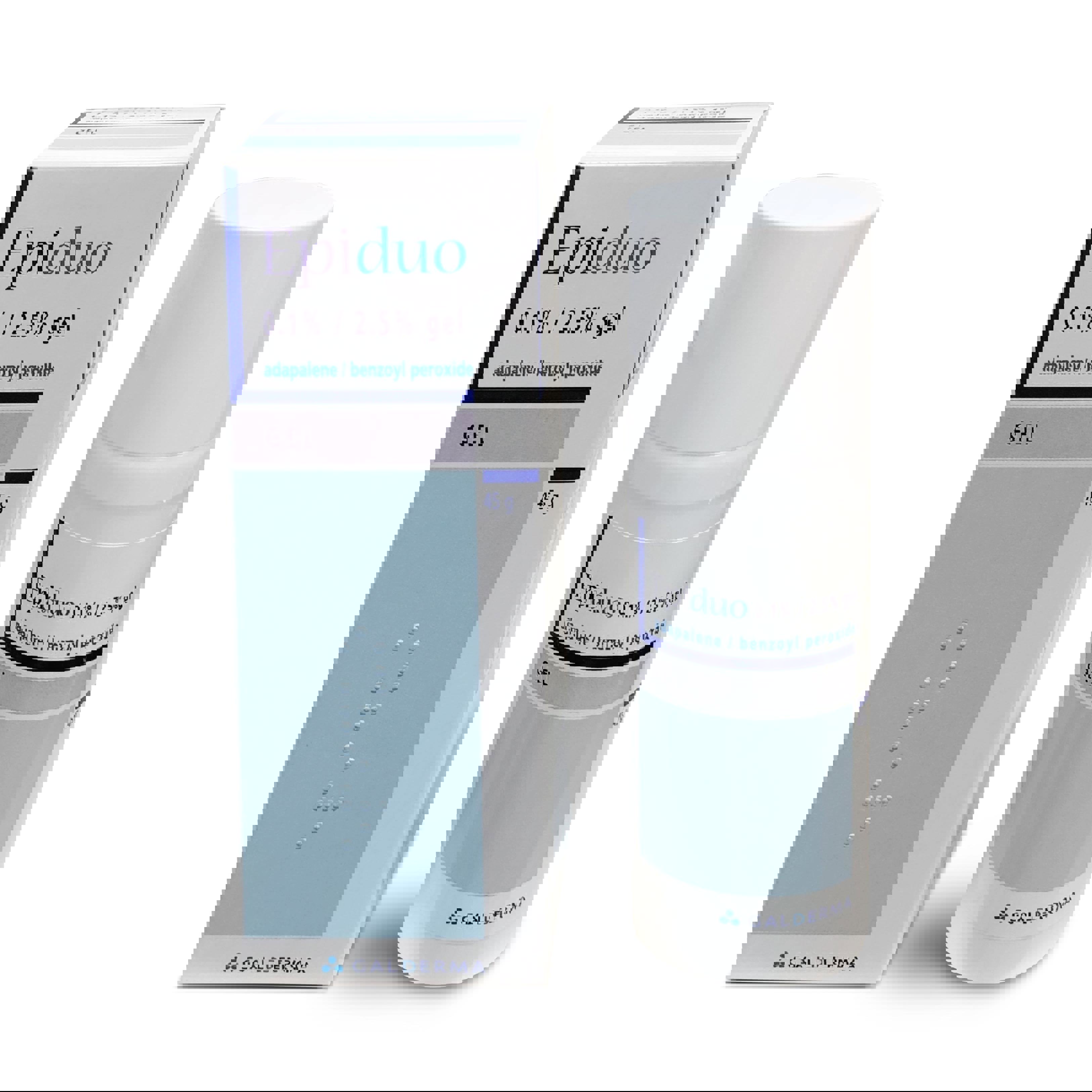
Epiduo
View Options
This website provides general information about medicines for educational purposes only. Always consult your doctor or pharmacist before taking any medication.
Choose Your Medicine
Select dosage and quantity
Online Consultation
Reviewed by a qualified physician
Fast, Discreet Delivery
Delivered to your door
Medical Information
About This Medicine
Epiduo Gel is a prescription-only topical treatment for acne vulgaris that combines two active ingredients with complementary mechanisms of action. Approved for use in adults and adolescents aged 9 years and above, it represents one of the most effective combination therapies available for moderate acne, addressing both the formation of blocked pores and the bacteria responsible for inflamed spots.
How Epiduo Gel Works
Adapalene is a third-generation retinoid that normalises the shedding of skin cells lining the hair follicle, preventing the build-up of dead cells that block pores and form comedones. It also has anti-inflammatory properties that help reduce the redness and swelling associated with pustules and papules. Benzoyl peroxide, the second active ingredient, acts as an antimicrobial agent that releases oxygen within the follicle, killing the acne-causing bacterium Cutibacterium acnes. Because it works by oxidative means rather than as an antibiotic, benzoyl peroxide does not contribute to bacterial resistance, an increasingly important consideration in acne management.
What to Expect During Treatment
Patients beginning Epiduo Gel should be prepared for an initial adjustment period during the first two to four weeks. During this time, skin may appear temporarily worse as existing microcomedones are brought to the surface, a process sometimes called "purging." Mild redness, dryness, and peeling are common and usually settle as the skin acclimatises. Consistent once-daily evening application is essential; skipping doses or stopping too early are the most common reasons treatment fails. Meaningful improvement is typically visible after eight to twelve weeks of continuous use, with optimal results often achieved after three to six months. Sun protection is essential throughout treatment, as adapalene increases photosensitivity.
Usage & Dosage
Epiduo Gel is applied once daily in the evening to clean, dry skin across all acne-affected areas of the face and, where relevant, the chest or back.
How to Apply
Wash your face with a gentle, non-comedogenic cleanser and pat dry thoroughly before applying Epiduo Gel. Allow the skin to dry completely for at least five minutes, as applying the gel to damp skin significantly increases the likelihood of irritation. Dispense a small pea-sized amount and spread a thin, even layer across the entire affected area rather than dabbing it only on individual spots. This approach treats existing lesions and prevents new ones from forming. Wash your hands immediately after application. Avoid the eyes, lips, nostrils, and any broken or sunburned skin.
Sun Protection and Skincare Routine
Because adapalene increases the skin's sensitivity to ultraviolet light, applying a broad-spectrum SPF 30 or higher sunscreen every morning is non-negotiable throughout treatment. A simple, fragrance-free moisturiser applied in the morning helps manage dryness and peeling without clogging pores. Avoid using other acne products containing retinoids, strong acids, or abrasive scrubs alongside Epiduo Gel unless directed by your prescriber, as combining active ingredients increases the risk of irritation. If significant dryness or peeling occurs, applying the gel every other evening for a week or two before returning to nightly use is a reasonable strategy.
The standard dose of Epiduo Gel is a single application each evening. No more than once daily should be applied, as more frequent use does not improve results and substantially increases irritation.
For adolescents aged 9 to 17 years, the same once-daily regimen applies. The gel should be used continuously for at least 12 weeks before its effectiveness can be properly assessed. Once acne is well controlled, your dermatologist or GP may advise reducing frequency or switching to a maintenance therapy.
If you miss an application, apply it the following evening and continue with your normal schedule. Do not double up on doses. The gel tube should be stored below 25 degrees Celsius and kept away from heat and open flames, as it contains flammable components. A standard 45g tube typically provides two to three months of treatment when used as directed on the face alone.
Side Effects
Common Side Effects
- Skin dryness and peeling, particularly in the first few weeks
- Redness and mild irritation at the application site
- Burning or stinging sensation after application
- Increased sensitivity to sunlight (photosensitivity)
- Temporary worsening of acne during the initial adjustment period
- Itching or discomfort at the application site
- Slight skin discolouration in people with darker skin tones
Serious Side Effects
- Severe allergic reaction (rash, swelling of the face, difficulty breathing), seek emergency care immediately
- Intense blistering or severe skin peeling beyond normal adjustment
- Eye irritation or chemical conjunctivitis if gel contacts the eyes
- Severe and persistent skin pain that does not settle after the first few weeks
Warnings & Precautions
Pregnancy and Breastfeeding
Epiduo Gel should not be used during pregnancy. Adapalene, as a retinoid, carries a theoretical teratogenic risk. Women of childbearing age should use effective contraception during treatment and discuss any planned pregnancy with their prescriber. Breastfeeding mothers should avoid applying the gel to the chest area to prevent infant exposure. If pregnancy is confirmed during treatment, stop use immediately and seek medical advice.
Skin Sensitivity and Sun Exposure
Adapalene markedly increases photosensitivity. Prolonged sun exposure, sunbeds, and UV lamp treatments should be avoided throughout the course of treatment. Always apply a broad-spectrum sunscreen in the morning and, where possible, cover treated areas with clothing. This precaution remains important even on overcast days, as UV radiation penetrates cloud cover. If you experience severe sunburn, suspend use until the skin has healed fully before restarting.
Avoid using Epiduo Gel on eczematous, broken, or inflamed skin, as well as near the mouth, eyes, and mucous membranes. Inform your prescriber if you are using any other topical products, particularly those containing retinoids, alpha hydroxy acids, or strong antibacterials, to avoid compounding irritation.
Contraindications
- Known hypersensitivity to adapalene, benzoyl peroxide, or any excipient in the formulation
- Pregnancy or women planning to conceive
- Application to eczematous, abraded, or sunburned skin
- Use on the lips, nostrils, eyes, or mucous membranes
- Concurrent use of other topical retinoids
- Known allergy to peanuts or soya (some formulations contain soybean extract)
- Active rosacea or perioral dermatitis (may worsen with retinoids)
Frequently Asked Questions
How long does it take for Epiduo Gel to clear acne?
Can I use Epiduo Gel on my back and chest as well as my face?
Is Epiduo Gel safe for teenagers to use?
Why does my skin look worse after starting Epiduo Gel?
Can I wear makeup while using Epiduo Gel?
Dr. Ross Elledge
General Practitioner · General & Family Medicine
Verified Healthcare Professional
TopDoctors Profile