
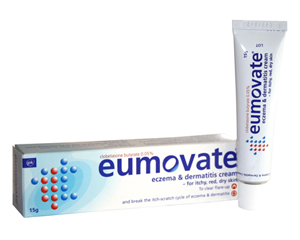
Eumovate
View Options
This website provides general information about medicines for educational purposes only. Always consult your doctor or pharmacist before taking any medication.
Choose Your Medicine
Select dosage and quantity
Online Consultation
Reviewed by a qualified physician
Fast, Discreet Delivery
Delivered to your door
Medical Information
About This Medicine
Eumovate is a moderately potent topical corticosteroid cream and ointment containing clobetasone butyrate 0.05%. It is used for the treatment of mild to moderate eczema (atopic dermatitis) and other inflammatory skin conditions where a moderate-strength steroid is appropriate. Eumovate is available both on prescription and over the counter in pharmacies for adults and children aged 12 years and over, making it one of the more accessible prescription-class topical steroids in the UK.
How Eumovate Works
Clobetasone butyrate exerts its anti-inflammatory effect by reducing the production of inflammatory mediators in skin cells, suppressing the immune response that drives the redness, itching, weeping, and thickening associated with eczema. It is classified as a Group 2 (moderately potent) corticosteroid under the UK classification system, placing it above hydrocortisone 1% (mild) but below betamethasone valerate 0.1% (potent) in terms of strength. This intermediate potency makes Eumovate a useful option when hydrocortisone has proven insufficient but a more potent steroid is not yet warranted.
Advantages Over Stronger Steroids
One of the notable features of clobetasone butyrate is its relatively low potential for systemic absorption and skin atrophy compared to potent and very potent steroids. This means it can be used on delicate areas of skin, including the face and flexures (such as the eyelids, groin, and armpits), for short periods under medical supervision, areas where stronger steroids are generally avoided. It is also considered suitable for short-term use in children aged 12 and above when prescribed by a clinician, and for adults who require a step-up from hydrocortisone without progressing to a full potency agent.
Usage & Dosage
Eumovate cream or ointment is applied thinly to the affected area of skin, typically two to three times daily during flares and then as directed by your prescriber.
Application Technique
Apply a thin layer of Eumovate to the affected skin and rub it in gently. The fingertip unit (FTU) method provides a practical guide to the correct amount: one FTU is the amount of cream squeezed from a standard tube along the length from the tip to the first crease of the index finger, and equates to roughly 0.5g, enough to cover an area twice the size of an adult hand. Using more cream than necessary does not improve the therapeutic effect but increases the risk of side effects.
Managing Flares and Step-Down Therapy
During an acute eczema flare, Eumovate is typically used two or three times daily until symptoms are controlled, then tapered to once daily or every other day as the skin improves. This step-down approach reduces the risk of skin thinning from prolonged use. Once the flare has resolved, maintaining the skin with regular emollients is the foundation of ongoing eczema management. Emollients should be applied liberally and frequently, at least twice daily and after bathing, even when the skin appears healthy. Apply the emollient first and allow it to absorb before applying Eumovate if both are used on the same day.
Eumovate is applied thinly two to three times daily to affected areas. The total weekly amount applied should generally not exceed 15-30g for adults in most areas.
When used on the face, treatment should generally not exceed five to seven days per episode without review. On the body or limbs, it may be used for slightly longer courses, but clinician review is recommended if improvement is not seen within two to four weeks.
For children aged 12 to 17 years on prescription, the same principles apply with conservative total quantities. Eumovate is not recommended for children under 12 years of age without specialist guidance. No dose adjustment is required for elderly patients, though skin fragility increases with age and conservative use is advisable. The cream formulation is generally better for weeping or exudative lesions; the ointment is preferred for dry, thickened, or lichenified skin.
Side Effects
Common Side Effects
- Mild skin irritation, stinging, or burning at the application site
- Skin dryness
- Folliculitis (infection of hair follicles with prolonged use)
- Perioral dermatitis with prolonged use on the face
- Mild skin thinning (atrophy) with extended use on sensitive areas
- Striae (stretch marks) with prolonged use in flexural areas
Serious Side Effects
- Significant skin atrophy with long-term or excessive use, leading to visible thinning, easy bruising, and telangiectasia
- Suppression of the body's cortisol production (adrenal suppression) if large areas are treated for extended periods
- Secondary skin infection (bacterial, fungal, or viral) masked by the steroid's anti-inflammatory effect
- Glaucoma or cataracts if applied around the eyes repeatedly over prolonged periods
Warnings & Precautions
Avoiding Skin Atrophy and Overuse
The most important principle with any topical steroid, including Eumovate, is to use the lowest effective amount for the shortest necessary time. Prolonged or excessive use causes the skin to thin, producing a fragile, papery appearance and increasing susceptibility to bruising, infection, and poor wound healing. Particular caution is needed on the face, eyelids, and skin folds, where absorption is higher and atrophy develops more readily. Do not bandage or wrap treated skin tightly, as occlusion significantly increases absorption and the risk of systemic side effects.
Infections and Skin Conditions
Eumovate should not be used on infected skin unless the infection is being treated simultaneously with an appropriate antimicrobial agent. Applying a corticosteroid to an unrecognised skin infection can mask the signs of infection while allowing it to spread. Common conditions that worsen with topical steroids include ringworm (tinea), impetigo, chickenpox, and acne rosacea. If skin worsens or fails to improve as expected, stop use and seek medical assessment to confirm the diagnosis before continuing.
Contraindications
- Rosacea, acne vulgaris, or perioral dermatitis
- Primary skin infections (bacterial, fungal, or viral) without concurrent antimicrobial treatment
- Perianal and genital itching without a confirmed inflammatory diagnosis
- Tuberculous or syphilitic skin lesions
- Known hypersensitivity to clobetasone butyrate or any excipient
- Children under 12 years of age (over-the-counter); requires specialist advice for younger children
- Unbroken or intact skin not affected by an inflammatory condition (not a moisturiser)
- Application to the eyes or mucous membranes
Frequently Asked Questions
Can I use Eumovate on my face for eczema?
How is Eumovate different from hydrocortisone cream?
Can children use Eumovate?
How do I know if my eczema is infected and should I stop using Eumovate?
Do I need to wean off Eumovate or can I stop suddenly?
Dr. Ross Elledge
General Practitioner · General & Family Medicine
Verified Healthcare Professional
TopDoctors Profile