
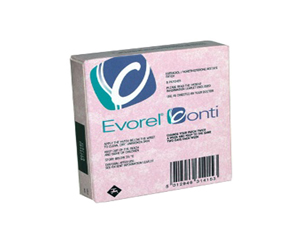
Evorel Conti
View Options
This website provides general information about medicines for educational purposes only. Always consult your doctor or pharmacist before taking any medication.
Choose Your Medicine
Select dosage and quantity
Online Consultation
Reviewed by a qualified physician
Fast, Discreet Delivery
Delivered to your door
Medical Information
About This Medicine
Evorel Conti is a continuous combined transdermal hormone replacement therapy (HRT) patch that delivers both estradiol and norethisterone acetate simultaneously through the skin. Manufactured by Theramex, it is designed for postmenopausal women who wish to use HRT without experiencing a monthly withdrawal bleed. The combination of an oestrogen and a progestogen in a single patch eliminates the need for a separate progestogen preparation and provides endometrial protection within the same convenient twice-weekly application.
Continuous Combined HRT and the Absence of Bleeding
In sequential combined HRT regimens, progestogen is taken for a set number of days each month, inducing a regular withdrawal bleed similar to a light period. Continuous combined HRT, as provided by Evorel Conti, delivers a low daily dose of progestogen alongside oestrogen without any hormone-free interval, which over time suppresses endometrial proliferation and avoids a monthly bleed. This approach is suitable only for women who are more than twelve months past their last natural period, in other words, who are clearly postmenopausal. Starting continuous combined HRT too early, when a woman is still in the perimenopause, frequently causes irregular and unpredictable bleeding.
Hormone Components and Delivery
Each Evorel Conti patch delivers 50 micrograms of estradiol and 170 micrograms of norethisterone acetate per 24 hours. The transdermal route offers the same advantages over oral HRT as other oestrogen patches: bypassing hepatic first-pass metabolism, avoiding the clotting factor stimulation associated with oral oestrogens, and providing stable, continuous hormone delivery without the daily peaks and troughs of tablets. This makes Evorel Conti a particularly suitable option for women in whom the VTE risk of oral HRT is a concern.
Usage & Dosage
Evorel Conti patches are applied to clean, dry, hairless skin on the lower trunk, the buttocks, lower abdomen, or upper thigh, and changed twice weekly on two consistent days.
Application and Site Rotation
Open the sachet and peel away one half of the protective backing. Apply the adhesive surface to a flat, undamaged area of skin, then remove the remaining backing and press the full patch firmly with the palm of your hand for at least 30 seconds, pressing the edges carefully. Rotate the application site with each patch change so that the same area is not used within seven days. Avoid the waistband area, which increases the risk of dislodgement, and do not apply to the breasts.
Managing Initial Irregular Bleeding
When starting Evorel Conti, it is common to experience some irregular spotting or light bleeding during the first three to six months as the endometrium adjusts to continuous combined stimulation. This usually settles and most women achieve amenorrhoea (no bleeding) within six months. If bleeding is heavy, prolonged, or begins after a period of amenorrhoea beyond six months, this must be investigated promptly with an endometrial assessment to exclude pathology.
Evorel Conti delivers a fixed dose of 50 micrograms estradiol and 170 micrograms norethisterone acetate per 24 hours via a single patch applied twice weekly. Unlike oestrogen-only patches, there is no dose titration; the fixed combination provides the required endometrial protection at the standard dose.
If symptoms are poorly controlled or if the patient requires a different oestrogen dose, switching to a separate oestrogen patch and separate progestogen preparation gives greater flexibility. Evorel Conti is not suitable for women who are perimenopausal or within 12 months of their last period, as irregular bleeding is very likely in this group.
Women who switch from sequential combined HRT to Evorel Conti should do so on the day following the completion of the progestogen phase of the sequential regimen. HRT should be reviewed annually and the continuing need for treatment assessed at each review.
Side Effects
Common Side Effects
- Irregular spotting or breakthrough bleeding, particularly in the first six months
- Skin irritation or redness at the patch site
- Breast tenderness
- Headache or migraine
- Fluid retention and ankle swelling
- Mood changes, including low mood or irritability
- Abdominal bloating or nausea
- Acne or oily skin (related to norethisterone's androgenic activity)
Serious Side Effects
- Venous thromboembolism (DVT or pulmonary embolism), report calf swelling, leg pain, or sudden breathlessness immediately
- Stroke or arterial thrombosis, seek emergency care for sudden severe headache, weakness, or speech disturbance
- Breast cancer: combined oestrogen-progestogen HRT is associated with a greater increase in breast cancer risk than oestrogen-only therapy
- Persistent or heavy vaginal bleeding after the initial settling-in period requires urgent endometrial investigation
Warnings & Precautions
Breast Cancer Risk with Combined HRT
The combination of oestrogen and progestogen in HRT is associated with a greater increase in breast cancer risk than oestrogen-only preparations. Data from the Women's Health Initiative and other studies suggest that continuous combined HRT increases the risk more than sequential regimens, particularly with longer duration of use. Women should be aware of this risk and attend regular breast screening in line with NHS guidance. Any new breast lump, skin change over the breast, nipple discharge, or breast pain should be reported to a GP and investigated promptly. The excess risk diminishes after stopping HRT, but returns to baseline only gradually.
Cardiovascular and Progestogen Considerations
Norethisterone acetate has some androgenic activity, which may slightly adversely affect lipid profiles compared to more neutral progestogens such as dydrogesterone or micronised progesterone. Women with significant cardiovascular risk factors or hyperlipidaemia may be better suited to an alternative progestogen. Blood pressure should be monitored before starting and regularly during Evorel Conti, as hypertension may develop or worsen. Any change in migraine frequency or the development of migraine with aura requires immediate medical review, as this increases stroke risk.
Contraindications
- Women who are still perimenopausal (within 12 months of last period) -- risk of irregular bleeding
- Known, suspected, or previous breast cancer
- Known or suspected oestrogen or progestogen-dependent malignancy
- Undiagnosed vaginal bleeding
- Untreated endometrial hyperplasia
- Active or previous confirmed VTE (DVT or pulmonary embolism)
- Recent arterial thromboembolic disease (MI, stroke, unstable angina)
- Active or recent liver disease with persistently abnormal liver function
- Known thrombophilia
- Pregnancy or breastfeeding
- Hypersensitivity to estradiol, norethisterone acetate, or any excipient
Frequently Asked Questions
Will I have periods on Evorel Conti?
How is Evorel Conti different from Evorel Sequi?
Can I use Evorel Conti if I still have my uterus?
Does Evorel Conti increase the risk of breast cancer?
What should I do if the Evorel Conti patch falls off?
Dr. Ross Elledge
General Practitioner · General & Family Medicine
Verified Healthcare Professional
TopDoctors Profile