
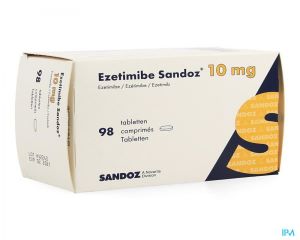
Ezetimibe
View Options
This website provides general information about medicines for educational purposes only. Always consult your doctor or pharmacist before taking any medication.
Choose Your Medicine
Select dosage and quantity
Online Consultation
Reviewed by a qualified physician
Fast, Discreet Delivery
Delivered to your door
Medical Information
About This Medicine
Ezetimibe is a lipid-lowering medicine used to reduce elevated levels of cholesterol in the blood. It belongs to a class of drugs known as cholesterol absorption inhibitors and works in a fundamentally different way from statins, making it a valuable option both for patients who cannot tolerate statins and as an add-on therapy for those whose cholesterol is not sufficiently controlled by a statin alone.
How Ezetimibe Works
Ezetimibe acts at the brush border of the small intestine, where it inhibits the Niemann-Pick C1-Like 1 (NPC1L1) protein — the transporter responsible for absorbing dietary and biliary cholesterol from the gut into the bloodstream. By blocking this transporter, ezetimibe reduces the amount of cholesterol delivered to the liver. In response, the liver upregulates its own LDL receptors, clearing more LDL cholesterol from the circulation. As a monotherapy, ezetimibe typically reduces LDL cholesterol by approximately 15 to 22%. When added to a statin, the combination produces significantly greater reductions than either agent alone.
Clinical Use and Evidence
Ezetimibe is used in the treatment of primary hypercholesterolaemia and homozygous familial hypercholesterolaemia. In the landmark IMPROVE-IT trial, the addition of ezetimibe to simvastatin in patients who had experienced an acute coronary syndrome reduced the risk of major cardiovascular events compared with simvastatin alone, providing strong evidence that ezetimibe-mediated LDL reduction translates into clinical cardiovascular benefit. It is commonly prescribed alongside a statin for patients at high or very high cardiovascular risk who have not reached their LDL target on statin monotherapy.
Formulation and Dosing
Ezetimibe is available as a 10 mg tablet taken once daily. It can be taken at any time of day, with or without food. The dose does not need to be adjusted for age, renal impairment, or mild hepatic impairment. Ezetimibe is also available in fixed-dose combinations with statins such as simvastatin (as Inegy) and atorvastatin (as Liptruzet), providing the convenience of a single tablet.
Usage & Dosage
How to Take Ezetimibe
Take ezetimibe 10 mg once daily, at any time of day, with or without food. Take it at the same time each day to build a consistent routine. Ezetimibe can be taken at the same time as a statin, or the two tablets can be taken at different times — they do not need to be co-administered.
Ezetimibe works by reducing the absorption of cholesterol in the small intestine. Used alongside a statin, it provides additional LDL cholesterol lowering that neither medicine achieves as well alone. Used as a single agent (monotherapy) for patients who cannot tolerate statins, it reduces LDL by around 15 to 22%.
Diet and Lifestyle
Drug therapy works best alongside a heart-healthy diet — limiting saturated fats, processed foods, and excessive alcohol. Do not stop ezetimibe without discussing it with your doctor, as the cholesterol benefit disappears quickly after stopping.
The standard dose of ezetimibe is 10 mg once daily for all adult patients, including the elderly. No dose adjustment is required based on age alone. The tablet may be taken at any time of day, with or without food, and should be swallowed whole.
No dose adjustment is necessary for patients with mild hepatic impairment (Child-Pugh score A). Ezetimibe is not recommended in patients with moderate or severe hepatic impairment (Child-Pugh score B or C), as ezetimibe exposure is markedly increased and the clinical consequences are unknown.
In patients with renal impairment, no dose adjustment is needed regardless of severity. Ezetimibe is not recommended in children under 6 years of age, and data in children aged 6 to 17 is limited to specific indications such as familial hypercholesterolaemia. Blood lipid levels should be measured before starting treatment and monitored at intervals to assess response. If using ezetimibe alongside a bile acid sequestrant, ezetimibe should be taken either two hours before or at least four hours after the sequestrant.
Side Effects
Common Side Effects
Ezetimibe is generally well tolerated. The most frequently reported effects include:
- Headache
- Abdominal pain or discomfort
- Diarrhoea
- Flatulence
- Fatigue
- Nasopharyngitis (cold-like symptoms)
Muscle Effects When Combined with a Statin
When ezetimibe is taken alongside a statin, both medicines can contribute to muscle-related effects. Tell your doctor if you develop unexplained muscle pain, weakness, or tenderness, as this may indicate a muscle condition that requires blood tests and dose adjustment. Liver function abnormalities have been reported rarely with ezetimibe, particularly when combined with a statin — your doctor may recommend periodic blood tests during long-term treatment.
Warnings & Precautions
Muscle-Related Risks with Statin Combination
When ezetimibe is used alongside a statin, the risk of muscle-related side effects, including myopathy and the rare but serious condition rhabdomyolysis, must be considered. Patients should be counselled to report any unexplained muscle pain, weakness, or cramps without delay. Creatine kinase should be measured if myopathy is clinically suspected. The risk is increased by factors such as renal impairment, hypothyroidism, and concomitant use of fibrates or certain other medicines.
Hepatic Function
Liver function tests are recommended when ezetimibe is co-administered with a statin, in line with the monitoring requirements for statin therapy. Ezetimibe itself has been associated with rare cases of liver enzyme elevation. If significant and persistent elevations occur, the cause should be investigated and treatment reviewed.
Fibrate Combination
The combination of ezetimibe with fibrates (such as fenofibrate or gemfibrozil) is not well studied and is not routinely recommended. If such a combination is considered necessary, patients should be closely monitored for evidence of cholelithiasis, as fibrates can increase cholesterol secretion into bile. Gemfibrozil in particular may increase ezetimibe exposure and the combination should be avoided where possible.
Contraindications
Ezetimibe must not be used in the following situations:
- Hypersensitivity to ezetimibe or any excipient in the tablet
- Moderate or severe hepatic impairment (Child-Pugh score B or C), particularly when used as part of combination therapy with a statin
- Active liver disease or unexplained persistent elevations in serum transaminases — when ezetimibe is prescribed together with a statin
- Pregnancy — when combined with a statin (statins are contraindicated in pregnancy); ezetimibe alone should be used with caution
- Breastfeeding — safety data are insufficient; it is not recommended
- Children under 6 years of age
Frequently Asked Questions
Can ezetimibe be taken at the same time as a statin?
How much does ezetimibe lower cholesterol?
Does ezetimibe have the same side effects as statins?
Can I take ezetimibe if I cannot tolerate statins?
Do I still need to follow a low-cholesterol diet while taking ezetimibe?
Dr. Ross Elledge
General Practitioner · General & Family Medicine
Verified Healthcare Professional
TopDoctors Profile