
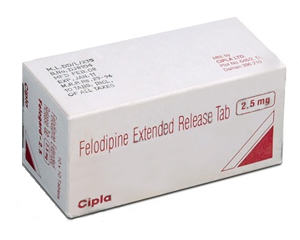
Felodipine
View Options
This website provides general information about medicines for educational purposes only. Always consult your doctor or pharmacist before taking any medication.
Choose Your Medicine
Select dosage and quantity
Online Consultation
Reviewed by a qualified physician
Fast, Discreet Delivery
Delivered to your door
Medical Information
About This Medicine
Felodipine is a dihydropyridine calcium channel blocker used in the long-term management of hypertension (high blood pressure) and stable angina pectoris. It is available as a modified-release tablet, designed to provide a steady, sustained level of the drug throughout the day with once-daily dosing, reducing fluctuations in blood pressure and minimising peak-related side effects.
Mechanism and Benefits
Felodipine works by blocking voltage-sensitive L-type calcium channels in the smooth muscle cells of peripheral arteries. By preventing calcium entry, it causes these blood vessels to relax and dilate, reducing the resistance against which the heart must pump. This lowers blood pressure without directly reducing heart rate or cardiac output to a significant degree, making it suitable for patients in whom rate-lowering drugs are not ideal. In angina, the reduction in peripheral vascular resistance decreases the oxygen demand of the heart muscle, helping to prevent chest pain during exertion.
Modified-Release Formulation
Because immediate-release calcium channel blockers can cause rapid swings in drug levels — producing pronounced flushing, headache, and reflex tachycardia — felodipine is formulated exclusively as a modified-release (MR) or extended-release tablet. This delivers the drug gradually over the course of the day, maintaining steadier plasma concentrations and a more consistent antihypertensive effect with a more favourable side effect profile.
Important Interaction with Grapefruit
A clinically significant interaction exists between felodipine and grapefruit juice. Grapefruit contains furanocoumarins that inhibit CYP3A4 enzymes in the gut wall, which are responsible for the first-pass metabolism of felodipine. Drinking grapefruit juice while taking felodipine can substantially increase plasma concentrations of the drug, potentially causing excessive blood pressure lowering, flushing, headache, and palpitations. Patients should avoid grapefruit and grapefruit juice throughout their treatment with felodipine.
Usage & Dosage
How to Take Felodipine
Felodipine extended-release tablets are taken once daily, with or without food. Swallow tablets whole — do not crush, chew, or break them, as this destroys the extended-release mechanism and causes the full dose to be released at once.
Avoid grapefruit and grapefruit juice completely throughout treatment. Grapefruit contains compounds that significantly increase felodipine blood levels by blocking its metabolism in the gut, which can cause an excessive drop in blood pressure and an increased heart rate.
The usual starting dose for high blood pressure is 5 mg once daily, which can be increased to 10 mg once daily if needed. For stable angina, similar doses are used. Take at the same time each day, and do not stop felodipine abruptly if you have angina — taper the dose under medical supervision.
Felodipine is available as 2.5 mg, 5 mg, and 10 mg modified-release tablets. The usual starting dose for hypertension is 5 mg once daily, although older patients or those with hepatic impairment may be initiated at 2.5 mg once daily. Based on clinical response, the dose may be titrated upward to 10 mg once daily if needed. Dose adjustments should not be made more frequently than every two to four weeks.
For stable angina, the typical dose range is again 5 to 10 mg once daily. In patients with symptomatic angina, the dose is adjusted based on response and tolerability, particularly the occurrence of ankle oedema or headache.
The tablet must be swallowed whole with a small amount of water — it must not be chewed, divided, or crushed. Felodipine can be taken at any time of day, with or without food, but grapefruit juice must be avoided at all times. No dose adjustment is needed in patients with renal impairment. Caution and dose reduction apply in hepatic impairment, as felodipine clearance is reduced. Felodipine is not recommended in children.
Side Effects
Common Side Effects
The most frequently reported side effects are related to the blood vessel-widening (vasodilatory) effect of felodipine:
- Ankle and lower leg swelling (peripheral oedema) — the most common complaint, especially at higher doses
- Flushing or warmth, particularly in the face and neck
- Headache
- Palpitations or a fast heartbeat
- Dizziness
Managing Ankle Swelling
Ankle swelling from felodipine is caused by fluid shifting into the lower legs due to vasodilation, not by heart or kidney problems. It may improve by reducing the dose or adding an ACE inhibitor to treatment. Elevating the legs when sitting helps manage swelling. If the swelling is significant or uncomfortable, discuss it with your doctor — switching to a different class of blood pressure medicine may be appropriate.
Warnings & Precautions
Grapefruit Interaction
Felodipine interacts significantly with grapefruit juice. Grapefruit contains compounds that inhibit intestinal CYP3A4, the enzyme primarily responsible for metabolising felodipine. Consuming grapefruit or grapefruit juice with felodipine can increase plasma drug concentrations by a factor of two or more, leading to excessive vasodilation, severe hypotension, tachycardia, and pronounced side effects. Patients must be clearly advised to avoid grapefruit juice entirely for the duration of their treatment, not merely on the day of dosing.
Hepatic Impairment
Felodipine is extensively metabolised by the liver, and clearance is significantly reduced in patients with hepatic impairment. This leads to higher plasma concentrations and an increased risk of side effects. Patients with impaired liver function should begin at the lowest available dose (2.5 mg once daily) and be closely monitored. Dose increases should be made with particular caution.
Modified-Release Tablet Integrity
The modified-release formulation is critical to the safe delivery of felodipine. Patients must be instructed not to chew, crush, or break the tablets. Disrupting the tablet releases the full dose rapidly, which can cause a sudden and dangerous drop in blood pressure. Elderly patients who have difficulty swallowing should be offered an alternative formulation or medicine if necessary.
Contraindications
Felodipine must not be used in patients who:
- Have a known hypersensitivity to felodipine, other dihydropyridine calcium channel blockers, or any excipient in the formulation
- Have decompensated heart failure or acute myocardial infarction within the preceding four weeks
- Have haemodynamically significant aortic stenosis
- Are in cardiogenic shock or have severe hypotension
- Have unstable angina (felodipine is indicated only for stable angina)
- Are pregnant or breastfeeding — calcium channel blockers are generally avoided in pregnancy and lactation
- Are under 18 years of age — safety and efficacy are not established in paediatric patients
Frequently Asked Questions
Why can't I eat grapefruit while taking felodipine?
Can I take felodipine if I have heart failure?
What should I do if I accidentally chew my felodipine tablet?
How long does it take for felodipine to lower my blood pressure?
Dr. Ross Elledge
General Practitioner · General & Family Medicine
Verified Healthcare Professional
TopDoctors Profile