
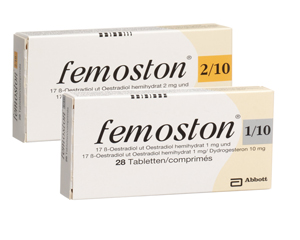
Femoston
View Options
This website provides general information about medicines for educational purposes only. Always consult your doctor or pharmacist before taking any medication.
Choose Your Medicine
Select dosage and quantity
Online Consultation
Reviewed by a qualified physician
Fast, Discreet Delivery
Delivered to your door
Medical Information
About This Medicine
Femoston is a sequential hormone replacement therapy (HRT) containing two hormones — estradiol and dydrogesterone — used to relieve symptoms of the menopause. It is designed for women who have not undergone a hysterectomy and who still have an intact uterus, as the progestogen component (dydrogesterone) is essential to protect the endometrium from the proliferative effects of oestrogen alone. Femoston is classified as a sequential HRT because the two hormones are taken in a phased pattern across a 28-day cycle rather than simultaneously throughout.
How Femoston Works
The oestrogen component, estradiol, is a bioidentical form of the naturally occurring human oestrogen 17-beta-oestradiol. It replaces the oestrogen that declines during and after the menopause, alleviating symptoms such as hot flushes, night sweats, vaginal dryness, sleep disturbances, and mood changes. During the first 14 days of each 28-day cycle, only the estradiol tablet is taken. In the second 14 days, a combined estradiol and dydrogesterone tablet is taken. This mimics a roughly physiological cycle and leads to a regular, predictable monthly withdrawal bleed when the cycle is completed.
Who Is Femoston For?
Femoston is indicated for perimenopausal women — those currently experiencing menopausal symptoms — or for women who have had their last natural menstrual period within the preceding 12 months. Sequential HRT is generally recommended for women closer to the menopause, as it provides a monthly withdrawal bleed which reassures patients and clinicians that the endometrium is being adequately protected and shed. It is available in two strengths: Femoston 1/10 (estradiol 1 mg / dydrogesterone 10 mg) and Femoston 2/10 (estradiol 2 mg / dydrogesterone 10 mg), with the higher strength reserved for women with more severe symptoms not adequately controlled on the lower dose.
Bioidentical Oestrogen
A notable feature of Femoston is the use of estradiol — a bioidentical oestrogen — rather than conjugated equine oestrogens or other synthetic forms. Many clinicians and patients prefer bioidentical oestrogens on the basis of their natural equivalence to human hormones, though it is important to note that all licensed HRT preparations have an established evidence base for safety and efficacy.
Usage & Dosage
Femoston is used to treat moderate to severe vasomotor symptoms of the menopause — including hot flushes, night sweats, and sleep disturbance — and other menopausal symptoms such as mood changes, vaginal dryness, and urinary discomfort. It may also help to prevent postmenopausal osteoporosis in women at risk, although dedicated osteoporosis treatments are generally preferred for that sole indication.
Sequential Dosing Regimen
Femoston is taken as a 28-day sequential cycle. Each pack contains two types of tablet: the white tablets (estradiol only, taken days 1 to 14) and the grey tablets (estradiol plus dydrogesterone, taken days 15 to 28). One tablet is taken daily without a break, and packs are started immediately after completing the previous one. A withdrawal bleed — similar to a period — typically occurs in the days following the last grey tablet of each cycle.
Duration of Treatment
The need for HRT should be reviewed at least annually in consultation with the prescriber. For symptom management, most guidelines recommend treating for as long as symptoms remain troublesome and benefits are deemed to outweigh risks. In women who are close to or within 12 months of their last menstrual period, Femoston is the appropriate sequential HRT choice. Women who are clearly postmenopausal (more than 12 months since last period) should consider switching to a continuous combined HRT such as Femoston-conti, to avoid unnecessary monthly bleeds.
Femoston is available in two strengths: Femoston 1/10 (estradiol 1 mg for the first 14 days; estradiol 1 mg + dydrogesterone 10 mg for the second 14 days) and Femoston 2/10 (estradiol 2 mg for the first 14 days; estradiol 2 mg + dydrogesterone 10 mg for the second 14 days).
Treatment is typically initiated with Femoston 1/10. If symptoms remain insufficiently controlled, the prescriber may increase to Femoston 2/10. One tablet is taken daily at the same time, following the sequence indicated on the blister pack, without any breaks between packs.
Femoston is taken orally, with or without food, and swallowed whole. It is not suitable for use in women who have had a hysterectomy (oestrogen-only HRT is more appropriate in this case). Dose reductions may be considered in older postmenopausal women or those at elevated risk for thrombosis, breast cancer, or stroke. The smallest effective dose should always be used for the shortest duration consistent with treatment goals, as reviewed annually by the prescriber.
Side Effects
Common Side Effects
The following side effects are commonly reported with Femoston and other forms of combined HRT:
- Breast tenderness or pain
- Nausea
- Headache or migraine
- Mood changes, including irritability or low mood in the progestogen phase
- Abdominal bloating and discomfort
- Vaginal discharge or bleeding outside the expected withdrawal bleed window
- Fluid retention and ankle swelling
- Acne or skin changes — less common with dydrogesterone than with older progestogens
Withdrawal bleeds with Femoston are usually predictable in timing and lighter than natural menstrual periods.
Serious Side Effects
All forms of combined HRT carry increased risks compared with no HRT:
- Venous thromboembolism — oral HRT is associated with increased VTE risk. Transdermal oestrogen may carry lower thrombotic risk than oral oestrogen
- Breast cancer — combined HRT (oestrogen plus progestogen) is associated with a small increase in breast cancer risk that increases with duration of use and declines after stopping
- Endometrial cancer — adequately protected by the progestogen in sequential HRT; irregular or heavy bleeding should be investigated
- Stroke — a slightly increased risk with oral HRT; transdermal routes are generally considered lower risk
- Cholelithiasis (gallstones) — oestrogen increases biliary cholesterol saturation
Warnings & Precautions
Cardiovascular and Thrombotic Risk
Oral oestrogen HRT, including Femoston, increases the risk of venous thromboembolism. Women with personal or family history of VTE, or with known thrombophilia, should be counselled carefully and may be better suited to transdermal oestrogen, which does not appear to carry the same elevation in VTE risk. Femoston should be discontinued four to six weeks before elective surgery involving prolonged immobilisation. Women with uncontrolled hypertension or a history of arterial disease should have cardiovascular risk carefully assessed before initiating HRT.
Endometrial and Breast Safety
The sequential progestogen in Femoston is prescribed to protect the endometrium. Any unexpected or prolonged bleeding — including bleeding during the oestrogen-only phase or unusually heavy withdrawal bleeds — should be investigated to exclude endometrial pathology. Women should be reminded of the importance of breast awareness, regular mammography screening where offered, and attending smear appointments. The small increase in breast cancer risk with combined HRT is well documented, and the benefit-risk balance should be reassessed annually.
Timing of Use
Femoston is intended for perimenopausal women or those within 12 months of their last period. Women clearly postmenopausal (more than 12 months since their last period) who are taking sequential HRT unnecessarily experience monthly bleeds that are not physiologically meaningful. In such women, switching to a continuous combined preparation (such as Femoston-conti) should be discussed to avoid unnecessary cyclical bleeding.
Contraindications
Femoston must not be used in women who have:
- Confirmed or suspected pregnancy
- Current, past, or suspected breast cancer
- Known or suspected oestrogen-dependent malignancy (e.g., endometrial cancer)
- Undiagnosed vaginal bleeding
- Untreated endometrial hyperplasia
- Active or recent venous thromboembolism (DVT or PE)
- Active or recent arterial thromboembolic disease (angina, stroke, myocardial infarction)
- Acute liver disease or a history of liver disease where liver function tests have not returned to normal
- Known thrombophilic disorders (e.g., protein C, S, or antithrombin deficiency, antiphospholipid antibodies)
- Porphyria
Frequently Asked Questions
Will I get a period every month on Femoston?
How is Femoston different from Femoston-conti?
How long can I take Femoston for?
Can Femoston help prevent osteoporosis?
Dr. Ross Elledge
General Practitioner · General & Family Medicine
Verified Healthcare Professional
TopDoctors Profile