
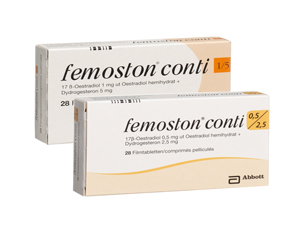
Femoston Conti
View Options
This website provides general information about medicines for educational purposes only. Always consult your doctor or pharmacist before taking any medication.
Choose Your Medicine
Select dosage and quantity
Online Consultation
Reviewed by a qualified physician
Fast, Discreet Delivery
Delivered to your door
Medical Information
About This Medicine
Femoston-conti is a continuous combined hormone replacement therapy (HRT) containing estradiol 1 mg and dydrogesterone 5 mg taken every day without a break. It is designed for postmenopausal women — those who have not had a natural menstrual period for at least 12 months — who wish to manage menopausal symptoms without experiencing a monthly withdrawal bleed. As a no-bleed HRT, Femoston-conti is one of the most commonly prescribed continuous combined HRT preparations in the UK.
How Femoston-conti Works
Femoston-conti provides both oestrogen and progestogen simultaneously, every day. The oestrogen component (estradiol) replaces declining ovarian oestrogen production and alleviates the vasomotor and other symptoms of the menopause. The progestogen component (dydrogesterone) protects the endometrium (womb lining) from the stimulating effects of oestrogen, which, if left unopposed, would cause endometrial hyperplasia and increase the risk of endometrial cancer. In continuous combined HRT, taking progestogen every day — rather than cyclically — maintains the endometrium in an atrophic state, preventing monthly withdrawal bleeds in most women.
The Transition from Sequential to Continuous HRT
Women using sequential HRT (such as Femoston) who are now clearly postmenopausal are typically advised to transition to a continuous combined preparation. Making this switch earlier — before the menopause is firmly established — can lead to irregular, unscheduled bleeding as the endometrium responds unpredictably to continuous progestogen exposure. This is why Femoston-conti is recommended specifically for women who are at least 12 months past their last natural period.
Initial Irregular Spotting
When first starting Femoston-conti, irregular spotting or light bleeding is common during the first three to six months of treatment. This is a normal part of the endometrium transitioning to an atrophic state and does not indicate a problem. Persistent or heavy bleeding after six months, or any bleeding after a prolonged bleed-free period, should be investigated.
Usage & Dosage
How to Take Femoston-conti
Take one Femoston-conti tablet once daily at the same time each day, without breaks. Swallow with water. Femoston-conti is a continuous combined HRT (no monthly progestogen-free phase), meaning both oestrogen (estradiol) and progestogen (dydrogesterone) are taken every day. It is suitable for women who are at least 12 months past their last natural period, as using it earlier can cause unpredictable bleeding.
What to Expect
In the first three to six months, unscheduled spotting or light bleeding is common as the uterine lining adjusts to continuous hormonal exposure — this is expected and usually settles. Persistent or heavy bleeding, or any bleeding after the first six months, should be reported to your doctor for assessment. After six months of treatment, most women taking Femoston-conti have no bleeding.
Femoston-conti contains estradiol 1 mg and dydrogesterone 5 mg in each tablet. The dose is fixed — one tablet once daily, every day, without a break. Unlike sequential HRT preparations, there is no alternating tablet type; every tablet in the pack contains both hormones.
The tablet should be swallowed whole with water and can be taken with or without food. It should be taken at approximately the same time each day. If a dose is missed and fewer than 12 hours have passed, the forgotten tablet should be taken immediately. If more than 12 hours have elapsed, the dose should be skipped and the next tablet taken at the usual time. Missing tablets increases the likelihood of unscheduled spotting.
Femoston-conti should only be used in women who are at least 12 months past their last menstrual period. Starting continuous combined HRT too early — in the peri- rather than post-menopausal phase — significantly increases the risk of unscheduled bleeding. In women who are very symptomatic and clearly postmenopausal, Femoston-conti is typically well tolerated and effective. The lowest effective dose should be used for the shortest duration consistent with treatment objectives, with annual benefit-risk review.
Side Effects
Common Side Effects
- Unscheduled spotting or bleeding, particularly in the first three to six months (expected and usually diminishes)
- Breast tenderness or enlargement
- Headache
- Nausea or abdominal discomfort
- Bloating or fluid retention
- Mood changes
Long-term Risks
Combined HRT (oestrogen plus progestogen) is associated with a small increased risk of breast cancer with prolonged use, and a small increased risk of blood clots (venous thromboembolism) and stroke. The absolute risk for any individual woman is low and depends on age, health, and duration of use. Your doctor will review your HRT at least annually. Report new breast lumps, persistent leg pain or swelling, chest pain, or sudden severe headache promptly.
Warnings & Precautions
Postmenopausal Timing Requirement
Femoston-conti is specifically designed for postmenopausal women — those who are at least 12 months past their last natural menstrual period. Prescribing Femoston-conti to women who are perimenopausal or who have been amenorrhoeic for fewer than 12 months significantly increases the risk of unpredictable and heavy unscheduled bleeding. Sequential HRT (such as Femoston) is more appropriate for women in the peri- or early postmenopausal phase.
Unscheduled Bleeding
Some unscheduled bleeding or spotting is expected and normal in the first three to six months of Femoston-conti. This occurs as the endometrium transitions to an atrophic state under continuous progestogen exposure. However, any bleeding that occurs after six months of continuous combined HRT, or any return of bleeding after a prolonged bleed-free interval, must be investigated to exclude endometrial hyperplasia or malignancy. The prescriber should arrange appropriate investigation (usually a pelvic ultrasound and/or endometrial biopsy) without delay.
Breast Cancer and Monitoring
All women taking Femoston-conti should be reminded of the importance of breast self-examination, and of attending NHS Breast Screening Programme appointments when invited. Combined HRT use is associated with a small but real increase in breast cancer incidence that increases with duration of use. Women with a personal history of breast cancer should not use Femoston-conti, and those with a significant family history should discuss this with their prescriber.
Contraindications
Femoston-conti must not be used in women who have:
- Confirmed or suspected pregnancy
- Current, past, or suspected breast cancer
- Oestrogen-dependent malignancies (including endometrial cancer)
- Undiagnosed or abnormal vaginal bleeding
- Untreated endometrial hyperplasia
- Active or recent venous thromboembolism (DVT or PE)
- Active or recent arterial thromboembolic events (stroke, angina, myocardial infarction)
- Acute hepatic disease or a history of liver disease with persistently abnormal liver function tests
- Known thrombophilic conditions (e.g., protein C or S deficiency, antithrombin deficiency, antiphospholipid syndrome)
- Porphyria
- Are in the perimenopause or fewer than 12 months past their last menstrual period
Frequently Asked Questions
Why is Femoston-conti only suitable for postmenopausal women?
Is it normal to bleed when first starting Femoston-conti?
Does Femoston-conti protect against osteoporosis?
How is Femoston-conti different from transdermal HRT patches or gels?
Can I take Femoston-conti if I smoke?
Dr. Ross Elledge
General Practitioner · General & Family Medicine
Verified Healthcare Professional
TopDoctors Profile