
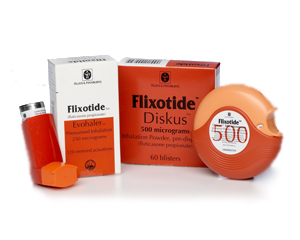
Flixotide
View Options
This website provides general information about medicines for educational purposes only. Always consult your doctor or pharmacist before taking any medication.
Choose Your Medicine
Select dosage and quantity
Online Consultation
Reviewed by a qualified physician
Fast, Discreet Delivery
Delivered to your door
Medical Information
About This Medicine
Flixotide is an inhaled corticosteroid (ICS) preventer treatment for asthma, available in two inhaler devices: the Flixotide Evohaler (a pressurised metered-dose inhaler, pMDI) and the Flixotide Accuhaler (a dry powder inhaler). Both devices deliver fluticasone propionate directly to the airways, where it acts locally to reduce inflammation and prevent the symptoms of asthma. Flixotide is available in a range of strengths to suit different levels of asthma severity, from 50 micrograms per actuation up to 500 micrograms per actuation, and it is prescribed for adults, adolescents, and children.
How Flixotide Prevents Asthma Symptoms
Asthma is a chronic inflammatory condition of the airways characterised by variable airflow obstruction, bronchial hyperresponsiveness, and airway remodelling. Fluticasone propionate, the active ingredient in Flixotide, suppresses the inflammatory processes that underlie these changes by binding to glucocorticoid receptors in airway epithelial and smooth muscle cells, reducing the production of inflammatory cytokines, inhibiting mast cell activation, and diminishing eosinophilic infiltration of the bronchial mucosa. With regular use, this leads to a reduction in airway hyperresponsiveness, fewer asthma exacerbations, improved lung function, and better control of day-to-day symptoms.
Preventer Versus Reliever Treatment
It is essential that patients understand the distinction between preventer and reliever inhalers. Flixotide is a preventer: it must be taken regularly every day, even when symptoms are absent, in order to maintain the anti-inflammatory effect that reduces the risk of asthma attacks. It does not provide rapid bronchodilation and should never be used to treat an acute asthma attack or sudden breathlessness. For acute symptom relief, a short-acting beta-agonist (SABA) reliever inhaler such as salbutamol should always be available.
Regular daily use of Flixotide as prescribed, combined with appropriate use of a reliever when needed and regular review of asthma control, is the foundation of effective asthma management in patients requiring ICS therapy.
Usage & Dosage
Using Your Flixotide Inhaler
The Flixotide Evohaler is a standard pressurised metered-dose inhaler that should ideally be used with a spacer device to maximise drug delivery to the lungs and reduce oropharyngeal deposition. Shake the inhaler well before each use, exhale fully, place the mouthpiece in your mouth forming a tight seal with your lips, press the canister down while breathing in slowly and deeply, then hold your breath for ten seconds before exhaling slowly. For children under eight years old and anyone who struggles with coordination, a spacer is strongly recommended.
The Flixotide Accuhaler is a breath-actuated dry powder device. Slide the lever to open the device and load a dose, exhale away from the mouthpiece, then breathe in through the mouthpiece quickly and deeply. Hold your breath for five to ten seconds after each inhalation.
Mouth Rinsing After Use
Rinse your mouth with water and spit after every dose of Flixotide. This is an important step that significantly reduces the risk of oral candidiasis (thrush) and hoarseness, which can result from deposition of fluticasone propionate in the oropharynx. Do not swallow the rinse water. Children should also rinse and spit after each use.
Flixotide dosing is highly individualised based on asthma severity, current level of control, and the patient's age.
Adults and adolescents (16 years and over): 100-1000 micrograms per day, divided into two doses (given morning and evening). Typical starting doses for mild asthma are 100-250 micrograms twice daily; moderate asthma may require 250-500 micrograms twice daily; severe or difficult-to-control asthma may require up to 500 micrograms twice daily.
Children aged 4-16 years: 50-200 micrograms twice daily, based on severity and response.
The lowest effective dose should always be used to maintain asthma control. Dose reductions should be made gradually, typically no more frequently than every three months, only after a period of sustained good control. The dose should never be reduced abruptly, and patients who have been on long-term high-dose ICS may require a supervised weaning plan if stepping down.
Side Effects
Common Side Effects
Local side effects in the mouth and throat are the most common adverse effects of inhaled fluticasone propionate. These include:
- Oral candidiasis (thrush in the mouth and throat), presenting as white patches or soreness
- Hoarseness of voice (dysphonia)
- Throat irritation or coughing after inhalation
- Dry mouth
Rinsing the mouth with water and spitting immediately after every dose reduces the incidence of oral thrush and hoarseness significantly.
Serious Side Effects
At high inhaled doses, particularly in patients also using oral corticosteroids or nasal corticosteroids, systemic effects may occur:
- Adrenal suppression, which can lead to reduced ability to mount a stress response; patients on high-dose ICS should carry a steroid warning card
- Growth retardation in children with prolonged high-dose use
- Bone mineral density reduction with long-term high-dose use, increasing fracture risk
- Paradoxical bronchospasm (rare; if wheezing worsens immediately after using the inhaler, stop and use your reliever inhaler)
- Raised intraocular pressure or cataracts with high-dose long-term use
Report any worsening of breathing or acute breathlessness immediately; do not use Flixotide alone to treat acute symptoms.
Warnings & Precautions
Flixotide Is Not a Reliever Inhaler
The most critical warning for Flixotide users is that it must never be used to treat an acute asthma attack. Flixotide will not provide rapid bronchodilation and using it in place of a reliever inhaler during an attack could be life-threatening. Patients must always have their short-acting reliever inhaler (such as salbutamol) available and know when to use it. If you require your reliever inhaler more than twice a week, or if your asthma symptoms are waking you at night, contact your GP or asthma nurse for a review.
Adrenal Suppression and Steroid Cards
Patients taking high doses of Flixotide, or who are using multiple corticosteroid preparations (inhaled, intranasal, and topical), should be aware of the risk of adrenal suppression. This is particularly relevant in situations of physical stress such as surgery, infection, or trauma. Patients on high-dose ICS should carry a steroid alert card and inform any healthcare professional treating them that they are using a corticosteroid inhaler. Do not stop Flixotide abruptly without medical guidance, particularly if you have been using it at high doses for a prolonged period.
Contraindications
Flixotide is contraindicated in the following circumstances:
- Known hypersensitivity to fluticasone propionate or any inhaler excipient (including lactose, which is present in the Accuhaler - this is relevant for patients with severe milk protein allergy)
- Treatment of acute asthma attacks or acute bronchospasm (Flixotide is a preventer only)
- Children under four years of age (Accuhaler); under sixteen for certain doses
- Patients with active pulmonary tuberculosis without appropriate antimycobacterial therapy
- Untreated respiratory fungal or viral infections
- Use as a sole treatment for acute severe asthma without a short-acting bronchodilator available
Frequently Asked Questions
What is the difference between Flixotide and a blue reliever inhaler?
Why do I need to rinse my mouth after using Flixotide?
Can I reduce my dose of Flixotide if my asthma is well controlled?
Is Flixotide safe to use during pregnancy?
How do I know if my Flixotide inhaler is working?
Dr. Ross Elledge
General Practitioner · General & Family Medicine
Verified Healthcare Professional
TopDoctors Profile