
Flutiform
View Options
This website provides general information about medicines for educational purposes only. Always consult your doctor or pharmacist before taking any medication.
Choose Your Medicine
Select dosage and quantity
Online Consultation
Reviewed by a qualified physician
Fast, Discreet Delivery
Delivered to your door
Medical Information
About This Medicine
Flutiform is a combined inhaled corticosteroid (ICS) and long-acting beta-2 agonist (LABA) pressurised metered-dose inhaler (pMDI) for the maintenance treatment of asthma in adults and adolescents aged twelve years and over who are not adequately controlled on an ICS alone, or who have already established that they require both an ICS and a LABA. The two active ingredients - fluticasone propionate and formoterol fumarate - work together in a complementary and synergistic manner to provide both anti-inflammatory protection and sustained bronchodilation throughout the day.
How the Two Ingredients Work Together
Fluticasone propionate is a potent inhaled corticosteroid that reduces airway inflammation, decreases bronchial hyperresponsiveness, and prevents the structural changes in the airway wall (remodelling) that contribute to the long-term progression of asthma. Formoterol fumarate is a long-acting beta-2 agonist that produces sustained relaxation of airway smooth muscle, reducing bronchoconstriction and maintaining airway patency for at least twelve hours after each dose. The combination of these two classes produces greater improvements in lung function, asthma control, and exacerbation prevention than can be achieved with either component alone at equivalent doses.
Available Strengths and Prescribing
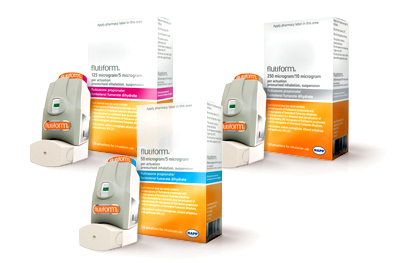
Flutiform is available in three strengths: 50/5 micrograms (fluticasone 50mcg / formoterol 5mcg), 125/5 micrograms, and 250/10 micrograms per actuation. The appropriate strength is selected by the prescribing clinician based on the patient's current level of asthma control and previous treatment history. As with all ICS/LABA combinations, Flutiform is prescribed as a regular preventer treatment and must not be used as a reliever inhaler for acute symptoms. Patients should always have a separate short-acting reliever inhaler available.
Usage & Dosage
How to Use Flutiform
Flutiform is a pressurised metered-dose inhaler containing fluticasone propionate (a corticosteroid preventer) and formoterol fumarate (a long-acting bronchodilator). Using a spacer device where possible maximises delivery to the lungs and reduces oropharyngeal deposition.
Before first use, or if unused for five or more days, prime the inhaler by releasing two test actuations into the air, away from your face. Shake well before each use. Breathe out fully, place the mouthpiece between your lips forming a tight seal, press the canister while breathing in slowly and steadily, then hold your breath for up to 10 seconds before breathing out.
Rinse your mouth with water and spit out after every use to prevent oral thrush from the steroid component.
Preventer Not Reliever
Flutiform is a preventer inhaler and must be used every day, even when you have no symptoms. It is not a rescue inhaler — always keep a short-acting reliever (such as salbutamol) separately for acute symptoms.
Flutiform is administered as two puffs twice daily (morning and evening) via the metered-dose inhaler. The prescribed strength is chosen based on asthma severity and previous ICS dose:
- Flutiform 50/5 micrograms: 2 puffs twice daily for patients requiring low-dose ICS (equivalent to up to 100mcg fluticasone propionate twice daily)
- Flutiform 125/5 micrograms: 2 puffs twice daily for patients requiring medium-dose ICS
- Flutiform 250/10 micrograms: 2 puffs twice daily for patients requiring high-dose ICS
The maximum daily dose is 4 puffs of the 250/10 formulation (1000mcg fluticasone / 40mcg formoterol). Patients should be reviewed regularly by their clinician to assess asthma control and step down therapy if appropriate. Flutiform is not licensed for use in children under twelve years old.
Side Effects
Common Side Effects
- Oral thrush (candida infection in the mouth and throat) — reduced significantly by rinsing your mouth after each use
- Hoarseness or voice changes (dysphonia) — related to the fluticasone depositing in the larynx
- Headache
- Palpitations or a slightly faster heartbeat (from the formoterol component)
- Muscle tremor or cramps
- Upper respiratory tract infections
Important Warnings
Do not stop Flutiform suddenly without medical advice — the fluticasone component is a corticosteroid preventer that the airways depend on for ongoing control. Stopping abruptly can cause a rapid worsening of asthma. If you feel your asthma is not well controlled (needing your reliever more than three times a week), contact your doctor for a review rather than increasing your Flutiform dose independently.
Warnings & Precautions
Not a Reliever Inhaler
Flutiform must not be used to treat acute asthma attacks or sudden breathlessness. Although formoterol has a relatively rapid onset of action, Flutiform is not licensed or designed for use as a reliever inhaler, and using it in this way could lead to dangerous delays in appropriate treatment. Patients must always carry a separate short-acting reliever inhaler such as salbutamol for the treatment of acute symptoms, and must know when to seek emergency care.
Cardiovascular and Metabolic Considerations
The formoterol component of Flutiform has the potential to cause cardiovascular effects including tachycardia, palpitations, and at high doses, QT interval prolongation. Patients with pre-existing cardiac conditions, including arrhythmias, ischaemic heart disease, or hypertrophic cardiomyopathy, should discuss the appropriateness of a LABA-containing inhaler with their clinician. Hypokalaemia is a potential risk, particularly at higher doses or when used alongside thiazide diuretics, xanthines, or high-dose corticosteroids. Electrolytes should be monitored in high-risk patients.
Patients on high-dose Flutiform should carry a steroid alert card and inform any clinician treating them of their inhaled corticosteroid use, particularly in situations of significant illness or planned surgery.
Contraindications
Flutiform is contraindicated in the following circumstances:
- Known hypersensitivity to fluticasone propionate, formoterol fumarate, or any inhaler excipient (including lactose, which contains milk proteins)
- Patients with severe milk protein allergy (Flutiform contains lactose derived from milk)
- Use as a reliever inhaler for acute asthma attacks
- Children under twelve years of age (not licensed)
- Patients with untreated active pulmonary tuberculosis
- Use as monotherapy in asthma (must be used as part of a step-based asthma management plan including a reliever inhaler)
- Patients with severe cardiovascular disease or cardiac arrhythmias where beta-2 agonist stimulation poses unacceptable risk
Frequently Asked Questions
What is the difference between Flutiform and a blue reliever inhaler?
Why does Flutiform come in three different strengths?
Can I switch from Seretide to Flutiform?
Does Flutiform cause weight gain?
Is it safe to use Flutiform during pregnancy?
Dr. Ross Elledge
General Practitioner · General & Family Medicine
Verified Healthcare Professional
TopDoctors Profile