
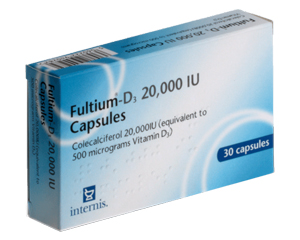
Fultium D3
View Options
This website provides general information about medicines for educational purposes only. Always consult your doctor or pharmacist before taking any medication.
Choose Your Medicine
Select dosage and quantity
Online Consultation
Reviewed by a qualified physician
Fast, Discreet Delivery
Delivered to your door
Medical Information
About This Medicine
What Is Fultium-D3?
Fultium-D3 is a vitamin D3 supplement containing colecalciferol, the natural form of vitamin D produced by the skin upon exposure to sunlight. Available in two strengths — 800 IU and 3200 IU capsules — Fultium-D3 is used to treat and prevent vitamin D deficiency and insufficiency in adults and children over 12 years of age. It is one of the most prescribed vitamin D supplements in the UK, where limited sunlight exposure, particularly during the autumn and winter months, makes deficiency extremely common across the population.
Vitamin D plays a fundamental role in maintaining healthy bones and teeth by regulating the absorption of calcium and phosphate in the gut. Without adequate vitamin D, the body cannot absorb sufficient calcium, which can lead to weakened bones, increased fracture risk, and conditions such as osteomalacia in adults and rickets in children. Beyond its skeletal role, vitamin D supports normal muscle function, immune system activity, and has been associated with broader aspects of health including mood regulation and cardiovascular wellbeing.
Who Is Fultium-D3 Prescribed For?
Fultium-D3 800 IU is commonly prescribed as a maintenance dose for individuals at risk of deficiency, including the elderly, those with limited sun exposure, people with darker skin tones living in northern latitudes, those who cover their skin for religious or cultural reasons, and individuals with conditions affecting fat absorption such as coeliac disease or Crohn's disease. The 3200 IU strength is used as a loading or treatment dose for confirmed deficiency, guided by serum 25-hydroxyvitamin D (25-OH vitamin D) blood test results.
In the management of osteoporosis, Fultium-D3 is frequently prescribed as an adjunct to calcium supplementation and other bone-protective therapies such as bisphosphonates. Ensuring adequate vitamin D status is considered an essential part of osteoporosis prevention and treatment, as vitamin D is required for calcium to be effectively absorbed and incorporated into bone tissue.
Monitoring and Long-Term Use
Before initiating treatment, and during long-term supplementation, healthcare providers may check serum 25-OH vitamin D levels to confirm deficiency and to guide appropriate dosing. Regular monitoring helps to avoid vitamin D toxicity, which, while uncommon at recommended doses, can cause hypercalcaemia and related complications. Fultium-D3 capsules are easy to swallow and can be taken with or without food, making them a convenient option for long-term supplementation.
Usage & Dosage
How to Take Fultium-D3
Fultium-D3 capsules should be swallowed whole with a drink of water. They can be taken with or without food, though some people find that taking them alongside a meal that contains a small amount of fat may improve absorption slightly, as vitamin D is a fat-soluble vitamin. The capsules should not be crushed or chewed.
The recommended dose depends on the indication and the patient's individual vitamin D status as measured by blood testing. For deficiency treatment, higher doses such as 3200 IU daily may be prescribed initially, followed by a maintenance dose of 800 IU once levels have been restored to the normal range. For general supplementation and prevention, 800 IU daily is the most commonly prescribed maintenance dose in the UK.
Special Populations and Missed Doses
Fultium-D3 is suitable for adults and adolescents over 12 years of age. It is often continued long-term in individuals at ongoing risk of deficiency. If a dose is missed, it should be taken as soon as remembered, but if the next dose is due soon, the missed dose should be skipped — a double dose should never be taken. Patients with kidney disease, hyperparathyroidism, or a history of kidney stones should take vitamin D supplements only under medical supervision, as they may be at higher risk of hypercalcaemia.
The dosage of Fultium-D3 is tailored to the individual patient's vitamin D status and clinical need. For confirmed vitamin D deficiency (serum 25-OH vitamin D below 25 nmol/L), a loading regimen using the 3200 IU strength is typically prescribed, with the dose taken daily or on alternate days until levels are corrected, after which a maintenance dose of 800 IU daily is continued. For vitamin D insufficiency (25-50 nmol/L), 800 IU daily may be sufficient both to restore and maintain levels. Adults at risk of deficiency without confirmed blood test results are typically started on 800 IU daily as a preventive dose. Patients with conditions such as obesity or malabsorption syndromes may require higher doses to achieve and maintain adequate levels. Elderly individuals in care homes are commonly prescribed 800 IU to 3200 IU daily. Dosing should always be reviewed in light of blood test results, and patients should not exceed the prescribed dose without medical advice.
Side Effects
Fultium-D3 is well tolerated by most people at standard therapeutic doses. Side effects are uncommon when taken as directed and are more likely to occur if the recommended dose is exceeded or if the patient has underlying conditions affecting calcium metabolism.
Common Side Effects
- Nausea or stomach discomfort, particularly when taken on an empty stomach
- Constipation or diarrhoea in some individuals
- Headache, which is usually mild and transient
- Dry mouth or an unusual taste in the mouth
- Mild skin reactions such as itching or rash (rare at normal doses)
- Fatigue or general malaise if doses are higher than needed
Serious Side Effects
Serious side effects are associated primarily with vitamin D toxicity (hypervitaminosis D) due to excessive dosing, and are very unlikely when taking Fultium-D3 as prescribed.
- Hypercalcaemia: symptoms include intense thirst, frequent urination, confusion, weakness, and nausea — seek medical advice promptly
- Kidney stones (nephrolithiasis), particularly in predisposed individuals
- Hypercalciuria (excess calcium in the urine), which may lead to kidney damage over time
- Metastatic calcification (deposition of calcium in soft tissues) in severe toxicity
- Cardiac arrhythmias associated with severely elevated calcium levels
- Worsening of pre-existing kidney disease in patients with renal impairment
Warnings & Precautions
Important Warnings
Before taking Fultium-D3, inform your doctor or pharmacist if you have or have had kidney disease, kidney stones, hypercalcaemia (high blood calcium), sarcoidosis, or any other condition that affects calcium or vitamin D metabolism. Patients with these conditions are at increased risk of adverse effects and require careful dose adjustment and regular monitoring of serum calcium levels.
Fultium-D3 should not be taken simultaneously with other vitamin D-containing products without medical supervision, as this significantly increases the risk of hypervitaminosis D. Many multivitamins and combined calcium/vitamin D products already contain colecalciferol, so the total daily intake should be calculated before adding additional supplementation. Patients taking thiazide diuretics alongside vitamin D supplements have an increased risk of hypercalcaemia and should be monitored more frequently.
Interactions and Pregnancy
Certain medicines can interact with Fultium-D3. These include thiazide diuretics, cardiac glycosides such as digoxin (vitamin D may increase the risk of digoxin toxicity by raising calcium levels), and orlistat or cholestyramine, which can reduce the absorption of fat-soluble vitamins including colecalciferol. Patients on these medications should inform their prescriber.
Fultium-D3 is considered safe for use during pregnancy and breastfeeding at recommended doses, and is often prescribed to pregnant women who are deficient. However, doses should not exceed safe upper limits during pregnancy, as excessive vitamin D intake can harm the developing baby.
Contraindications
Fultium-D3 must not be used in the following circumstances:
- Hypercalcaemia (high blood calcium levels) of any cause
- Hypervitaminosis D (vitamin D toxicity or overdose)
- Hypercalciuria (excess calcium in the urine)
- Severe renal impairment or renal failure where calcium metabolism is significantly disrupted
- Nephrolithiasis (calcium-based kidney stones) where further vitamin D may worsen the condition
- Sarcoidosis or other granulomatous diseases (in which vitamin D metabolism is dysregulated, increasing risk of hypercalcaemia)
- Known hypersensitivity or allergy to colecalciferol or any excipients in the capsule formulation
- Patients already receiving therapeutic doses of vitamin D from another source without medical review
Frequently Asked Questions
How long does it take for Fultium-D3 to correct vitamin D deficiency?
Can I take Fultium-D3 without a blood test?
Is Fultium-D3 suitable for vegetarians and vegans?
Can I take Fultium-D3 alongside a calcium supplement?
Does Fultium-D3 interact with any medicines?
Dr. Ross Elledge
General Practitioner · General & Family Medicine
Verified Healthcare Professional
TopDoctors Profile