
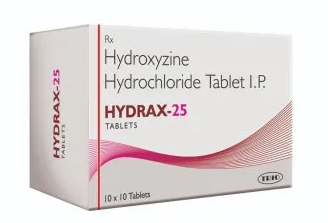
Hydroxyzine
View Options
This website provides general information about medicines for educational purposes only. Always consult your doctor or pharmacist before taking any medication.
Choose Your Medicine
Select dosage and quantity
Online Consultation
Reviewed by a qualified physician
Fast, Discreet Delivery
Delivered to your door
Medical Information
About This Medicine
What Is Hydroxyzine?
Hydroxyzine is a first-generation antihistamine with significant anxiolytic (anti-anxiety) and sedative properties, used to treat anxiety, tension, pruritus (itching), and urticaria (hives). It is available under the brand name Atarax (tablets) and Ucerax (syrup) in the UK, as well as in generic formulations. Unlike many newer antihistamines, hydroxyzine crosses the blood-brain barrier and acts centrally to produce sedation and anxiolytic effects, which underpins its use in both dermatology and psychiatry.
In dermatology, hydroxyzine is effective for the relief of pruritus associated with chronic urticaria, eczema, contact dermatitis, and other allergic skin conditions. Its sedating properties are particularly beneficial in patients whose itching disrupts sleep. In psychiatry and general medicine, hydroxyzine is used for the short-term management of anxiety and tension, particularly in situations where rapid anxiolytic effect is needed without the dependence risks associated with benzodiazepines. It is sometimes prescribed for pre-operative anxiety.
Mechanism of Action
Hydroxyzine exerts its effects primarily through antagonism of H1 histamine receptors, which accounts for its antipruritic and antiallergic properties. Its anxiolytic effect is thought to be mediated through activity at serotonin receptors (particularly 5-HT2A) and muscarinic acetylcholine receptors, as well as possible interactions with subcortical areas of the central nervous system. The sedative effect is a consequence of H1 blockade in the brain combined with anticholinergic activity.
Suitable Alternatives to Benzodiazepines
Hydroxyzine is sometimes selected as an anxiolytic precisely because it does not carry the same risk of dependence, tolerance, or withdrawal as benzodiazepines, making it a potentially safer option for short-term anxiety management in patients where long-term anxiolytic prescribing may be problematic. However, it is not recommended for long-term anxiety management, and its sedating and anticholinergic properties make it unsuitable for some patient groups.
Usage & Dosage
How to Take Hydroxyzine
Hydroxyzine tablets or syrup should be taken by mouth, with or without food. For anxiety and tension, the usual approach is to take the dose in the evening initially to manage the sedating effects, with daytime dosing added if needed and if the patient tolerates it without excessive drowsiness. For pruritus and urticaria, it is often most effective when taken at night, as the sedating properties help with sleep disrupted by itching.
The lowest effective dose should always be used, particularly in elderly patients. The dose should be reviewed regularly, and hydroxyzine should not be used for prolonged periods without reassessment. Unlike benzodiazepines, hydroxyzine does not cause physical dependence, but tolerance to its sedative effects can develop with continuous use, and it is not recommended for chronic anxiety management as a long-term solution.
Driving and Operating Machinery
Hydroxyzine causes sedation in most patients, particularly at higher doses. Patients should not drive or operate heavy machinery until they know how the medicine affects them. The sedating effect is potentiated by alcohol and other CNS depressants, and both should be avoided. Even when patients feel they have adapted to the sedation, reaction times and cognitive function may still be impaired. This is an important safety consideration in patients who drive or whose work requires sustained concentration.
For anxiety in adults, the recommended dose of hydroxyzine is 25 mg three to four times daily, increasing if necessary to a maximum of 100 mg three to four times daily (maximum 400 mg daily). A common clinical approach is to start with 25 mg at night and titrate upward based on response and tolerability. For pre-operative anxiety, a single dose of 50 to 100 mg is given one hour before the procedure.
For pruritus and urticaria in adults, the typical dose is 25 mg three to four times daily, which may be increased to 25 mg four times daily if required. In elderly patients, the dose should be reduced — typically starting at 12.5 mg (half a tablet) once or twice daily — due to the increased sensitivity to sedation, falls risk, and anticholinergic effects in this age group. In children, dosing is based on body weight (typically 1 mg/kg/day in divided doses) and should only be undertaken under medical supervision. Treatment should be limited to the shortest effective period.
Side Effects
Hydroxyzine is associated with a range of side effects related primarily to its sedating, antihistaminergic, and anticholinergic properties. Awareness of these effects is important, as some may impair daily functioning.
Common Side Effects
- Drowsiness and sedation — the most common effect, which may be significant at standard doses
- Dry mouth (xerostomia), which can be uncomfortable and may affect oral hygiene
- Urinary hesitancy or retention, particularly in men with an enlarged prostate
- Blurred vision due to anticholinergic effects on the ciliary muscle of the eye
- Constipation
- Dizziness and impaired coordination, increasing the risk of falls in elderly patients
- Headache and fatigue
- Confusion or cognitive impairment, particularly in elderly patients
Serious Side Effects
- QT interval prolongation: hydroxyzine can prolong the QT interval on the ECG, particularly at higher doses, increasing the risk of ventricular arrhythmias (torsades de pointes) — this risk is higher when combined with other QT-prolonging medicines or in patients with pre-existing cardiac disease
- Acute urinary retention in susceptible patients (particularly men with prostatic hypertrophy)
- Severe allergic reaction (rare): rash, urticaria, angioedema, anaphylaxis
- Seizures at high doses (hydroxyzine lowers the seizure threshold)
- Anticholinergic toxidrome at overdose: hyperthermia, tachycardia, confusion, urinary retention
Warnings & Precautions
QT Prolongation Risk
Hydroxyzine prolongs the cardiac QT interval, particularly at higher doses, and this effect is amplified by concurrent use of other QT-prolonging medicines. Patients with known cardiac arrhythmias, congenital long QT syndrome, or those taking other medicines that prolong the QT interval (such as certain antibiotics, antipsychotics, or antifungal agents) should use hydroxyzine with caution or avoid it. A baseline ECG is recommended in patients with cardiac risk factors. The dose should be kept as low as possible to minimise cardiac risk.
Hydroxyzine should be avoided in patients with pre-existing urinary retention, narrow-angle glaucoma, or severe constipation due to its anticholinergic properties, which can worsen all of these conditions. Particular caution is needed in elderly patients, who are disproportionately vulnerable to the sedating and anticholinergic effects of hydroxyzine and are at increased risk of falls, cognitive impairment, and acute confusion.
Alcohol and CNS Depressants
Alcohol must be avoided while taking hydroxyzine, as the sedating effect is significantly potentiated, increasing the risk of severe CNS depression. The same applies to opioids, benzodiazepines, tricyclic antidepressants, and other CNS depressants. Patients should be clearly warned about this interaction before starting treatment. Hydroxyzine should not be used in patients taking monoamine oxidase inhibitors (MAOIs), as the combination can produce unpredictable and potentially dangerous reactions.
Contraindications
Hydroxyzine is contraindicated in the following circumstances:
- Prolonged QT interval (congenital or acquired) or pre-existing ventricular arrhythmia
- Concurrent use of other medications that significantly prolong the QT interval where the combined risk is considered unacceptable
- Porphyria (hydroxyzine can precipitate an acute attack)
- Narrow-angle glaucoma (anticholinergic effect can precipitate acute angle-closure)
- Urinary retention or significant prostatic hypertrophy at risk of acute retention
- Known hypersensitivity or allergy to hydroxyzine, cetirizine, or other piperazine derivatives
- Pregnancy: hydroxyzine is contraindicated in early pregnancy due to evidence of adverse foetal effects in animal studies; use in the peripartum period is also contraindicated as it can cause neonatal adverse effects
- Breastfeeding: hydroxyzine passes into breast milk and may cause sedation in the infant
Frequently Asked Questions
Is hydroxyzine addictive or habit-forming?
Can I drive while taking hydroxyzine?
How long does it take for hydroxyzine to work for anxiety?
Can hydroxyzine be used for sleep problems caused by itching?
Is hydroxyzine safe for elderly patients?
Dr. Ross Elledge
General Practitioner · General & Family Medicine
Verified Healthcare Professional
TopDoctors Profile