
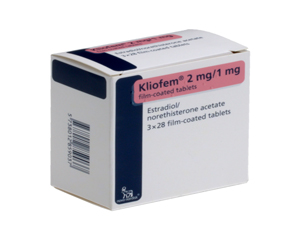
Kliofem
View Options
This website provides general information about medicines for educational purposes only. Always consult your doctor or pharmacist before taking any medication.
Choose Your Medicine
Select dosage and quantity
Online Consultation
Reviewed by a qualified physician
Fast, Discreet Delivery
Delivered to your door
Medical Information
About This Medicine
Kliofem is a continuous combined hormone replacement therapy (HRT) containing two active hormones: estradiol 2mg and norethisterone acetate 1mg. It is taken as a once-daily tablet to relieve the symptoms of the menopause in postmenopausal women — that is, women who have not had a natural period for at least one year. As a continuous combined HRT, Kliofem is specifically designed to be taken every day without a break, eliminating the monthly withdrawal bleed that is characteristic of sequential HRT regimens.
Why Kliofem Is Prescribed
The decline in oestrogen production that accompanies the menopause causes a range of distressing symptoms including hot flushes, night sweats, vaginal dryness, mood disturbances, poor concentration, and disrupted sleep. By replacing oestrogen through the estradiol component, Kliofem effectively alleviates these symptoms, significantly improving quality of life for many postmenopausal women. The norethisterone acetate component is included to oppose the proliferative effect of oestrogen on the endometrium (the lining of the womb). In women who still have a uterus, unopposed oestrogen stimulates the endometrial lining to thicken excessively over time, increasing the risk of endometrial hyperplasia and cancer. Norethisterone acetate counteracts this by causing the endometrium to remain thin and stable.
The No-Bleed Advantage
The principal benefit of continuous combined HRT such as Kliofem over sequential regimens is the absence of a monthly withdrawal bleed. Sequential HRT — in which oestrogen is taken throughout the cycle and a progestogen is added for 10 to 14 days each month — reliably produces a monthly bleed when the progestogen is withdrawn. Many postmenopausal women prefer to avoid this. Kliofem achieves this by maintaining constant levels of both oestrogen and progestogen, which keeps the endometrium thin and inactive. However, in the initial months of treatment (typically the first three to six months), irregular light spotting or breakthrough bleeding is common and expected as the womb lining stabilises. Any new bleeding arising after the first six months of established treatment, or any heavy or persistent bleeding at any stage, should be investigated by a doctor.
Usage & Dosage
Kliofem is taken as one tablet once daily, every day, without any breaks between packs. Each tablet is swallowed whole with water and may be taken at any time of day, with or without food. It is helpful to take the tablet at the same time each day to build a consistent routine and maintain stable hormone levels. Treatment should be started on any convenient day, and — importantly — Kliofem is only suitable for women who have been fully postmenopausal for at least twelve months.
Switching From Sequential HRT
Women currently taking a sequential HRT regimen (which produces a monthly bleed) can switch to Kliofem to achieve a no-bleed regimen. The switch should be made on the day after the last tablet of the previous sequential pack. However, as with starting Kliofem de novo, some irregular spotting is expected in the first few months as the endometrium adjusts from a cycling pattern to a stable, continuously suppressed state.
If a Dose Is Missed
If a dose of Kliofem is missed, it should be taken as soon as remembered if this is within twelve hours of the usual time. If more than twelve hours have elapsed, the missed tablet should be skipped and the next tablet taken as normal the following day. Do not take two tablets on the same day. After a missed dose, some breakthrough bleeding may occur, which is not cause for concern. Women who are having difficulty remembering to take their tablets at a consistent time may benefit from setting a daily reminder.
Kliofem is available as a single tablet strength: estradiol 2mg / norethisterone acetate 1mg. One tablet is taken once daily, every day, continuously, without any pill-free breaks. There are no dose variations within the Kliofem product — the dose is fixed. If a different oestrogen or progestogen dose is required (for example, a lower oestrogen dose in a patient sensitive to side effects), an alternative HRT preparation with adjustable strengths — such as Indivina or Femoston Conti — may be more appropriate.
The dose of oestrogen in Kliofem (estradiol 2mg) is considered a standard therapeutic dose for the treatment of postmenopausal symptoms. HRT should always be used at the lowest effective dose for the shortest duration necessary to control symptoms. At least an annual review with the prescribing clinician is recommended to assess the ongoing need for treatment, the balance of risks and benefits, and the appropriateness of the current formulation. Kliofem is not recommended for use in premenopausal or perimenopausal women, in whom the hormone levels may be unpredictable and a sequential regimen is usually more appropriate.
Side Effects
Common Side Effects
- Irregular vaginal bleeding or spotting, especially in the first three to six months of treatment
- Breast tenderness or enlargement
- Headache or migraine
- Nausea or abdominal discomfort
- Bloating
- Mood changes, including low mood or mood swings
- Fluid retention and ankle swelling
- Acne or oily skin (due to the androgenic activity of norethisterone)
- Decreased libido
- Weight gain
Serious Side Effects
- Breast cancer — combined HRT is associated with an increased risk of breast cancer; risk increases with duration of use. Report any breast changes, lumps, or nipple discharge to your doctor immediately
- Venous thromboembolism (VTE) — deep vein thrombosis or pulmonary embolism; symptoms include leg pain and swelling, or breathlessness and chest pain. Seek emergency medical help immediately
- Stroke — oral HRT carries a slightly elevated risk of ischaemic stroke; symptoms include sudden facial drooping, arm weakness, or slurred speech — call 999 immediately
- Rare: gallbladder disease, cholestatic jaundice
- Rare: endometrial cancer if progestogen protection is inadequate (not expected with correct Kliofem use)
Warnings & Precautions
Risks and Benefit-Risk Assessment
Kliofem, like all combined HRT preparations, is associated with an increased risk of breast cancer, venous thromboembolism, and stroke compared with women not using HRT. These risks are influenced by multiple factors including age, body mass index, duration of HRT use, personal and family medical history, and lifestyle factors such as smoking. Oral HRT (such as Kliofem) carries a higher risk of VTE than transdermal HRT preparations (patches or gels); women at higher risk of blood clots may be better suited to a transdermal formulation. The decision to use Kliofem should be made jointly between the patient and clinician after thorough discussion of individual risks and benefits.
Women taking Kliofem should continue to attend breast cancer screening through the NHS mammography programme and should perform regular self-examination of the breasts, reporting any new lumps, skin changes, or nipple changes to their doctor promptly.
Irregular Bleeding
Breakthrough bleeding or spotting in the first three to six months of Kliofem use is common and expected. Any bleeding that occurs after the initial six months of established treatment, or that is heavy or prolonged at any stage, must be investigated by a doctor, as it may indicate endometrial pathology requiring assessment, including possible endometrial biopsy or ultrasound.
Contraindications
Kliofem must not be used in patients with any of the following conditions:
- Known, suspected, or past history of breast cancer
- Known or suspected oestrogen-dependent malignant tumours (e.g. endometrial cancer)
- Undiagnosed vaginal or uterine bleeding
- Untreated endometrial hyperplasia
- Active or previous venous thromboembolism (DVT or PE)
- Active or previous arterial thromboembolic disease (e.g. myocardial infarction, stroke, or TIA)
- Active liver disease or previous liver disease with persistently abnormal liver function tests
- Known hypersensitivity to estradiol, norethisterone acetate, or any excipient in the formulation
- Porphyria
- Women who are not fully postmenopausal (still experiencing natural periods or within twelve months of the last natural bleed)
Frequently Asked Questions
Will I have periods whilst taking Kliofem?
What is the difference between Kliofem and Kliovance?
How long can I stay on Kliofem?
Is Kliofem suitable if I have not had a period for less than a year?
Can I switch from Kliofem to a patch or gel form of HRT?
Dr. Ross Elledge
General Practitioner · General & Family Medicine
Verified Healthcare Professional
TopDoctors Profile