
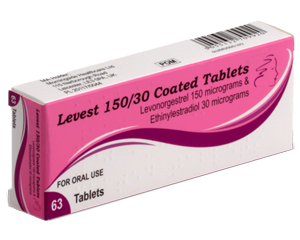
Levest
View Options
This website provides general information about medicines for educational purposes only. Always consult your doctor or pharmacist before taking any medication.
Choose Your Medicine
Select dosage and quantity
Online Consultation
Reviewed by a qualified physician
Fast, Discreet Delivery
Delivered to your door
Medical Information
About This Medicine
Levest is a combined oral contraceptive (COC) pill containing levonorgestrel 150 micrograms and ethinylestradiol 30 micrograms. It is a generic equivalent of Microgynon 30, one of the most widely prescribed combined pills in the UK, and both products contain identical active ingredients in identical doses. Levest is available in 21-tablet strips and is taken according to a standard 21-day regimen followed by a seven-day pill-free interval.
How Levest Prevents Pregnancy
Levest provides contraceptive protection through three complementary mechanisms. The synthetic oestrogen (ethinylestradiol) suppresses the mid-cycle surge in follicle-stimulating hormone (FSH) and luteinising hormone (LH) that would normally trigger ovulation, so no egg is released. Levonorgestrel, the progestogen component, thickens the cervical mucus so that sperm cannot easily penetrate it, and also alters the lining of the womb (endometrium) to make it less receptive to implantation in the unlikely event that ovulation and fertilisation did occur. Together, these effects give Levest a failure rate of less than 1% per year with perfect use.
Additional Benefits Beyond Contraception
Like other combined pills, Levest can provide benefits beyond pregnancy prevention. Many women find that it regulates or lightens their periods, reduces menstrual cramps, and decreases premenstrual symptoms. It may also reduce the frequency and severity of acne, though it is not specifically licensed for this indication. The pill-free interval usually produces a predictable withdrawal bleed that many women find reassuring.
Who Can Take Levest
Levest is suitable for healthy women of reproductive age who do not have contraindications to oestrogen-containing contraception. Before starting, a thorough assessment of personal and family history, blood pressure measurement, and discussion of individual risk factors is essential.
Usage & Dosage
Levest is taken on a 21-day cycle. The first tablet of the first pack should ideally be taken on the first day of the menstrual period, in which case protection against pregnancy is immediate and no additional contraception is needed. If started later in the cycle (days two to five), additional barrier contraception should be used for the first seven days.
How to Take Each Pack
One tablet is taken each day at approximately the same time for 21 consecutive days, following the direction of the arrows printed on the blister strip. After completing the 21 tablets, a seven-day tablet-free interval follows, during which a withdrawal bleed typically occurs. The next pack should then begin on day eight, regardless of whether the bleed has finished. There should never be a gap of more than seven days between packs.
Missed Pills
If one pill is missed and less than 24 hours have passed since it should have been taken, the pill should be taken immediately and the rest of the pack continued as usual. If a pill is more than 24 hours late, the missed pill should be taken as soon as remembered, even if this means taking two in one day, and additional contraception used for the next seven days. If these seven days run beyond the end of the pack, the next pack should be started immediately without a break. Further guidance on missed pills is included in the patient information leaflet.
The dose of Levest is one tablet taken orally each day for 21 consecutive days, followed by a seven-day pill-free interval. Each tablet contains levonorgestrel 150mcg and ethinylestradiol 30mcg. There is only one strength available; dose adjustment is not applicable.
The pill should be taken at the same time each day to maintain consistent hormone levels and minimise the risk of contraceptive failure due to missed or delayed pills. Levest is for use in women of reproductive age only and is not appropriate for use after the menopause. No dose adjustment is needed for renal or hepatic impairment in mild to moderate cases, but Levest should be used with caution or avoided in women with severe liver disease.
Side Effects
Common Side Effects
- Nausea, particularly in the first few weeks of use
- Breast tenderness or swelling
- Headache or migraine
- Changes in mood, including low mood or irritability
- Decreased libido
- Breakthrough bleeding or spotting between periods
- Changes in vaginal discharge
- Contact lens intolerance (related to fluid retention)
Serious Side Effects
- Venous thromboembolism: deep vein thrombosis or pulmonary embolism, seek emergency care for sudden leg swelling, chest pain, or breathlessness
- Arterial events: stroke or myocardial infarction, particularly in women who smoke or have other cardiovascular risk factors
- Liver tumours: rare benign hepatic adenomas or, very rarely, hepatocellular carcinoma associated with long-term COC use
- Severe hypertension: blood pressure should be monitored at prescription and follow-up
- Cervical cancer: long-term COC use is associated with a small increase in cervical cancer risk, which returns to baseline after stopping
Warnings & Precautions
Levest is an oestrogen-containing contraceptive and carries specific warnings that must be considered before prescribing.
Thrombosis and Cardiovascular Risk
Combined oral contraceptives increase the risk of venous thromboembolism (VTE). This risk is higher in women who smoke, are overweight, are immobile for extended periods (e.g. long-haul flights), or have a family or personal history of VTE or known thrombophilia. Women over 35 who smoke should not use combined hormonal contraception. The risk of arterial events (stroke, heart attack) is also elevated in women with uncontrolled hypertension, migraine with aura, or multiple cardiovascular risk factors. Blood pressure must be measured before starting and monitored during use.
Other Important Considerations
Women should be advised to stop Levest immediately and seek medical attention if they develop sudden severe headache, visual disturbances, chest pain, breathlessness, or leg pain and swelling. Certain medicines reduce the effectiveness of Levest, including rifampicin, some anticonvulsants (carbamazepine, phenytoin, phenobarbital, topiramate), and St John's Wort; additional contraception or an alternative method may be needed. Levest does not protect against sexually transmitted infections. Women with a history of cholestasis of pregnancy, liver disease, or jaundice should use Levest with caution or avoid it.
Contraindications
- Personal history of venous thromboembolism (DVT or PE)
- Known thrombophilia (e.g. Factor V Leiden, antiphospholipid syndrome)
- Migraine with aura
- Active or history of arterial cardiovascular disease (stroke, ischaemic heart disease)
- Uncontrolled hypertension
- Women aged 35 or over who smoke
- Severe or multiple risk factors for cardiovascular disease
- Diabetes with vascular complications
- Breast cancer (current or within past five years)
- Active liver disease or liver tumours
- Pregnancy or suspected pregnancy
Frequently Asked Questions
Is Levest the same as Microgynon 30?
What should I do if I miss a Levest pill?
How soon does Levest become effective at preventing pregnancy?
Can Levest affect my mood or mental health?
Does Levest protect against sexually transmitted infections?
Dr. Ross Elledge
General Practitioner · General & Family Medicine
Verified Healthcare Professional
TopDoctors Profile