
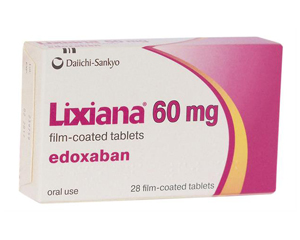
Lixiana
View Options
This website provides general information about medicines for educational purposes only. Always consult your doctor or pharmacist before taking any medication.
Choose Your Medicine
Select dosage and quantity
Online Consultation
Reviewed by a qualified physician
Fast, Discreet Delivery
Delivered to your door
Medical Information
About This Medicine
Lixiana is the brand name for edoxaban, a direct oral anticoagulant (DOAC) belonging to the class of Factor Xa inhibitors. By selectively and reversibly inhibiting Factor Xa, a key enzyme in the coagulation cascade, edoxaban prevents the formation of blood clots without requiring frequent blood monitoring or dose adjustments for diet or the vast majority of drug interactions. It represents a major advance over warfarin, offering predictable anticoagulation with the convenience of once-daily oral dosing.
Mechanism of Action
Clot formation depends on a cascade of clotting factors culminating in the conversion of prothrombin to thrombin, which then converts fibrinogen to fibrin, the scaffolding of a blood clot. Factor Xa sits at the convergence of the intrinsic and extrinsic pathways of the coagulation cascade, making it a highly effective target for anticoagulation. Edoxaban binds directly and reversibly to Factor Xa, inhibiting both free Factor Xa and Factor Xa within the prothrombinase complex, thereby interrupting thrombin generation and clot formation.
Clinical Indications
Lixiana is licensed in the UK for two main indications: the prevention of stroke and systemic embolism in adults with non-valvular atrial fibrillation (AF) who have at least one additional stroke risk factor, and the treatment and prevention of recurrence of deep vein thrombosis (DVT) and pulmonary embolism (PE) in adults. For VTE treatment, Lixiana is started after five to ten days of parenteral anticoagulation (typically low-molecular-weight heparin).
Advantages Over Warfarin
Lixiana does not require regular INR blood monitoring, has fewer food interactions (not affected by vitamin K-containing foods), has a predictable dose-response relationship, and has a shorter half-life, which may reduce bleeding duration if it occurs. These factors improve quality of life and treatment adherence.
Usage & Dosage
Lixiana is taken by mouth once daily, with or without food. The simplicity of once-daily dosing without dietary restrictions or routine monitoring makes it straightforward to integrate into daily life. The tablet should be swallowed whole with a drink of water. Lixiana can be taken at any time of day, but choosing a consistent time each day helps establish a reliable routine and reduces the risk of missed doses.
Initiating Treatment
For AF stroke prevention, Lixiana can be started at any time following clinical assessment and confirmation of non-valvular AF. For VTE treatment, Lixiana must not be used as the sole initial therapy; it should be started after five to ten days of parenteral anticoagulation such as low-molecular-weight heparin (enoxaparin). This initial parenteral phase is necessary because edoxaban alone does not reach full anticoagulant effect rapidly enough for acute VTE management.
Managing Missed Doses and Stopping Treatment
If a dose is missed, it should be taken as soon as remembered on the same day and the once-daily schedule resumed the next day. Two doses should never be taken in the same day. Lixiana should not be stopped without medical advice, as stopping anticoagulation abruptly in AF or after a VTE significantly increases the risk of stroke or clot recurrence. Any planned procedures, operations, or dental extractions should be discussed with the prescribing doctor well in advance, as temporary interruption of anticoagulation may need to be planned carefully.
For stroke prevention in non-valvular AF, the standard dose is edoxaban 60mg once daily. The dose is reduced to 30mg once daily in patients with any of the following: moderate to severe renal impairment (creatinine clearance 15-50ml/min), low body weight (60kg or less), or concomitant use of certain P-glycoprotein inhibitors (such as dronedarone, quinidine, verapamil, or azithromycin).
For the treatment of DVT and PE, the standard dose is also 60mg once daily, again with dose reduction to 30mg in the same circumstances. Edoxaban is not recommended for use with a creatinine clearance above 95ml/min for AF stroke prevention, as clinical trial data suggest reduced efficacy in this group. In severe hepatic impairment (Child-Pugh C) or in patients with hepatic disease expected to affect coagulation, Lixiana should not be used. The 15mg tablet is used to facilitate dose reductions where splitting would not be appropriate.
Side Effects
Common Side Effects
- Bleeding from minor cuts or wounds that takes longer than usual to stop
- Bruising more easily
- Nausea or abdominal discomfort
- Skin rash
- Anaemia (due to occult bleeding)
- Elevated liver enzymes (transaminases)
- Fatigue
- Headache
Serious Side Effects
- Major haemorrhage: including intracranial bleeding, gastrointestinal haemorrhage (presenting as black or bloody stools, or vomiting blood), and retroperitoneal bleeding, this is a medical emergency; seek immediate care
- Haemorrhagic stroke: risk is low but serious; report sudden severe headache, facial drooping, or limb weakness immediately
- Spinal or epidural haematoma: if undergoing neuraxial anaesthesia or spinal puncture, there is a risk of haematoma causing paralysis
- Severe anaemia: from occult bleeding requiring transfusion
- Serious hypersensitivity reactions including angioedema
Warnings & Precautions
Lixiana carries important warnings relating primarily to bleeding risk.
Bleeding Risk Management
All anticoagulants increase the risk of bleeding, and edoxaban is no exception. The risk is higher in patients who also take antiplatelet drugs (aspirin, clopidogrel), NSAIDs, or other anticoagulants. Patients should seek immediate medical attention if they experience any signs of major bleeding, including coughing or vomiting blood, black or red tarry stools, unexpected or severe bruising, prolonged bleeding from a cut, blood in the urine, or sudden severe headache. There is no licensed specific reversal agent for edoxaban in the UK at the time of writing, although andexanet alfa (Ondexxya) is available for life-threatening or uncontrolled bleeding and may be used on a case-by-case basis in specialist centres.
Procedural Management and Drug Interactions
Lixiana should be temporarily stopped before invasive procedures where bleeding risk is significant. The interruption period depends on the procedure's bleeding risk and the patient's renal function. Patients must inform all treating clinicians -- including dentists and surgeons -- that they are taking an anticoagulant. Lixiana is a substrate of P-glycoprotein, and potent P-gp inducers such as rifampicin, carbamazepine, phenytoin, and St John's Wort significantly reduce edoxaban levels and should be avoided. Potent P-gp inhibitors (see dosage section) necessitate dose reduction.
Contraindications
- Clinically significant active bleeding
- Hepatic disease associated with coagulopathy and clinically relevant bleeding risk
- Severe hepatic impairment (Child-Pugh C)
- Uncontrolled severe hypertension
- Lesions or conditions with a significant risk of major haemorrhage (e.g. active peptic ulcer, recent intracranial haemorrhage, oesophageal varices)
- Concurrent anticoagulant therapy (with exceptions under specialist guidance)
- Pregnancy and breastfeeding
- Valvular atrial fibrillation (mechanical heart valves or rheumatic mitral stenosis)
- Creatinine clearance above 95ml/min in non-valvular AF (reduced efficacy shown in trials)
- Hypersensitivity to edoxaban or any excipients
Frequently Asked Questions
Do I need regular blood tests while taking Lixiana?
What should I do if I miss a dose of Lixiana?
Is Lixiana safe if I also take aspirin or ibuprofen?
Can I have an operation or dental procedure while on Lixiana?
Why was I given heparin injections before starting Lixiana for my blood clot?
Dr. Ross Elledge
General Practitioner · General & Family Medicine
Verified Healthcare Professional
TopDoctors Profile