
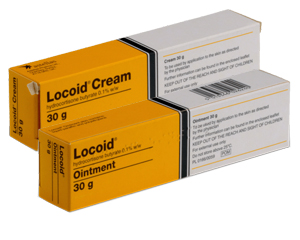
Locoïd
View Options
This website provides general information about medicines for educational purposes only. Always consult your doctor or pharmacist before taking any medication.
Choose Your Medicine
Select dosage and quantity
Online Consultation
Reviewed by a qualified physician
Fast, Discreet Delivery
Delivered to your door
Medical Information
About This Medicine
Locoid is a moderately potent topical corticosteroid containing hydrocortisone 17-butyrate 0.1% as its active ingredient. Despite its relationship to the hydrocortisone family, the butyrate ester gives it considerably greater anti-inflammatory potency than the standard 1% hydrocortisone preparations sold over the counter. It is classified as a moderately potent steroid and is used to treat a range of inflammatory and pruritic skin conditions in adults and, in certain formulations and with careful supervision, in children.
Available Formulations
Locoid is available in several topical formulations, each suited to different skin conditions and body sites. The standard cream is suitable for moist, weeping, or acutely inflamed areas of skin. The ointment, which has a greasier base, provides better occlusion and is preferred for dry, lichenified (thickened), or scaly lesions. Locoid Crelo is an oil-in-water emulsion that combines the moisturising qualities of a cream with the occlusive properties of an ointment, making it particularly suitable for scalp application and for areas where a thin, less greasy product is preferred.
Conditions Treated
Locoid is prescribed primarily for eczema (atopic dermatitis), contact dermatitis, seborrhoeic dermatitis, psoriasis of the scalp and body (excluding widespread plaque psoriasis), and other inflammatory skin conditions that have not responded adequately to milder topical steroids such as 1% hydrocortisone. It effectively reduces the redness, itching, swelling, and scaling associated with these conditions by suppressing the local inflammatory and immune responses in the skin.
Mechanism of Action
Hydrocortisone 17-butyrate acts on glucocorticoid receptors within skin cells, inhibiting the production of inflammatory mediators including prostaglandins, leukotrienes, and cytokines. It also reduces vascular permeability, limiting the influx of inflammatory cells into the skin. The result is a rapid reduction in the cardinal signs of inflammation: redness, heat, swelling, and itch.
Usage & Dosage
Locoid should be applied to the affected area of skin in a thin layer, once or twice daily, unless instructed otherwise by a doctor or pharmacist. A thin application is sufficient for therapeutic effect; applying more does not increase efficacy but increases the risk of systemic absorption and local side effects. The product should not be applied to unaffected skin.
Application Technique
Hands should be washed before and after applying Locoid, unless the hands themselves are the area being treated. A thin layer is gently smoothed into the affected skin. Rubbing vigorously is unnecessary and should be avoided. Locoid should not be applied to the face unless specifically directed by a doctor, and should not be used near the eyes, as this can cause raised intraocular pressure or, with prolonged use, glaucoma. Application under tight dressings or occlusive bandages significantly increases steroid absorption and should only be done under medical supervision.
Duration of Use
Topical corticosteroids should be used for the shortest time necessary to bring the condition under control. For most flares of eczema, a one to two week course is usually sufficient. Continuing beyond two to four weeks without medical review is not recommended. Once the flare has resolved, the frequency of application should be stepped down (for example, reducing to alternate days) before stopping, and a moisturiser used regularly to maintain skin hydration and reduce the frequency of flares. Long-term continuous use is associated with skin thinning and other local side effects.
Locoid cream, ointment, or Crelo is applied topically in a thin layer to the affected area once or twice daily. The dose is expressed in terms of application rather than weight or volume.
A practical guide is the fingertip unit (FTU): one FTU, the amount squeezed from the tube tip to the first crease of the index finger, covers roughly the area of two adult hands. This helps guide appropriate quantities. Excessive application does not improve outcomes and increases the risk of side effects.
In children, topical steroids should be used with particular caution and for the shortest possible duration. Locoid is generally not recommended in infants under one year without specialist supervision. For the scalp or hairy areas, Locoid Crelo is the preferred formulation. Treatment courses should be reassessed regularly, and if conditions are not improving as expected after one to two weeks, medical review is needed.
Side Effects
Common Side Effects
- Stinging or burning sensation on first application, particularly on broken or inflamed skin
- Skin dryness or irritation
- Itching at the application site
- Mild skin thinning (atrophy) with prolonged use
- Striae (stretch marks) with prolonged use in susceptible areas
- Perioral dermatitis (if applied near the mouth)
- Folliculitis (inflammation of hair follicles)
- Hypertrichosis (increased hair growth at application site)
- Acneiform eruptions with prolonged use
Serious Side Effects
- Hypothalamic-pituitary-adrenal (HPA) axis suppression: with extensive or prolonged use, particularly in children or under occlusion; can cause growth retardation in children and adrenal insufficiency
- Glaucoma and cataract: with periocular application or inadvertent eye contact over time
- Skin infections: topical steroids can mask signs of bacterial, fungal, or viral skin infections, allowing them to spread undetected
- Cushing's syndrome: very rare with moderately potent topical steroids used appropriately but possible with extreme overuse
Warnings & Precautions
Locoid carries important warnings that apply to all topical corticosteroids, though the risks are proportionate to the dose, potency, area of application, and duration of use.
Infection Risk
Locoid must not be used to treat skin infections, including bacterial impetigo, fungal infections such as ringworm or candidiasis, viral infections such as cold sores or chickenpox, or scabies. Applying a corticosteroid to an infected area suppresses the inflammatory response that helps contain the infection and can allow it to spread rapidly. If there is any uncertainty about whether a rash is infected, a medical assessment should be obtained before applying Locoid.
Special Populations and Long-Term Use
Children and elderly patients are at greater risk of systemic absorption and local side effects due to thinner or more fragile skin. In children, the face, nappy area, flexures, and large body surface areas should be treated with particular caution. Prolonged continuous use on any area of skin risks causing permanent atrophy, telangiectasia, and striae. When treating the face or scalp, the minimum effective amount should be used for the shortest time possible. Women who are pregnant should use topical steroids only when clearly necessary, and in the smallest effective amount. The safety of topical hydrocortisone 17-butyrate during breastfeeding is not well established; it should not be applied to the breast if breastfeeding.
Contraindications
- Bacterial skin infections (impetigo, folliculitis) without concurrent appropriate antibacterial treatment
- Fungal skin infections (ringworm, candidiasis)
- Viral skin infections (herpes simplex, chickenpox, shingles)
- Tuberculous skin conditions
- Perioral dermatitis
- Rosacea
- Acne vulgaris
- Hypersensitivity to hydrocortisone 17-butyrate or any excipients
- Application to the eyes or surrounding areas (except under specialist supervision)
- Not recommended for use in infants under one year without specialist advice
Frequently Asked Questions
How is Locoid different from over-the-counter hydrocortisone cream?
Can Locoid be used on the face?
What is the fingertip unit method for applying Locoid?
Can I use Locoid during pregnancy?
How long can I use Locoid continuously without seeing a doctor?
Dr. Ross Elledge
General Practitioner · General & Family Medicine
Verified Healthcare Professional
TopDoctors Profile