
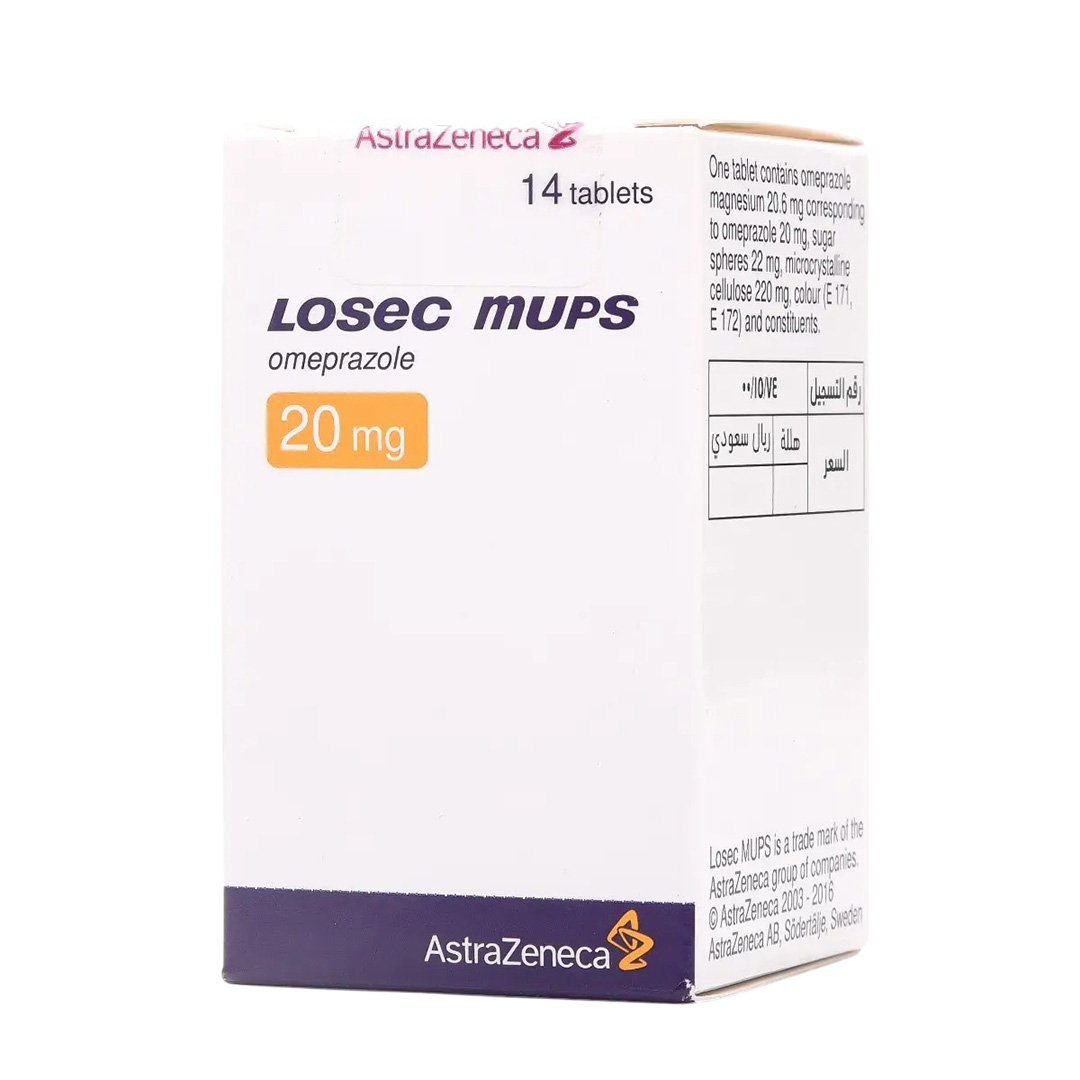
Losec MUPS
View Options
This website provides general information about medicines for educational purposes only. Always consult your doctor or pharmacist before taking any medication.
Choose Your Medicine
Select dosage and quantity
Online Consultation
Reviewed by a qualified physician
Fast, Discreet Delivery
Delivered to your door
Medical Information
About This Medicine
Losec MUPS is a branded formulation of omeprazole presented as multiple-unit pellet system (MUPS) tablets. These tablets contain hundreds of tiny enteric-coated pellets that can be swallowed whole or dispersed in water, making them particularly useful for patients who have difficulty swallowing conventional capsules or who require administration through a nasogastric tube. Omeprazole belongs to the class of medicines known as proton pump inhibitors (PPIs), which are among the most widely prescribed drugs in the world for the treatment of acid-related gastrointestinal conditions.
How Losec MUPS Works
The proton pump, located in the lining of the stomach, is the final step in acid production. Omeprazole irreversibly inhibits this enzyme (H+/K+ ATPase), dramatically reducing the secretion of gastric acid. By lowering stomach acid levels, the drug allows the oesophageal lining to heal in gastro-oesophageal reflux disease (GORD), permits peptic ulcers to recover, and creates an environment less conducive to the bacterium Helicobacter pylori. Because the enteric-coated pellets in MUPS tablets are protected from the acidic stomach environment, they pass intact to the small intestine where absorption takes place.
Conditions Treated
Losec MUPS is indicated for the treatment and prevention of gastric and duodenal ulcers, GORD (including erosive oesophagitis and symptomatic reflux), Zollinger-Ellison syndrome (a rare condition involving excessive acid production), and as part of eradication regimens for H. pylori infection. It is also used to prevent ulcers in patients taking NSAIDs such as ibuprofen or naproxen who are at high risk of gastrointestinal complications. The flexible dosing options and dispersible tablet format make Losec MUPS particularly versatile in clinical practice, suitable for a broad range of patients including those with swallowing difficulties or those managed via enteral feeding tubes.
Usage & Dosage
Losec MUPS tablets should ideally be taken in the morning, thirty minutes before eating, to achieve the greatest reduction in acid production. The tablets can be swallowed whole with a glass of water, or, for patients who need it, dispersed in a small amount of non-carbonated water (approximately half a glass) and stirred until the pellets are evenly suspended, then swallowed immediately. The suspension should not be chewed or crushed, as this would damage the protective enteric coating on the pellets.
Administration via Nasogastric Tube
For patients requiring tube feeding, Losec MUPS tablets can be dispersed in water and administered via a syringe through a nasogastric or percutaneous gastrostomy tube, making them significantly more practical than capsule formulations in this setting. The tube and syringe should be flushed with water after administration.
Duration of Treatment
Treatment duration depends on the indication. Acute ulcers and erosive oesophagitis are typically treated for four to eight weeks. Maintenance therapy may be recommended for patients with recurrent GORD or those on long-term NSAIDs. H. pylori eradication courses typically last seven to fourteen days in combination with antibiotics. Patients should not self-medicate for more than two weeks without medical review, as persistent heartburn may signal an underlying condition requiring investigation.
GORD (symptomatic relief): 20mg once daily for four weeks; may continue for a further four weeks if symptoms persist.
Erosive oesophagitis (healing): 20-40mg once daily for four to eight weeks.
Gastric ulcer: 20-40mg once daily for four to eight weeks.
Duodenal ulcer: 20mg once daily for two to four weeks; prevention of recurrence 10-20mg daily.
H. pylori eradication: 20mg twice daily for 7 days combined with two appropriate antibiotics.
NSAID-associated ulcer prevention: 20mg once daily during NSAID use.
Zollinger-Ellison syndrome: Initial 60mg once daily; adjust based on response (up to 120mg/day in divided doses).
Children (1 year and over, weight-based dosing): Specialist-directed. Typically 0.7-1.4mg/kg once daily up to 20-40mg.
Hepatic impairment: Maximum 20mg daily; use with caution.
Side Effects
Common Side Effects
- Headache
- Nausea and abdominal discomfort
- Diarrhoea or constipation
- Flatulence and bloating
- Dry mouth
- Elevated liver enzymes on blood tests (usually transient)
- Dizziness
Serious Side Effects
- Hypomagnesaemia (low magnesium levels with long-term use): may cause muscle cramps, tremor, or irregular heartbeat
- Clostridium difficile infection (particularly in hospitalised patients): severe or prolonged diarrhoea requiring medical review
- Vitamin B12 deficiency with prolonged use: fatigue, neurological symptoms
- Severe allergic reactions: anaphylaxis, angioedema, bronchospasm, seek immediate medical attention
- Interstitial nephritis (rare): unexplained decline in kidney function
Warnings & Precautions
Before starting Losec MUPS, it is important to rule out the possibility of gastric malignancy, as PPIs can mask the symptoms of stomach cancer. Any patient with alarm symptoms -- such as unexplained weight loss, persistent vomiting, difficulty swallowing, or blood in stools -- should undergo endoscopic investigation before commencing PPI therapy.
Long-Term Use Considerations
Long-term use of omeprazole (typically over one year) has been associated with a small increased risk of bone fractures, particularly of the hip, wrist, and spine, in older patients or those with other risk factors. Patients at risk of osteoporosis should ensure adequate calcium and vitamin D intake. Prolonged PPI therapy may also reduce magnesium absorption; serum magnesium should be checked before starting long-term treatment and periodically thereafter.
Drug Interactions
Omeprazole can affect the absorption and metabolism of several other medicines. It inhibits CYP2C19 and may increase the plasma concentration of medicines such as diazepam, phenytoin, and clopidogrel -- the latter interaction is particularly important as it may reduce the antiplatelet effect. Concomitant use with methotrexate at high doses should be approached with caution. Atazanavir and nelfinavir (HIV medicines) should not be co-administered with PPIs. Patients should always inform their doctor or pharmacist of all medicines they are taking.
Contraindications
- Hypersensitivity to omeprazole, other PPIs (substituted benzimidazoles), or any excipients
- Concurrent use with nelfinavir (HIV protease inhibitor)
- Concurrent use with atazanavir (reduction in antiretroviral efficacy)
- Concurrent use with St John's Wort (reduced omeprazole efficacy)
- Undiagnosed dyspepsia with alarm features (weight loss, dysphagia, haematemesis) without prior endoscopy
- Severe hepatic impairment at higher doses (dose capping required)
- Known hypomagnesaemia that cannot be corrected (relative -- risk of worsening)
- Children under 1 year (safety not established)
Frequently Asked Questions
What is the difference between Losec MUPS and regular omeprazole capsules?
Can I take Losec MUPS long term?
How quickly does Losec MUPS start working?
Can I take Losec MUPS with other medicines?
Is it safe to take Losec MUPS during pregnancy?
Dr. Ross Elledge
General Practitioner · General & Family Medicine
Verified Healthcare Professional
TopDoctors Profile