
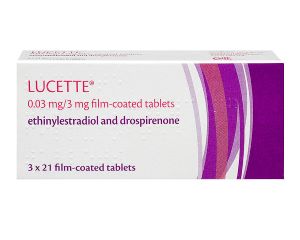
Lucette
View Options
This website provides general information about medicines for educational purposes only. Always consult your doctor or pharmacist before taking any medication.
Choose Your Medicine
Select dosage and quantity
Online Consultation
Reviewed by a qualified physician
Fast, Discreet Delivery
Delivered to your door
Medical Information
About This Medicine
Lucette is a combined oral contraceptive (COC) pill containing drospirenone 3mg and ethinylestradiol 20mcg. It is a generic equivalent of Yaz and belongs to the fourth-generation progestogen group. Lucette is taken on a 24-day active pill, 4-day pill-free interval schedule (24/4 regimen), which differs from the traditional 21/7 pill cycle. This shorter hormone-free interval maintains more consistent hormone levels and may reduce cycle-related symptoms during the pill-free days.
Drospirenone: A Distinctive Progestogen
Drospirenone is structurally derived from spironolactone and possesses anti-mineralocorticoid properties, which means it counteracts the water-retaining effects of oestrogen. This property makes Lucette particularly beneficial for women who experience bloating, breast tenderness, or weight gain related to water retention with other COCs. Drospirenone also has anti-androgenic activity, making it helpful for women with acne or signs of mild androgen excess such as hirsutism.
Indications and Benefits
Lucette is licensed for contraception in women of reproductive age. It may also be of benefit in women who experience moderate acne or premenstrual dysphoric disorder (PMDD), conditions for which the identical-composition branded pill Yaz has received a specific indication in some countries. Because of the lower oestrogen dose (20mcg ethinylestradiol versus the 30mcg in many other COCs), Lucette may be suitable for women who experience oestrogen-related side effects such as nausea, breast tenderness, or headaches on higher-dose pills.
Hyperkalaemia Risk
An important and unique consideration with drospirenone-containing pills is the potential for raised serum potassium levels. Because drospirenone antagonises aldosterone, it can reduce potassium excretion. This is a clinically relevant concern in women taking other medications that raise potassium, such as ACE inhibitors, ARBs, potassium-sparing diuretics, or NSAIDs used regularly. Potassium levels should be checked in at-risk patients.
Usage & Dosage
Lucette tablets are taken orally, one tablet per day, following the order indicated on the blister pack. The pack contains 24 pink active tablets followed by 4 white placebo tablets, making a total of 28 tablets. Tablets should be taken at roughly the same time each day, with water if needed. Taking Lucette at a consistent time helps maintain steady hormone levels and reduces the risk of breakthrough bleeding.
Starting Lucette
If starting Lucette on the first day of menstruation, contraceptive protection is immediate and no additional precautions are needed. If started on days 2 to 5 of the cycle, additional barrier contraception (such as condoms) should be used for the first seven days. Switching from another COC should be done by starting Lucette the day after finishing the active tablets of the previous pill pack, without a hormone-free interval. When switching from a progestogen-only pill (POP), Lucette can be started on any day.
Missed Pills and Vomiting
If a pink active tablet is missed by less than 24 hours, it should be taken as soon as remembered, with the next tablet taken at the usual time. If more than 24 hours have passed, the rules for missed pills in the product information should be followed carefully, and additional contraception may be needed. Vomiting within three to four hours of taking the tablet may reduce absorption; an additional tablet should be taken if possible, and barrier contraception used for the following seven days.
Adults and adolescents post-menarche: One tablet daily for 28 consecutive days. Take 24 pink active tablets, then 4 white placebo tablets, without a break. Start the next pack immediately after completing the current one.
Starting dose: No dose titration required. One tablet per day throughout treatment.
Missed dose (pink tablet): If less than 24 hours late, take immediately. If more than 24 hours late, follow the missed pill guidelines in the package leaflet; additional contraception may be required for seven days.
Missed dose (white placebo tablet): No action required -- the white tablets contain no active ingredient.
Renal or hepatic impairment: Contraindicated in significant hepatic impairment. Caution in renal impairment due to drospirenone's hyperkalaemic potential.
Elderly: Not applicable (contraceptive use is for women of reproductive age).
Side Effects
Common Side Effects
- Headache or migraine
- Nausea (more common in the first few months)
- Breast tenderness or pain
- Irregular bleeding or spotting, particularly in the first few cycles
- Mood changes, including low mood or reduced libido
- Decreased menstrual flow or lighter periods
- Decreased sexual desire
Serious Side Effects
- Venous thromboembolism (VTE): blood clots in deep veins or lungs, seek emergency help if you experience leg pain, swelling, sudden breathlessness, or chest pain
- Arterial thrombosis: increased risk of heart attack or stroke, particularly in smokers over 35
- Hyperkalaemia: raised blood potassium, monitor in women on potassium-raising medications
- Hepatic tumours (rare benign or malignant): upper abdominal pain or liver enlargement
- Hypertension: blood pressure should be monitored regularly
Warnings & Precautions
Lucette, like all combined oral contraceptives, carries a risk of venous thromboembolism (VTE). The overall risk of blood clots is higher than in women not using hormonal contraception but lower than the risk during pregnancy and the postpartum period. The risk is greatest in the first year of use and on restarting after a break of four weeks or more. Women with a personal or strong family history of blood clots, obesity, prolonged immobility, or other major VTE risk factors should discuss the appropriateness of COC use with their doctor.
Smoking and Cardiovascular Risk
Smoking significantly increases the risk of serious cardiovascular events in COC users, including heart attack and stroke. Women over 35 who smoke should not use combined hormonal contraceptives. Blood pressure should be checked before prescribing and monitored during treatment, as COCs can raise blood pressure.
Drospirenone-Specific Considerations
Because drospirenone has anti-mineralocorticoid activity, potassium levels may rise in women who concurrently take potassium-sparing diuretics, ACE inhibitors, ARBs, or heparin. Serum potassium should be checked during the first treatment cycle in these women. Women with conditions that may affect potassium regulation -- including adrenal insufficiency -- require particular caution.
Oestrogen-Related Risks
Lucette contains ethinylestradiol, which, even at its low 20mcg dose, is associated with the full range of oestrogen-related COC risks including thromboembolism, gallbladder disease, and potentially a small increase in the risk of breast cancer with prolonged use. Women should be aware of these risks and be supported in making an informed contraceptive choice.
Contraindications
- Personal history of or current venous thromboembolism (DVT or pulmonary embolism)
- Personal history of or current arterial thrombosis (heart attack, stroke, TIA)
- Presence of severe or multiple risk factors for arterial or venous thrombosis (e.g. smoking over 35, hypertension, obesity, migraine with aura)
- Severe hepatic disease or liver tumours (benign or malignant)
- Known or suspected sex hormone-sensitive malignancy (e.g. breast cancer)
- Renal insufficiency requiring potassium monitoring in combination with drospirenone
- Adrenal insufficiency
- Undiagnosed abnormal uterine bleeding
- Pregnancy or suspected pregnancy
- Breastfeeding (in the early postpartum period -- discuss with doctor)
- Hypersensitivity to drospirenone, ethinylestradiol, or any excipient
Frequently Asked Questions
What makes Lucette different from other combined pills like Microgynon?
Can Lucette help with acne?
Does Lucette cause blood clots?
What should I do if I miss a Lucette tablet?
Is Lucette suitable if I am sensitive to oestrogen?
Dr. Ross Elledge
General Practitioner · General & Family Medicine
Verified Healthcare Professional
TopDoctors Profile