
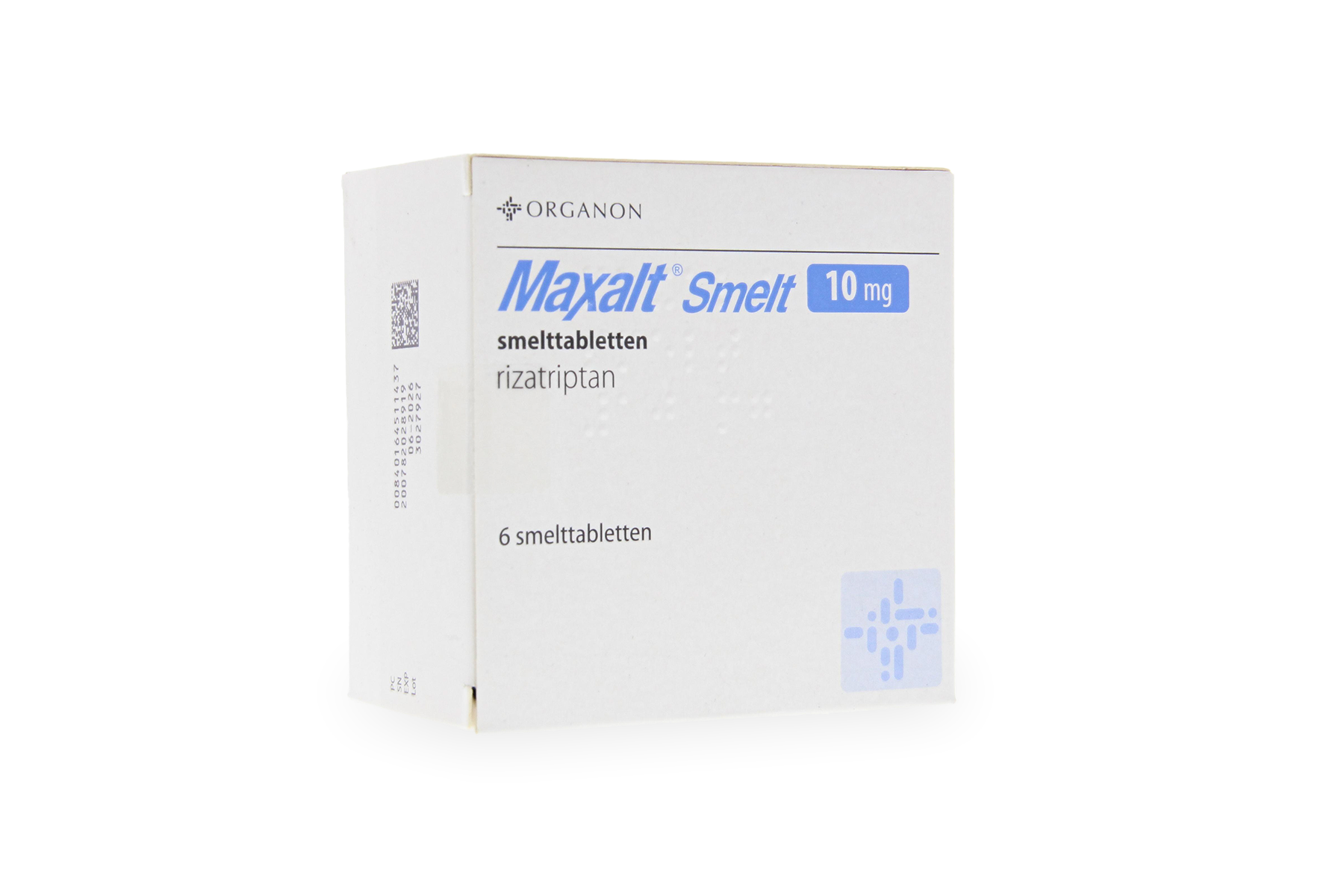
Maxalt
View Options
This website provides general information about medicines for educational purposes only. Always consult your doctor or pharmacist before taking any medication.
Choose Your Medicine
Select dosage and quantity
Online Consultation
Reviewed by a qualified physician
Fast, Discreet Delivery
Delivered to your door
Medical Information
About This Medicine
Maxalt is a branded triptan containing rizatriptan, used for the acute treatment of migraine headaches with or without aura in adults. It is available in two formulations: standard film-coated tablets (5mg and 10mg) and Maxalt Melt (also called Maxalt RPD), which are freeze-dried wafers that dissolve rapidly on the tongue without the need for water. Rizatriptan belongs to the serotonin 5-HT1B/1D receptor agonist class, the triptans, which are the mainstay pharmacological treatment for moderate to severe migraine attacks.
How Maxalt Works
Migraine headaches are associated with dilation of intracranial blood vessels and the release of inflammatory neuropeptides, particularly via the trigeminovascular pathway. Rizatriptan acts on 5-HT1B receptors on cranial blood vessel walls, causing vasoconstriction and reducing the throbbing pain that characterises migraine. It also acts on 5-HT1D receptors on trigeminal nerve terminals, inhibiting the release of pro-inflammatory neuropeptides such as CGRP (calcitonin gene-related peptide). Together, these actions address two of the core mechanisms of migraine pain.
Onset of Action and Effectiveness
Maxalt works relatively quickly for a triptan, most patients begin to notice relief within 30 to 60 minutes of taking the tablet. Maxalt Melt wafers offer the additional practical advantage of dissolving on the tongue, making them suitable for patients who experience nausea or vomiting during a migraine attack and struggle to swallow conventional tablets. Rizatriptan 10mg has been shown in clinical trials to achieve headache relief in approximately 67-77% of patients at two hours, with a meaningful pain-free rate.
When to Take Maxalt
Maxalt is most effective when taken as soon as the migraine headache phase begins. It can be taken at any point during the migraine, but the evidence for treatment during the aura phase only (before headache onset) is less robust. It should not be used as a preventative treatment or taken to ward off anticipated migraines.
Usage & Dosage
Maxalt should be taken at the first sign of the headache phase of a migraine attack. For Maxalt tablets, swallow with water. For Maxalt Melt wafers, open the sachet carefully, place the wafer on the tongue, and allow it to dissolve, it does not need to be chewed or swallowed with water, making it particularly convenient during attacks accompanied by nausea.
Repeat Dosing
If the migraine returns after initial relief (a recurrence), a second dose may be taken, provided at least two hours have elapsed since the first dose. The maximum daily dose is 20mg (two 10mg doses or four 5mg doses). If the first dose has no effect on the initial headache, a second dose should not be taken for the same attack, the treatment is unlikely to be effective for that particular episode.
Frequency of Use and Medication Overuse Headache
Maxalt should not be used for more than ten days per month on an ongoing basis. Frequent use of triptans, or indeed any acute headache medication, on more than 10-15 days per month is associated with medication overuse headache (MOH), a condition in which headaches become more frequent and more difficult to treat. If you find yourself using Maxalt very frequently, discuss this with your doctor, as preventative migraine therapy may be more appropriate.
Adults (standard dose): 10mg as a single dose at the onset of migraine headache. A lower dose of 5mg may be used in patients prone to side effects or those taking propranolol (see interactions).
Patients on propranolol: Use only the 5mg dose; maximum 10mg in 24 hours.
Repeat dosing: If headache returns after initial relief, a second dose may be taken after a minimum of 2 hours. Maximum 20mg in 24 hours.
No effect from first dose: Do not take a second dose for the same attack.
Maxalt Melt wafers: Same doses as tablets -- available in 5mg and 10mg. Place on tongue and allow to dissolve without water.
Elderly patients: Use with caution; clinical trial data are limited; start at 5mg.
Hepatic or renal impairment: Use the 5mg dose with caution; avoid in severe impairment.
Children and adolescents under 18: Not recommended.
Side Effects
Common Side Effects
- Dizziness or vertigo
- Tiredness and somnolence
- Nausea and vomiting
- Dry mouth
- Headache (distinct from the treated migraine, may occur as a treatment effect)
- Sensation of heaviness, pressure, or tightness in the chest or throat
- Warm or flushing sensation
- Tingling or pins and needles (paraesthesia)
Serious Side Effects
- Coronary vasospasm and myocardial ischaemia: chest pain, tightness, or pressure, seek emergency care immediately, triptans cause coronary artery constriction and must not be used in patients with ischaemic heart disease
- Serotonin syndrome: agitation, confusion, rapid heart rate, high temperature, muscle twitching, risk increased when combined with SSRIs or MAOIs; seek urgent help
- Severe hypertension: transient blood pressure elevation; use with caution in controlled hypertension
- Hypersensitivity reactions: anaphylaxis, urticaria, angioedema
Warnings & Precautions
Maxalt should not be used in patients with cardiovascular disease. Because rizatriptan causes vasoconstriction, it is contraindicated in coronary artery disease, Prinzmetal's angina, peripheral vascular disease, and uncontrolled hypertension. Patients with risk factors for coronary artery disease -- such as smoking, diabetes, hypertension, obesity, or strong family history -- should have cardiovascular evaluation before being prescribed a triptan, particularly if middle-aged or older.
Serotonin Syndrome Risk
Concurrent use of Maxalt with other serotonergic drugs -- including SSRIs, SNRIs, and monoamine oxidase inhibitors (MAOIs) -- carries a risk of serotonin syndrome. Maxalt is absolutely contraindicated within two weeks of stopping an MAOI. If using SSRIs or SNRIs alongside Maxalt, patients should be counselled on the signs and symptoms of serotonin syndrome (agitation, tremor, rapid heartbeat, sweating, diarrhoea, high temperature) and advised to seek urgent medical help if they occur.
Propranolol Interaction
Propranolol, often used as a migraine preventative, significantly increases plasma rizatriptan levels by inhibiting monoamine oxidase A (MAO-A). Patients taking propranolol must use only the 5mg dose of Maxalt, with a maximum of two 5mg doses (10mg) in any 24-hour period.
Medication Overuse Headache
Chronic frequent use of Maxalt can paradoxically worsen headache frequency. Patients should be advised that using any acute headache treatment -- including triptans -- on more than ten days per month puts them at risk of developing medication overuse headache, a chronic daily headache pattern. Regular review by a neurologist or headache specialist is recommended for frequent migraine sufferers.
Contraindications
- Established ischaemic heart disease (angina, prior myocardial infarction)
- Coronary vasospasm including Prinzmetal's angina
- Peripheral vascular disease
- Prior stroke or transient ischaemic attack (TIA)
- Uncontrolled hypertension
- Hemiplegic or basilar migraine (risk of neurological complications)
- Concurrent or recent use (within 2 weeks) of a monoamine oxidase inhibitor (MAOI)
- Concurrent use of another triptan or ergotamine-containing medicine (use within 24 hours)
- Severe hepatic impairment
- Severe renal impairment
- Hypersensitivity to rizatriptan or any excipient
- Children and adolescents under 18 years
Frequently Asked Questions
How quickly does Maxalt work for migraine?
What is the difference between Maxalt tablets and Maxalt Melt?
Can I take Maxalt if I am on antidepressants?
Can I use Maxalt during pregnancy?
Why does Maxalt not always work for my migraine?
Dr. Ross Elledge
General Practitioner · General & Family Medicine
Verified Healthcare Professional
TopDoctors Profile