
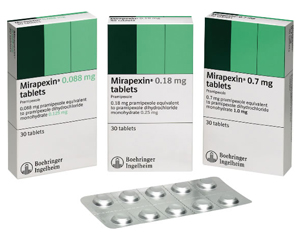
Mirapexin
View Options
This website provides general information about medicines for educational purposes only. Always consult your doctor or pharmacist before taking any medication.
Choose Your Medicine
Select dosage and quantity
Online Consultation
Reviewed by a qualified physician
Fast, Discreet Delivery
Delivered to your door
Medical Information
About This Medicine
Mirapexin contains pramipexole, a non-ergot dopamine agonist that stimulates dopamine D2, D3, and D4 receptors in the brain. It is used in the UK for two main indications: the treatment of signs and symptoms of idiopathic Parkinson's disease (alone or in combination with levodopa), and the treatment of moderate to severe idiopathic restless legs syndrome (RLS) in adults.
Parkinson's Disease
In Parkinson's disease, the progressive loss of dopamine-producing neurons in the substantia nigra leads to motor symptoms including tremor, rigidity, bradykinesia, and postural instability. Pramipexole compensates for this dopamine deficiency by directly stimulating dopamine receptors, improving motor control and reducing both motor and non-motor symptoms. It can be used as initial monotherapy in early Parkinson's or as adjunct therapy to levodopa in more advanced disease.
Restless Legs Syndrome
Mirapexin at lower doses is effective for moderate to severe RLS, reducing the irresistible urge to move the legs, particularly at night. It improves sleep quality and daily functioning in people with this condition.
Usage & Dosage
Parkinson's Disease Dosing
Mirapexin (pramipexole) for Parkinson's is taken three times daily (every 8 hours). Treatment begins at 0.088 mg three times daily and is gradually increased every five to seven days, up to a maximum of 3.3 mg per day. Dose increases are guided by your neurologist based on your response and tolerability.
Restless Legs Syndrome Dosing
For restless legs syndrome, Mirapexin is taken as a single dose two to three hours before bedtime. The starting dose is 0.088 mg, increasing if needed to a maximum of 0.54 mg daily. Tablets may be taken with or without food. Do not stop pramipexole suddenly, reduce the dose gradually under medical supervision.
Mirapexin immediate-release tablets are available in strengths of 0.088 mg, 0.18 mg, 0.35 mg, and 0.7 mg (all expressed as pramipexole base). For Parkinson's disease, dosing is three times daily. For RLS, dosing is once daily before bedtime. A prolonged-release formulation (Mirapexin PR) is also available for once-daily dosing in Parkinson's disease.
Side Effects
Common Side Effects
Nausea, dizziness, somnolence (sleepiness), insomnia, constipation, and headache are the most commonly reported side effects, particularly at the start of treatment. These often improve with continued use. Taking pramipexole with food may reduce nausea. Sudden onset of sleep has been reported; caution is required when driving or operating machinery.
Impulse Control Disorders
A particularly important class of side effects associated with dopamine agonists including pramipexole are impulse control disorders (ICDs). These include pathological gambling, hypersexuality, compulsive spending, and binge eating. Patients and carers should be advised to watch for unusual or compulsive behaviours and report them promptly. Dose reduction or discontinuation is usually required if ICDs develop. Hallucinations and confusion can also occur, particularly in older patients.
Warnings & Precautions
Never stop pramipexole suddenly; abrupt withdrawal can cause a syndrome resembling neuroleptic malignant syndrome (including fever, rigidity, and altered consciousness). Dose reductions must be gradual under medical supervision. Dopamine agonist withdrawal syndrome (DAWS) can cause severe anxiety, dysphoria, and autonomic symptoms in some patients. Monitor closely in patients with renal impairment; dose adjustment is required. Use with caution in patients with cardiovascular disease or psychosis.
Contraindications
Pramipexole is contraindicated in patients with known hypersensitivity to the drug or any excipient. Use with caution in patients with renal impairment (dose adjustment required based on creatinine clearance) and in those with a history of impulse control disorders or psychosis.
Frequently Asked Questions
What are the signs of impulse control disorder with Mirapexin?
Can I drive while taking Mirapexin?
How does Mirapexin differ from levodopa for Parkinson's?
Dr. Ross Elledge
General Practitioner · General & Family Medicine
Verified Healthcare Professional
TopDoctors Profile