
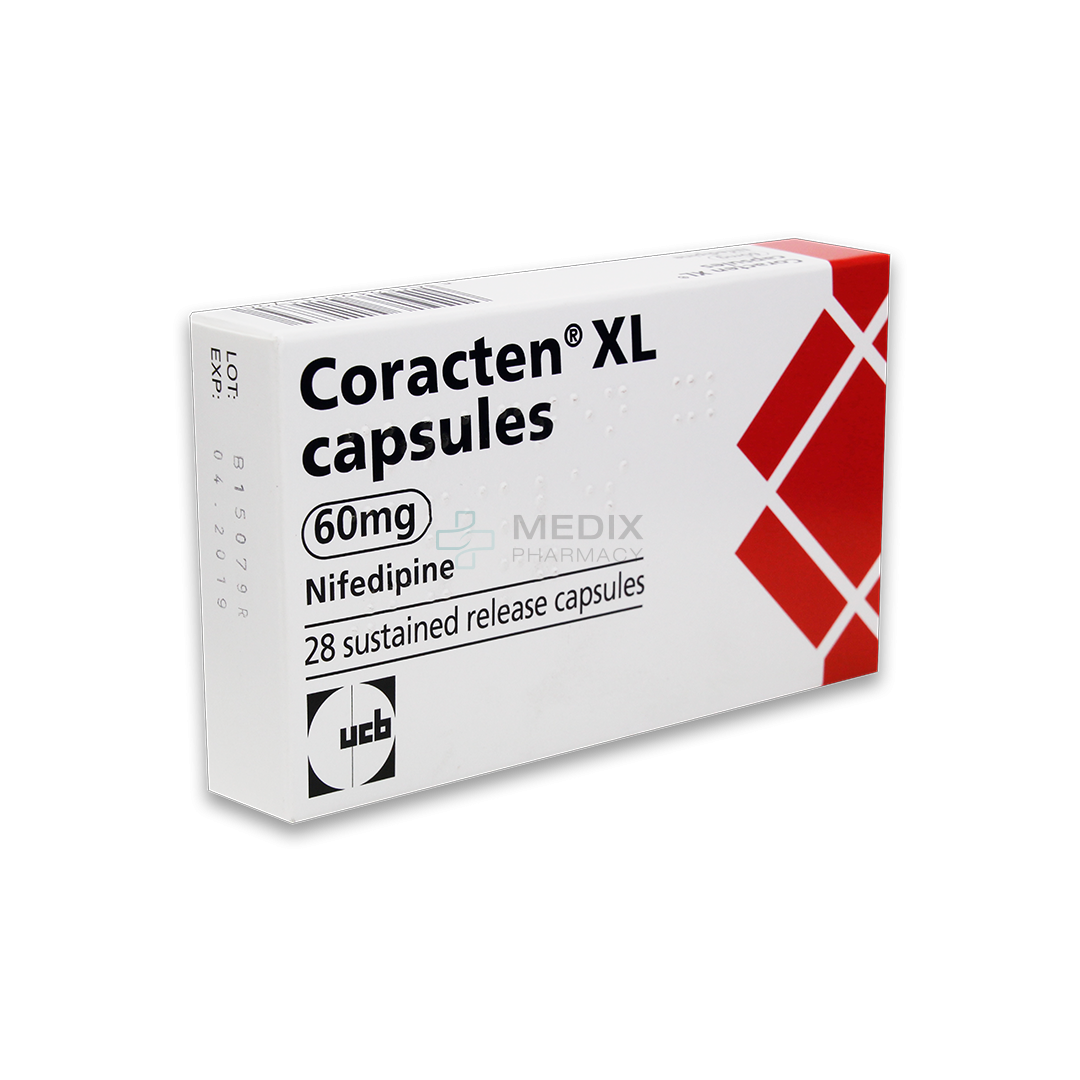
Nifedipine
View Options
This website provides general information about medicines for educational purposes only. Always consult your doctor or pharmacist before taking any medication.
Choose Your Medicine
Select dosage and quantity
Online Consultation
Reviewed by a qualified physician
Fast, Discreet Delivery
Delivered to your door
Medical Information
About This Medicine
Nifedipine (sometimes misspelled as nefidipine) is a dihydropyridine calcium channel blocker used in the treatment of hypertension, stable and vasospastic angina, and Raynaud's phenomenon. It is one of the oldest and most widely studied calcium channel blockers and is available in several formulations: immediate-release capsules (Adalat) and modified-release tablets (Adalat LA, Adalat CC, Coracten SR, and others). The choice of formulation depends on the indication being treated.
How Nifedipine Works
Nifedipine acts by blocking L-type voltage-gated calcium channels in the smooth muscle cells of blood vessel walls and, to a lesser extent, in cardiac muscle. By preventing calcium ions from entering these cells during depolarisation, nifedipine reduces the contractile activity of vascular smooth muscle, causing vasodilation - particularly in the arteries. This lowers peripheral vascular resistance, reducing the workload on the heart and decreasing blood pressure. In coronary vessels, nifedipine relieves vasospasm and improves blood flow to the myocardium, providing relief from angina.
Formulation Matters
Immediate-release nifedipine capsules act rapidly and are primarily used for acute management of vasospastic angina (Prinzmetal's angina) or in certain obstetric settings. However, they cause a rapid fall in blood pressure and reflex tachycardia, which can be problematic for long-term hypertension management. Modified-release preparations provide more stable plasma levels over 24 hours, avoiding the peaks and troughs of the immediate-release formulation, and are preferred for hypertension and chronic stable angina.
Grapefruit Interaction
A clinically important interaction exists between nifedipine and grapefruit juice. Grapefruit contains furanocoumarins that inhibit the CYP3A4 enzyme responsible for nifedipine's first-pass metabolism in the gut wall and liver, significantly increasing nifedipine plasma levels and the risk of adverse effects including severe hypotension. Patients taking nifedipine in any formulation should avoid grapefruit and grapefruit juice entirely.
Usage & Dosage
How to Take Nifedipine
For high blood pressure and stable angina, modified-release nifedipine tablets are used. These should be swallowed whole, never chew, break, or crush them, as this causes the full dose to be released at once. Modified-release tablets are typically taken once or twice daily depending on the formulation.
Avoid grapefruit and grapefruit juice completely throughout treatment, as it significantly increases nifedipine blood levels and the risk of side effects. Do not stop nifedipine abruptly if you have angina, as this can trigger a rebound increase in chest pain (vasospasm). Always taper the dose gradually under medical supervision.
Doses vary significantly depending on formulation and indication.
Hypertension (modified-release): Starting dose typically 30 mg once daily (Adalat LA) or 10-20 mg twice daily (Coracten SR). Dose may be titrated up to a maximum of 90 mg once daily or 40 mg twice daily depending on the specific product and blood pressure response.
Chronic stable angina (modified-release): Similar dosing to hypertension - 30-90 mg daily depending on formulation and response.
Raynaud's phenomenon: Modified-release preparations at 10-20 mg two to three times daily are commonly used.
Immediate-release formulations (Adalat 5 mg and 10 mg capsules): Reserved for specific indications (vasospastic angina, acute hypertension in specialist settings) - 5-20 mg per dose, three times daily. Modified-release tablets must be swallowed whole. No dose adjustment is typically required in elderly patients based on age alone, but lower starting doses may be appropriate. Caution is required in hepatic impairment.
Side Effects
Common Side Effects
The following side effects are related primarily to nifedipine's vasodilatory action and are more pronounced with immediate-release formulations:
- Flushing and sensation of warmth or heat, particularly affecting the face and upper body
- Headache, often pulsating in quality, especially early in treatment
- Peripheral oedema (ankle and leg swelling) due to arteriolar vasodilation increasing capillary hydrostatic pressure
- Dizziness and light-headedness, particularly on standing
- Palpitations and reflex tachycardia (more common with immediate-release)
- Nausea and gastrointestinal discomfort
- Fatigue
- Constipation (less common than with verapamil)
Serious Side Effects
The following require urgent medical review:
- Severe hypotension (marked fall in blood pressure) - more likely with immediate-release formulations, in combination with other antihypertensives, or when grapefruit juice has been consumed
- Chest pain or worsening angina at the start of treatment - paradoxical angina can occur, particularly with immediate-release nifedipine, due to reflex tachycardia
- Severe peripheral oedema causing pitting or skin changes
- Hypersensitivity reactions including rash, urticaria, or angioedema
- Gingival hyperplasia (overgrowth of the gums) with prolonged use - rare
Warnings & Precautions
Grapefruit Interaction
Patients taking nifedipine must completely avoid grapefruit and grapefruit juice throughout their treatment. Grapefruit inhibits the CYP3A4 enzyme responsible for nifedipine's metabolism, causing plasma levels to rise significantly and unpredictably, increasing the risk of severe hypotension, dizziness, and other adverse effects. Seville oranges and related citrus fruits should also be avoided.
Formulation and Cardiovascular Precautions
Immediate-release nifedipine should not be used routinely for hypertension management, as rapid blood pressure reduction and reflex tachycardia may be harmful, particularly in patients with coronary artery disease. Modified-release formulations are preferred for this indication. Nifedipine can interact with beta-blockers, digoxin, phenytoin, rifampicin, and CYP3A4 inhibitors (such as certain antifungals, HIV medicines, and macrolide antibiotics). Concurrent use of CYP3A4 inhibitors may require dose reduction.
Nifedipine may cause ankle oedema, which can be mistaken for heart failure. This peripheral oedema is haemodynamic in origin rather than due to fluid overload and typically does not respond to diuretics. If ankle swelling is significant, a dose reduction or switching to a different antihypertensive class may be necessary. Nifedipine should be used with caution in pregnancy; it is sometimes used for pre-term labour tocolysis and for hypertension in pregnancy under specialist supervision, but this requires careful benefit-risk assessment.
Contraindications
Nifedipine must not be used in patients with:
- Cardiogenic shock or haemodynamically significant cardiac failure
- Unstable angina or within one month of a myocardial infarction (risk of worsening coronary ischaemia, particularly with immediate-release)
- Known hypersensitivity to nifedipine, other dihydropyridines, or excipients
- Significant aortic stenosis (vasodilation may compromise coronary perfusion)
- Concurrent administration of rifampicin (induces CYP3A4 to such a degree that nifedipine plasma levels become sub-therapeutic)
- Pregnancy in the first trimester; use in later pregnancy only under specialist supervision
- Porphyria
- Severe hypotension (systolic below 90 mmHg)
- Immediate-release preparations are additionally contraindicated for routine hypertension treatment
Frequently Asked Questions
Why can I not drink grapefruit juice while taking nifedipine?
What is the difference between Adalat and Adalat LA?
My ankles have swollen since starting nifedipine - what should I do?
Can nifedipine be used during pregnancy?
Can I take nifedipine with a beta-blocker?
Dr. Ross Elledge
General Practitioner · General & Family Medicine
Verified Healthcare Professional
TopDoctors Profile