
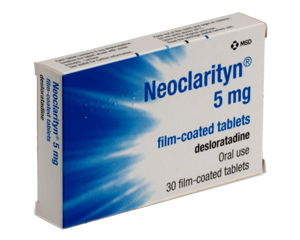
Neoclarityn
View Options
This website provides general information about medicines for educational purposes only. Always consult your doctor or pharmacist before taking any medication.
Choose Your Medicine
Select dosage and quantity
Online Consultation
Reviewed by a qualified physician
Fast, Discreet Delivery
Delivered to your door
Medical Information
About This Medicine
Neoclarityn is a prescription antihistamine medicine containing desloratadine 5 mg, used for the relief of symptoms associated with allergic rhinitis and chronic idiopathic urticaria (hives). Desloratadine is a second-generation, non-sedating antihistamine that provides effective allergy symptom relief without causing the drowsiness associated with older antihistamines. It is manufactured by Organon and available as standard 5 mg tablets and an oral solution for children.
The Active Metabolite of Loratadine
Desloratadine is the primary active metabolite of loratadine - a well-established antihistamine available over the counter in the UK. Because desloratadine is already in its pharmacologically active form, it does not require metabolic conversion before exerting its effects. This means its onset of action is rapid and consistent. Desloratadine is approximately three times more potent than loratadine in vitro in blocking the histamine H1 receptor, which may translate into clinical advantages for some patients.
Benefits for Patients
Neoclarityn effectively relieves the full spectrum of allergic rhinitis symptoms: sneezing, nasal itching, runny nose, and nasal congestion, as well as itchy, watery, and red eyes. It is also effective for urticaria, reducing itching and the size and number of wheals. Because it is non-sedating and does not cause QT interval prolongation (cardiac arrhythmia risk), Neoclarityn is considered cardiovascularly safe and can be taken by patients who need to remain alert during the day, including those who drive or operate machinery.
One tablet taken once daily provides 24-hour symptom control. Neoclarityn can be taken with or without food and at any time of day that suits the patient, making adherence easy.
Usage & Dosage
How to Take Neoclarityn
Take one Neoclarityn (desloratadine) 5 mg tablet once daily, at any time of day, with or without food. Neoclarityn provides relief from sneezing, nasal discharge, itching, nasal congestion, and eye symptoms.
For seasonal allergic rhinitis, start at the beginning of the pollen season and continue until exposure ends. For perennial allergic rhinitis or chronic urticaria, longer-term treatment may be appropriate. Neoclarityn can be taken continuously as needed without losing its effectiveness.
The standard dose of Neoclarityn for adults and adolescents (12 years and over) is 5 mg (one tablet) once daily. The tablet may be taken with or without food. There is no evidence that higher doses (above 5 mg once daily) provide additional clinical benefit in allergic rhinitis.
For children aged 6-11 years: 2.5 mg (half a tablet or 2.5 mg oral solution) once daily.
For children aged 1-5 years: 1.25 mg oral solution once daily.
For infants 6-11 months (for urticaria only, where indicated under specialist guidance): 1 mg once daily.
In patients with severe renal impairment, the dose should be reduced to 5 mg every other day, as desloratadine and its metabolites are renally excreted. No dose adjustment is required in hepatic impairment. No dose adjustment is required in elderly patients. Treatment duration depends on the condition: seasonal allergic rhinitis is treated during the relevant season, while perennial rhinitis and chronic urticaria may require longer courses.
Side Effects
Common Side Effects
Neoclarityn is generally very well tolerated. Side effects reported in clinical trials at frequencies similar to placebo include:
- Headache
- Dry mouth
- Fatigue or drowsiness (though significantly less than with first-generation antihistamines)
- Nausea
- Myalgia (muscle aches) - uncommon
- Dizziness - uncommon
- Abdominal discomfort - uncommon
- Tachycardia (fast heart rate) - uncommon
Serious Side Effects
Serious adverse effects with desloratadine are rare, but patients should be aware of:
- Hypersensitivity reactions including urticaria, angioedema (swelling of the face, lips, tongue, or throat), and anaphylaxis - rare but requires immediate medical attention
- Severe tachycardia or palpitations - seek medical advice if heart rate appears very fast or irregular
- Seizures - very rarely reported in post-marketing surveillance, mechanism unclear
- Liver function abnormalities and jaundice - very rare and typically reversible on discontinuation
Warnings & Precautions
Driving and Sedation
Neoclarityn is classified as a non-sedating antihistamine and has been shown in studies not to impair psychomotor performance. Patients are generally able to drive and operate machinery while taking Neoclarityn. However, a very small number of individuals may experience drowsiness, and patients should be aware of how the medicine affects them individually, particularly when first starting treatment.
Interactions and Renal Impairment
Unlike older antihistamines, desloratadine does not have significant interactions with alcohol at the population level - it does not meaningfully enhance alcohol's sedative effects. However, individual sensitivity varies and excessive alcohol consumption during any antihistamine treatment is inadvisable. In patients with severe renal impairment, dose reduction is required (5 mg every other day) to avoid accumulation. Desloratadine does not significantly interact with erythromycin or ketoconazole at therapeutic doses (unlike its predecessor loratadine, where these interactions were studied), and its cardiac safety profile is well established.
Neoclarityn is not recommended during pregnancy unless clearly necessary, as there are limited human data. Animal studies have not shown embryotoxic effects, but caution remains appropriate. Desloratadine is excreted in breast milk and is not recommended during breastfeeding. Patients with galactose intolerance or glucose-galactose malabsorption should note the lactose content of the tablet formulation.
Contraindications
Neoclarityn must not be used in patients with:
- Known hypersensitivity to desloratadine, loratadine, or any excipient in the formulation
- Children under 1 year of age (insufficient safety data)
- Galactose intolerance, lactase deficiency, or glucose-galactose malabsorption (contains lactose)
- Severe renal impairment without appropriate dose adjustment
- Pregnancy unless benefit clearly outweighs risk and no safer alternative is available
- Breastfeeding (desloratadine excreted in breast milk)
Frequently Asked Questions
Is Neoclarityn the same as Clarityn?
Can I drive after taking Neoclarityn?
How quickly does Neoclarityn start to work?
Can I take Neoclarityn every day long term?
Can Neoclarityn be used during pregnancy?
Dr. Ross Elledge
General Practitioner · General & Family Medicine
Verified Healthcare Professional
TopDoctors Profile