
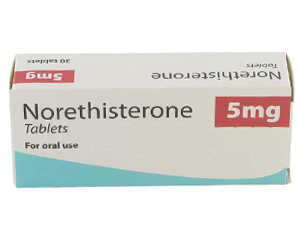
Norethisterone
View Options
This website provides general information about medicines for educational purposes only. Always consult your doctor or pharmacist before taking any medication.
Choose Your Medicine
Select dosage and quantity
Online Consultation
Reviewed by a qualified physician
Fast, Discreet Delivery
Delivered to your door
Medical Information
About This Medicine
Norethisterone is a synthetic progestogen (progesterone-like hormone) used in a wide variety of gynaecological and hormonal conditions. It is one of the most versatile progestogens available in the UK, appearing in formulations ranging from contraceptive pills to hormone replacement therapy, and is used at varying dose levels depending on the clinical indication.
Clinical Indications
Norethisterone has several distinct therapeutic roles. At higher doses (5 mg tablets), it is prescribed for the treatment of endometriosis, dysfunctional uterine bleeding (abnormal or heavy periods), premenstrual syndrome, and - most commonly in short-term use - to delay menstruation. The latter is a widely sought indication where norethisterone 5 mg three times daily, started three days before the expected period, can postpone menstruation for up to two weeks.
At the much lower dose of 350 micrograms, norethisterone forms the active ingredient of the progestogen-only contraceptive pill (mini-pill), available as Noriday. In this form, it is particularly suitable for women who cannot take oestrogen-containing contraceptives, including breastfeeding mothers, women with certain types of migraine, or those with a history of thromboembolic disease.
Norethisterone also forms the progestogen component of combined oral contraceptive pills (such as Loestrin and Brevinor) and of sequential hormone replacement therapy preparations (such as Novofem).
Mechanism and Considerations
As a progestogen, norethisterone has partial androgenic activity - which may cause acne or hirsutism in some patients, particularly at higher doses. Women using norethisterone to delay a period should be aware that their next period may be heavier or more irregular than usual once treatment is stopped. Norethisterone used for period postponement does not provide contraceptive protection.
Usage & Dosage
How to Take Norethisterone
Dosing varies considerably by indication.
Period Delay
For short-term period postponement, take norethisterone 5 mg three times daily, starting three to four days before the expected period. Continue for up to 14 days. Menstruation typically returns two to three days after stopping. This does not provide contraceptive protection.
Endometriosis and Heavy Bleeding
For endometriosis, higher doses (10 to 15 mg daily) may be prescribed for several months under specialist supervision. For dysfunctional uterine bleeding, a common regimen is 5 mg two to three times daily from days 19 to 26 of the cycle. Take with food if you experience stomach upset.
Dosing varies considerably with indication:
Period postponement: 5 mg three times daily, starting 3-4 days before expected period; continue for up to 14 days.
Dysfunctional uterine bleeding: 5 mg two to three times daily from day 19 to day 26 of the menstrual cycle, repeated for several cycles.
Endometriosis: 10-15 mg daily (in divided doses), continuously for 4-6 months or longer under specialist supervision, increasing to 20-25 mg daily if breakthrough bleeding occurs.
Premenstrual syndrome: 5 mg daily from day 19 to day 26 of the cycle.
Progestogen-only pill (Noriday): 350 micrograms daily, continuously, taken at the same time each day (within a 3-hour window). There is no dose adjustment guidance for renal or hepatic impairment for the gynaecological indications; however, norethisterone should be used with caution in liver disease and avoided in severe hepatic impairment. It is not recommended during pregnancy.
Side Effects
Common Side Effects
Norethisterone at therapeutic doses (5 mg or higher) may cause:
- Breakthrough bleeding or spotting, particularly early in treatment
- Nausea, bloating, or abdominal discomfort
- Breast tenderness or swelling
- Headache or migraine
- Mood changes including depression, irritability, or low mood
- Acne and oily skin (due to the androgenic activity of norethisterone)
- Weight gain or fluid retention
- Decreased libido
- Irregular menstrual bleeding following cessation of treatment
Serious Side Effects
Less common but more serious effects include:
- Thromboembolic events - deep vein thrombosis or pulmonary embolism; progestogens used alone have lower VTE risk than combined oestrogen-progestogen preparations, but the risk is not negligible, particularly in susceptible individuals; seek urgent medical help if you develop sudden leg swelling, chest pain, or breathlessness
- Liver dysfunction - jaundice or altered liver function tests; norethisterone should be discontinued if liver function is significantly impaired
- Severe depression - if mood disturbance is significant, the medicine should be reviewed
- Cholestatic jaundice, particularly in women with a history of obstetric cholestasis or prior jaundice with oral contraceptive use
Warnings & Precautions
Thromboembolic Risk
Norethisterone at doses used for gynaecological indications (5 mg and above) carries a risk of venous thromboembolism (VTE) that is comparable to that of combined oral contraceptives. This is particularly relevant when norethisterone is used for period postponement - a common short-term indication. Women with additional VTE risk factors (obesity, immobility, smoking, prior DVT, thrombophilia) should be assessed carefully before prescribing. It is important that patients are not under the impression that period postponement with norethisterone is risk-free.
Liver, Mood, and Androgenic Effects
Norethisterone should be used with caution in patients with hepatic disease, and it is contraindicated in severe liver impairment or a history of jaundice associated with previous progestogen use. Women with a personal or family history of depression should be monitored carefully, as progestogens can precipitate or worsen depressive symptoms. The androgenic activity of norethisterone means acne and excess hair growth may occur, particularly at higher doses. Norethisterone interacts with enzyme-inducing medicines such as rifampicin, carbamazepine, phenytoin, and St John's Wort, which can reduce its effectiveness. During breastfeeding, norethisterone at 5 mg doses is not recommended; however, the 350 mcg progestogen-only pill (Noriday) is considered compatible with breastfeeding.
Contraindications
Norethisterone must not be used in patients with:
- Undiagnosed vaginal bleeding
- Severe hepatic impairment or liver tumours (benign or malignant)
- Active or previous arterial or venous thromboembolic disease (DVT, pulmonary embolism, stroke, myocardial infarction) - particularly relevant at the 5 mg dose
- Known or suspected hormone-sensitive malignancy (breast cancer, endometrial cancer) unless under specialist supervision
- Porphyria
- Known hypersensitivity to norethisterone or any excipient
- Pregnancy (may cause virilisation of a female foetus at high doses; progestogen-only pills are not teratogenic at contraceptive doses but should still be discontinued once pregnancy is confirmed)
- History of cholestatic jaundice associated with previous progestogen or oral contraceptive use
- Dubin-Johnson syndrome or Rotor syndrome (inherited disorders of bilirubin transport)
Frequently Asked Questions
Can norethisterone be used to delay a period before a holiday?
Will my period be heavier after I stop taking norethisterone?
Is norethisterone a form of contraception?
Can norethisterone cause acne?
Can I take norethisterone while breastfeeding?
Dr. Ross Elledge
General Practitioner · General & Family Medicine
Verified Healthcare Professional
TopDoctors Profile