
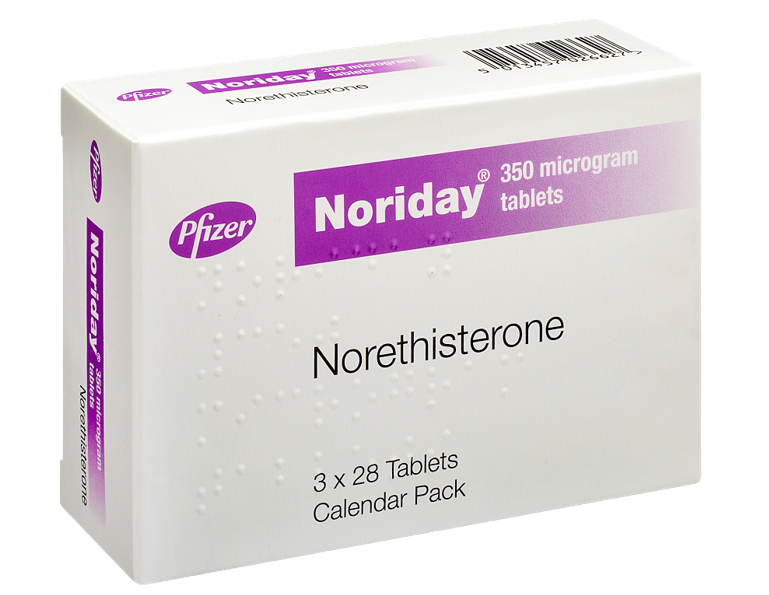
Noriday
View Options
This website provides general information about medicines for educational purposes only. Always consult your doctor or pharmacist before taking any medication.
Choose Your Medicine
Select dosage and quantity
Online Consultation
Reviewed by a qualified physician
Fast, Discreet Delivery
Delivered to your door
Medical Information
About This Medicine
Noriday is a progestogen-only contraceptive pill (POP), also known as the mini-pill, containing norethisterone 350 micrograms per tablet. It is manufactured by Pfizer and provides effective contraception without the use of oestrogen, making it suitable for a wider range of women than combined oral contraceptive pills.
Who Can Use Noriday
Noriday is particularly valuable for women who cannot take oestrogen-containing contraceptives. This includes women who are breastfeeding (oestrogen can suppress milk production), women who experience oestrogen-related migraines with aura, women over 35 who smoke, women with a history of deep vein thrombosis or pulmonary embolism, and those with cardiovascular risk factors that make oestrogen-containing pills inadvisable. Noriday is also suitable for women of any age who prefer to avoid oestrogen for personal or medical reasons.
How the Mini-Pill Works
Noriday works primarily by thickening the cervical mucus, making it difficult for sperm to travel through the cervix to fertilise an egg. It also thins the lining of the uterus, making implantation less likely. At the 350 microgram dose, it does not consistently suppress ovulation in all cycles - this differs from higher-dose desogestrel-containing mini-pills (such as Cerazette), which reliably inhibit ovulation in most cycles.
The Three-Hour Rule
A critical feature of Noriday is its three-hour timing window. Each tablet must be taken at the same time every day, within a three-hour window of the scheduled time. If a tablet is taken more than three hours late, contraceptive protection is reduced and additional contraceptive precautions (such as condoms) should be used for the next 48 hours. This is stricter than the 12-hour window allowed with desogestrel-containing pills, and women with variable daily schedules should factor this into their choice of contraceptive.
Usage & Dosage
How to Take Noriday
Noriday (norethisterone 350 mcg) must be taken every day without a break, including during menstruation. Take one tablet daily at exactly the same time each day. The three-hour timing window is critical, missing this window reduces contraceptive effectiveness.
Starting Noriday
If started on the first day of menstruation, protection is immediate. If started on any other day, use condoms for the first 48 hours. One tablet must be taken within three hours of the regular time. If a tablet is more than three hours late, take it as soon as possible, continue as normal, and use condoms for the next 48 hours.
The dose is one tablet (350 micrograms norethisterone) taken once daily at the same time each day, continuously without a break. There is no hormone-free interval - a new strip is started the day after finishing the previous one.
The three-hour timing window is critical: if a tablet is taken more than three hours late, it is considered a missed pill and additional contraception should be used for 48 hours.
There is no dose adjustment for weight, age, or other factors. However, women taking enzyme-inducing medicines (such as rifampicin, carbamazepine, phenytoin, or St John's Wort) should be aware that the effectiveness of Noriday may be significantly reduced by these drugs, and alternative or additional contraceptive methods should be discussed with their prescriber. Noriday is not recommended before menarche. No specific dosing changes apply in renal impairment; caution is required in liver disease.
Side Effects
Common Side Effects
Side effects of Noriday are generally related to its progestogenic action and are more likely to be noticeable in the first few months of use:
- Irregular menstrual bleeding or spotting (very common - the most significant side effect for many women)
- Amenorrhoea (absence of periods) in some women, particularly with long-term use
- Breast tenderness
- Nausea, particularly in the first few weeks
- Headache
- Mood changes, including low mood or irritability
- Acne or skin changes (due to mild androgenic activity)
- Decreased libido
- Weight changes
- Ovarian cysts - functional ovarian cysts occur more often with progestogen-only pills (usually resolve spontaneously)
Serious Side Effects
Serious effects are uncommon but include:
- Ectopic pregnancy - if pregnancy occurs while taking Noriday (which can happen if pills are missed or in the rare case of contraceptive failure), there is a higher chance it may be ectopic (occurring in the fallopian tube rather than the uterus); seek urgent assessment if you suspect pregnancy and experience abdominal pain
- Thromboembolic events - the risk is very low with progestogen-only pills but not entirely absent
- Severe allergic reactions (rare)
- Significant liver abnormalities (rare)
Warnings & Precautions
Irregular Bleeding
Irregular bleeding is the most common reason women discontinue the progestogen-only pill. Noriday can cause unpredictable spotting or bleeding throughout the cycle, and some women find their periods become lighter or stop altogether. While these changes are not harmful, they can be distressing. Women should be counselled about this before starting Noriday and encouraged to persist for at least three months if possible, as patterns often settle.
Ectopic Pregnancy Risk and Timing
Because Noriday does not reliably suppress ovulation, there is a small risk that ovulation may occur and fertilisation may happen. In the event of contraceptive failure, there is a higher relative risk of ectopic pregnancy compared with combined pill failures. Women taking Noriday should seek urgent evaluation if they experience lower abdominal pain or suspect they may be pregnant. Enzyme-inducing medicines (rifampicin, carbamazepine, phenytoin, lamotrigine at contraceptive doses, St John's Wort) can significantly reduce norethisterone's effectiveness, potentially rendering Noriday unreliable. A barrier method or alternative contraceptive should be discussed if any enzyme-inducing drug is being taken. Noriday does not protect against sexually transmitted infections. Women should return to fertility quickly after stopping Noriday - there is no delay in return to fertility.
Contraindications
Noriday must not be used in patients with:
- Current or recent arterial cardiovascular disease (angina, myocardial infarction, stroke) - though progestogen-only pills have lower VTE risk than combined pills, arterial disease remains a concern
- Severe hepatic disease or liver tumours
- Undiagnosed vaginal bleeding
- Known or suspected pregnancy
- History of ectopic pregnancy (relative contraindication; specialist advice recommended)
- Hormone-sensitive tumours, including breast cancer (current or recent history)
- Known hypersensitivity to norethisterone or any excipient
- Porphyria
- Concurrent use of hepatic enzyme-inducing drugs without additional contraceptive protection
Frequently Asked Questions
What happens if I take the Noriday pill more than three hours late?
Will Noriday affect my periods?
Is Noriday safe to use while breastfeeding?
How effective is Noriday as a contraceptive?
Can I use Noriday if I get migraines?
Dr. Ross Elledge
General Practitioner · General & Family Medicine
Verified Healthcare Professional
TopDoctors Profile