
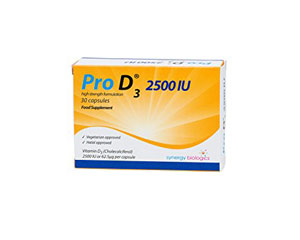
ProD3
View Options
This website provides general information about medicines for educational purposes only. Always consult your doctor or pharmacist before taking any medication.
Choose Your Medicine
Select dosage and quantity
Online Consultation
Reviewed by a qualified physician
Fast, Discreet Delivery
Delivered to your door
Medical Information
About This Medicine
What Is Pro-D3 and Why Is Vitamin D Important?
Pro-D3 is a high-strength vitamin D3 supplement containing colecalciferol, the natural form of vitamin D produced by the skin in response to sunlight exposure and found in certain foods such as oily fish and egg yolks. Vitamin D is an essential fat-soluble nutrient that plays a central role in calcium and phosphate absorption from the gut, making it critical for the development and maintenance of healthy bones and teeth. Beyond bone health, vitamin D has important functions in supporting immune system function, muscle performance, and normal cell division. Deficiency is associated with increased susceptibility to infections, muscle weakness, mood disturbances, and in severe cases, rickets in children and osteomalacia or osteoporosis in adults.
Vitamin D deficiency is extremely common in the UK. Because the country lies at a latitude where sunlight is insufficient for adequate skin synthesis for much of the year (particularly from October to March), and because modern indoor lifestyles, office work, sunscreen use, and covered skin clothing further reduce sun exposure, many people, particularly those who are elderly, housebound, have darker skin, or cover their skin for cultural reasons, are at risk of deficiency. The NHS recommends that everyone in the UK considers taking a daily vitamin D supplement, particularly during the autumn and winter months.
High-Strength Formulations and Who Needs Them
Pro-D3 is available in a range of strengths from 1,000 IU to 10,000 IU (and sometimes higher), allowing treatment of both maintenance supplementation and therapeutic correction of established deficiency. Standard over-the-counter supplements typically contain 400-1,000 IU, which is adequate for routine supplementation in healthy adults. Higher strengths (such as 3,000 IU or 10,000 IU) are used under medical supervision to rapidly correct deficiency measured by a low serum 25-hydroxyvitamin D (25-OH-D) blood test. These high-dose preparations are particularly useful for people with malabsorption conditions, obesity, or those who have failed to respond to lower-dose supplementation.
Colecalciferol Versus Ergocalciferol
Pro-D3 contains colecalciferol (vitamin D3) rather than ergocalciferol (vitamin D2). Current evidence suggests that colecalciferol is more effective at raising and sustaining serum 25-OH-D levels than ergocalciferol, making D3 the preferred form for both supplementation and treatment of deficiency in clinical practice.
Usage & Dosage
How to Take Pro-D3
Pro-D3 tablets or capsules should be taken orally, ideally with or shortly after a meal containing some fat, as vitamin D3 is a fat-soluble vitamin and its absorption is significantly enhanced in the presence of dietary fat. Taking it at the same time each day helps establish a consistent habit and ensures reliable supplementation. For high-strength preparations intended for deficiency treatment, follow the dosing schedule prescribed by your doctor precisely, do not self-prescribe high doses without a confirmed deficiency on blood testing.
For routine supplementation (400-1,000 IU daily), Pro-D3 can be taken continuously throughout the year or specifically during the autumn and winter months in line with NHS guidance. Many clinicians recommend year-round supplementation for individuals at higher risk, including the elderly, those with darker skin, and those who avoid sun exposure.
Monitoring During High-Dose Treatment
If you are taking high-dose Pro-D3 (3,000 IU or above) under medical supervision for confirmed deficiency, your prescriber will typically arrange a follow-up blood test after two to three months of treatment to check that 25-OH-D levels have normalised and to reduce the dose to a maintenance level once deficiency has been corrected. Regular monitoring is important to avoid vitamin D toxicity (hypervitaminosis D), which, while rare, can cause dangerously elevated calcium levels.
Pro-D3 (colecalciferol) is available in a wide range of strengths: 400 IU, 1,000 IU, 3,000 IU, 5,000 IU, and 10,000 IU tablets or capsules.
Routine supplementation (general population): 400-1,000 IU once daily. NHS recommendations for at-risk groups: 400 IU daily (minimum). Vitamin D insufficiency (25-OH-D 25-50 nmol/L): 1,000-3,000 IU daily. Vitamin D deficiency (25-OH-D below 25 nmol/L): 3,000-10,000 IU daily for 8-12 weeks, then reassess and step down to maintenance. Maximum safe daily dose for routine supplementation: 4,000 IU (25 micrograms). Doses above 4,000 IU should only be taken under medical supervision with blood monitoring.
Vitamin D requirements may be higher in obesity, malabsorption syndromes (coeliac disease, Crohn's disease), and in patients taking enzyme-inducing medications (rifampicin, anticonvulsants) that accelerate vitamin D metabolism.
Side Effects
Common Side Effects
- At recommended doses, Pro-D3 is very well tolerated with minimal side effects
- Mild nausea or gastrointestinal discomfort (rare at standard doses)
- Headache (uncommon)
- Metallic taste (rare)
- Dry mouth (uncommon)
- Fatigue (at high doses)
- Increased thirst (sign of early hypercalcaemia at high doses)
Serious Side Effects
- Hypercalcaemia (vitamin D toxicity): excessive thirst, frequent urination, nausea, vomiting, confusion, muscle weakness, associated with prolonged very high doses
- Hypercalciuria: excess calcium in the urine, risk of kidney stones
- Acute kidney injury: secondary to hypercalcaemia in severe toxicity
- Cardiac arrhythmias: associated with severe hypercalcaemia
Warnings & Precautions
Vitamin D Toxicity Warning
Pro-D3 at routine supplementation doses (up to 4,000 IU daily) is considered safe for most adults. However, vitamin D toxicity (hypervitaminosis D) can occur with prolonged use of very high doses, typically above 10,000 IU per day for extended periods. Toxicity results from an accumulation of calcium in the blood (hypercalcaemia) and tissues, which can cause serious organ damage. Unlike vitamin D deficiency -- which is common and easy to develop -- toxicity from dietary supplements requires sustained high-dose intake and is preventable with appropriate monitoring.
Patients with conditions that cause elevated calcium (such as sarcoidosis, primary hyperparathyroidism, or certain lymphomas) are at higher risk of hypercalcaemia even from modest doses of vitamin D and should only take supplements under close medical supervision with regular blood tests. Patients with a history of kidney stones should also exercise caution.
Drug Interactions
Thiazide diuretics (e.g., bendroflumethiazide) reduce urinary calcium excretion and can increase the risk of hypercalcaemia when combined with high-dose vitamin D supplementation. Digoxin toxicity is enhanced by hypercalcaemia, so vitamin D levels should be carefully monitored in patients taking digoxin. Anticonvulsants (phenytoin, carbamazepine) and rifampicin increase vitamin D metabolism and may necessitate higher supplementation doses.
Contraindications
- Hypercalcaemia (elevated blood calcium levels)
- Hypervitaminosis D (vitamin D toxicity)
- Hypercalciuria (elevated urinary calcium)
- Nephrolithiasis (kidney stones) -- use with caution and medical supervision
- Sarcoidosis (increased sensitivity to vitamin D effects on calcium)
- Severe renal impairment without medical supervision
- Primary hyperparathyroidism without medical supervision
- Known hypersensitivity to colecalciferol or any excipient
Frequently Asked Questions
How do I know if I am deficient in vitamin D?
Is it safe to take 10,000 IU of vitamin D daily?
Can vitamin D supplements improve mood and mental health?
Should I take Pro-D3 with calcium?
Can children take Pro-D3?
Dr. Ross Elledge
General Practitioner · General & Family Medicine
Verified Healthcare Professional
TopDoctors Profile