
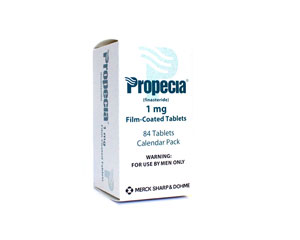
Propecia
View Options
This website provides general information about medicines for educational purposes only. Always consult your doctor or pharmacist before taking any medication.
Choose Your Medicine
Select dosage and quantity
Online Consultation
Reviewed by a qualified physician
Fast, Discreet Delivery
Delivered to your door
Medical Information
About This Medicine
What Is Propecia and How Does It Work?
Propecia contains finasteride 1 mg, a type II 5-alpha-reductase inhibitor used for the treatment of androgenetic alopecia (male pattern hair loss) in men. Male pattern baldness is driven by the action of dihydrotestosterone (DHT) on hair follicles in genetically susceptible individuals. DHT, which is converted from testosterone by the enzyme 5-alpha-reductase, causes progressive miniaturisation of susceptible hair follicles, leading to the characteristic pattern of receding hairline and thinning at the crown. Propecia works by inhibiting the type II isoform of 5-alpha-reductase, which is the predominant form in the scalp. By reducing scalp and serum DHT levels by approximately 70%, Propecia slows or halts follicle miniaturisation and, in many men, allows some degree of regrowth of existing miniaturised follicles.
Propecia was the first oral medication approved specifically for male pattern hair loss and remains one of the most effective pharmacological options available. It is suitable for men of all ages who have evidence of ongoing hair loss, and is most effective when started early in the process before extensive follicle loss has occurred.
What Results to Expect
Clinical trials have shown that approximately 90% of men taking Propecia daily either maintain their existing hair or experience regrowth after one to two years of treatment. Results are not immediate, improvements are typically first noticed at three to six months, with maximum benefit achieved after around two years of continuous use. Hair gain tends to be most pronounced at the crown and least predictable at the temples. If treatment is stopped, the beneficial effect is lost and hair loss resumes within six to twelve months.
Comparison With Minoxidil
Propecia is often used in conjunction with topical minoxidil, which works via a different mechanism to stimulate hair growth. The combination of finasteride and minoxidil is generally more effective than either treatment alone. Propecia addresses the underlying hormonal cause of hair loss, while minoxidil directly stimulates follicle activity. Together, they provide a complementary approach to comprehensive hair loss management.
Usage & Dosage
How to Take Propecia
Propecia 1 mg tablets are taken orally once daily, with or without food. The tablet should be swallowed whole and can be taken at any time of day, though choosing a consistent time helps maintain the habit. Propecia must be taken every day without interruption to maintain its effect, skipping doses or stopping treatment will reduce its effectiveness and hair loss will progressively resume.
Because results develop gradually, patience and commitment are essential. Many men see little or no visible change in the first three months and should not be discouraged from continuing. The treatment is a long-term commitment: Propecia must be continued indefinitely to maintain benefit, as cessation leads to reversal of improvement within six to twelve months.
Handling Precautions for Women
Propecia tablets must not be handled by women who are pregnant or who may become pregnant. Finasteride can be absorbed through the skin and is teratogenic (causes birth defects) in developing male foetuses, specifically causing abnormal development of the external genitalia. If a woman accidentally touches a crushed or broken Propecia tablet, the affected skin should be washed thoroughly with soap and water immediately. Whole, coated tablets do not pose a risk through casual skin contact, provided they are not crushed.
Propecia is available as 1 mg finasteride film-coated tablets.
Recommended dose: 1 mg orally once daily. This dose is taken continuously -- there is no loading or titration phase. The therapeutic effect begins to accumulate over months; maximum benefit is achieved at approximately two years. Propecia is only for use in adult men. It is not licensed for use in women or children.
No dose adjustment is required for renal impairment. Propecia should be used with caution in patients with hepatic impairment, as finasteride is metabolised by the liver. Note that finasteride significantly reduces serum PSA (prostate-specific antigen) levels by approximately 50%; PSA values must be interpreted accordingly in prostate cancer screening.
Side Effects
Common Side Effects
- Decreased libido (reduced sex drive)
- Erectile dysfunction
- Decreased ejaculatory volume
- Ejaculatory disorder
- Breast tenderness or enlargement (gynaecomastia)
- Testicular discomfort
- Skin rash
- Depression or mood changes
Serious Side Effects
- Post-finasteride syndrome: a controversial but recognised syndrome in some men of persistent sexual dysfunction, depression, and cognitive effects persisting after stopping treatment
- Prostate cancer risk: rare high-grade prostate cancers have been reported in clinical trials (clinical significance debated)
- Male breast cancer: rare cases reported; seek evaluation for any breast lumps or nipple discharge
- Severe depression and suicidal ideation: rare but reported; seek immediate help if mood deteriorates significantly
- Hypersensitivity reactions: angioedema, lip and face swelling
Warnings & Precautions
Sexual Side Effects and Post-Finasteride Syndrome
The most commonly reported side effects of Propecia relate to sexual function, including reduced libido, erectile dysfunction, and decreased ejaculatory volume. These side effects are reported in a small proportion of men (fewer than 2% in clinical trials) and typically resolve after stopping treatment. However, a subset of men has reported persistence of sexual dysfunction, mood disturbances, and cognitive difficulties even after discontinuing finasteride -- referred to as post-finasteride syndrome. The Medicines and Healthcare products Regulatory Agency (MHRA) and the European Medicines Agency (EMA) have recommended that prescribers discuss this possibility with patients before initiating treatment.
Not for use in women: Finasteride 1 mg is not licensed or effective for female hair loss and must not be taken by women. It is teratogenic and women who are pregnant or may become pregnant must not handle broken or crushed tablets.
PSA Monitoring and Prostate Considerations
Propecia reduces serum PSA levels by approximately 50% in men taking it for six months or more. Men undergoing prostate cancer screening with PSA testing should inform their clinician that they are taking finasteride, as the PSA level must be doubled to correct for this effect. Failure to account for this could result in a cancer being missed.
Contraindications
- Women (especially those who are pregnant or may become pregnant)
- Children and adolescents under 18 years of age
- Hypersensitivity to finasteride or any excipient
- Severe hepatic impairment (use with caution and monitoring in mild-moderate impairment)
- Bladder outflow obstruction that requires surgical intervention (Propecia does not treat BPH at this dose)
- Men planning fertility treatment (finasteride may affect semen quality in some individuals)
Frequently Asked Questions
How long does Propecia take to work?
What happens if I stop taking Propecia?
Can Propecia affect fertility?
Does Propecia affect PSA prostate cancer screening results?
Is Propecia safe for long-term use?
Dr. Ross Elledge
General Practitioner · General & Family Medicine
Verified Healthcare Professional
TopDoctors Profile