
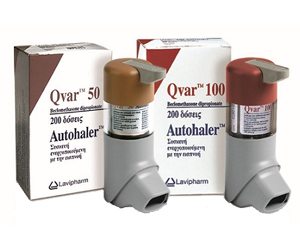
QVAR
View Options
This website provides general information about medicines for educational purposes only. Always consult your doctor or pharmacist before taking any medication.
Choose Your Medicine
Select dosage and quantity
Online Consultation
Reviewed by a qualified physician
Fast, Discreet Delivery
Delivered to your door
Medical Information
About This Medicine
Qvar (beclometasone dipropionate) is an inhaled corticosteroid preventer inhaler for the long-term management of asthma. It is available as a pressurised metered-dose inhaler (pMDI) in 50mcg and 100mcg per actuation strengths. What sets Qvar apart from conventional beclometasone inhalers is its extrafine aerosol formulation, which allows the drug particles to penetrate more deeply into the small airways of the lungs, improving drug delivery and clinical efficacy.
CFC-Free Extrafine Technology
Qvar uses a hydrofluorocarbon (HFC) propellant rather than the older chlorofluorocarbon (CFC) propellants, making it environmentally preferable. More importantly, the HFC-based formulation produces an extrafine aerosol with particle sizes of 1.1 micrometres. These particles are considerably smaller than those produced by conventional beclometasone inhalers, enabling significantly better deposition in the peripheral small airways where much of the inflammation in asthma occurs. This improved lung deposition means that lower microgram doses of Qvar are needed to achieve equivalent clinical control compared with conventional beclometasone formulations.
Role in Asthma Management
Like other inhaled corticosteroids, Qvar is a preventer inhaler that must be used every day to maintain asthma control. It does not provide immediate relief during an acute asthma attack, and patients should always keep a short-acting bronchodilator (reliever inhaler such as salbutamol) available for such situations. Regular use of Qvar reduces airway inflammation, decreases bronchial hyper-responsiveness, and over time reduces the frequency of asthma attacks and the need for reliever medication.
Correct inhaler technique is critical. Because Qvar is a pressurised inhaler rather than a breath-actuated device, it requires coordination between pressing the canister and inhaling. Patients who struggle with coordination may benefit from using a spacer device, which also improves drug delivery and reduces oral deposition.
Usage & Dosage
How to Use Qvar Inhaler
Before using Qvar for the first time (or if unused for more than three days), prime the inhaler by releasing two actuations into the air away from your face. Shake the inhaler well before each use. Breathe out gently away from the inhaler, place the mouthpiece in your mouth and seal your lips around it. Breathe in slowly and deeply while pressing the canister down firmly. Hold your breath for ten seconds, then breathe out slowly. Always rinse your mouth with water and spit out after each use to reduce the risk of oral thrush.
Using a Spacer
A spacer device is strongly recommended if you find it difficult to coordinate pressing the canister and inhaling. A spacer also significantly reduces the amount of medication deposited in the mouth, lowering the risk of oral thrush and improving lung delivery.
Qvar is available in 50mcg and 100mcg per actuation strengths. Standard adult doses for mild to moderate asthma are typically 100 to 200mcg twice daily. For more severe asthma, doses up to 400mcg twice daily (800mcg total daily dose) may be required under specialist guidance. Because Qvar's extrafine particles deliver approximately twice the lung dose of conventional beclometasone, the prescribed dose of Qvar will typically be around half what a patient was previously using with a CFC or standard HFC beclometasone inhaler.
In children aged 5 to 12 years, doses of 50 to 100mcg twice daily are typical. The lowest effective dose should be used and stepped down as asthma control allows. Store at room temperature below 30 degrees Celsius, protect from frost and direct sunlight, and do not pierce or incinerate the canister.
Side Effects
Common Side Effects
- Oral thrush (candidiasis): white patches in the mouth, reduced significantly by mouth rinsing and spacer use
- Hoarseness or voice changes (dysphonia)
- Throat irritation
- Headache
- Dry mouth or throat
- Mild cough after inhalation
- Nasopharyngitis
Serious Side Effects
- Adrenal suppression: At high doses or with prolonged use, reduced cortisol production may occur; symptoms include weakness, dizziness, and low blood pressure
- Reduced bone mineral density: High-dose long-term use may contribute to osteoporosis; supplement with calcium and vitamin D if at risk
- Growth retardation in children: Monitor height regularly; use the lowest effective dose
- Severe allergic reactions: Paradoxical bronchospasm, rash, or angioedema require immediate medical attention
- Systemic corticosteroid effects: Cataracts, raised intraocular pressure (glaucoma), and skin thinning at very high doses
Warnings & Precautions
Dose Equivalence When Switching Inhalers
Switching from a conventional beclometasone inhaler to Qvar requires a dose reduction. Qvar delivers approximately twice the lung dose per microgram compared with older beclometasone formulations. A patient switching should have their dose reviewed by a healthcare professional and should not assume that their previous microgram dose translates directly to the same dose of Qvar. Incorrect dosing can result in either under-treatment of asthma or excessive corticosteroid exposure.
Do Not Use as a Reliever Inhaler
Qvar is strictly a preventer inhaler and must not be used to relieve acute asthma symptoms. Patients must always have a short-acting bronchodilator available. If asthma symptoms are worsening or the reliever inhaler is needed more frequently than usual, medical advice should be sought promptly, as this may indicate deteriorating asthma control requiring a step-up in treatment.
Adrenal Suppression and Systemic Effects
While inhaled beclometasone at standard doses is associated with minimal systemic effects, prolonged use at high doses may suppress adrenal function. Patients who require prolonged courses of oral corticosteroids in addition to their inhaler are at increased risk. In times of physiological stress such as surgery or serious illness, additional corticosteroid cover may be required.
Contraindications
- Known hypersensitivity to beclometasone dipropionate or any excipient
- Use as a reliever inhaler in acute asthma attacks
- Active or untreated pulmonary tuberculosis
- Untreated fungal, bacterial, or viral respiratory infections
- Children under 5 years (efficacy and safety in this age group not established for this formulation)
- Severe lactose intolerance (check excipient list for individual formulations)
Frequently Asked Questions
How is Qvar different from other beclometasone inhalers?
Should I use a spacer with my Qvar inhaler?
Why must I rinse my mouth after using Qvar?
Can I use Qvar when I am having an asthma attack?
If my asthma seems well controlled, can I stop taking Qvar?
Dr. Ross Elledge
General Practitioner · General & Family Medicine
Verified Healthcare Professional
TopDoctors Profile