
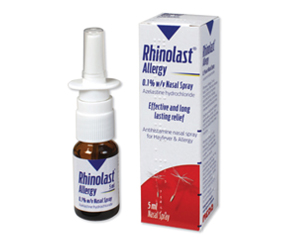
Rhinolast
View Options
This website provides general information about medicines for educational purposes only. Always consult your doctor or pharmacist before taking any medication.
Choose Your Medicine
Select dosage and quantity
Online Consultation
Reviewed by a qualified physician
Fast, Discreet Delivery
Delivered to your door
Medical Information
About This Medicine
Rhinolast is a prescription nasal spray containing azelastine hydrochloride 140 micrograms per actuation, used to relieve the symptoms of seasonal and perennial allergic rhinitis. It belongs to the antihistamine class of medicines and works locally within the nasal passages to block the action of histamine, the chemical responsible for the sneezing, itching, nasal congestion, and runny nose that characterise allergic rhinitis. Rhinolast offers the advantage of a rapid onset of action, with symptom relief often experienced within 15 minutes of application.
How Rhinolast Works
Azelastine is a potent, selective H1 receptor antagonist that also has mast cell stabilising and anti-inflammatory properties. When an allergen such as grass pollen, house dust mite, or pet dander triggers an allergic response in the nasal lining, mast cells release histamine and other inflammatory mediators. Rhinolast blocks H1 receptors on nasal mucosal cells, preventing histamine from binding and initiating the cascade of allergic symptoms. Its additional anti-inflammatory effects, including inhibition of leukotriene and cytokine release, contribute to its efficacy beyond simple antihistamine activity.
Seasonal and Perennial Allergic Rhinitis
For seasonal allergic rhinitis (hay fever), Rhinolast is most effective when started before the pollen season and used regularly throughout the season rather than on an as-needed basis. For perennial rhinitis, it may be used long-term to control symptoms triggered by year-round allergens such as house dust mite. It is suitable for adults and children aged 6 years and over.
Practical Advice for Use
To avoid the bitter taste that some patients experience, the spray should be directed slightly forward into the nostril rather than towards the back of the throat. Tilting the head slightly forward during application helps ensure the spray reaches the nasal mucosa rather than the pharynx. Rhinolast nasal spray does not generally cause significant sedation when used topically, though a small amount of systemic absorption occurs and some individuals may notice mild drowsiness.
Usage & Dosage
How to Use Rhinolast Nasal Spray
Before first use, prime Rhinolast (azelastine) by actuating the pump several times into the air until a fine mist appears. Blow your nose gently before each use. Hold the bottle upright, tilt your head slightly forward, and insert the nozzle into one nostril while closing the other. Press the pump firmly while breathing in gently through the nose. Repeat in the other nostril. Avoid spraying towards the back of the throat to reduce the bitter taste.
Frequency and Duration
The standard adult dose is one spray into each nostril twice daily (morning and evening). This can be increased to two sprays per nostril twice daily if symptoms are not adequately controlled. For seasonal rhinitis, continue throughout the allergen season. For perennial rhinitis, treatment may be needed year-round.
The standard dose of Rhinolast for adults and adolescents (12 years and over) is one spray (140 mcg azelastine) into each nostril twice daily, equivalent to 560 mcg azelastine per day. For inadequate symptom control, the dose may be increased to two sprays per nostril twice daily (1,120 mcg/day). For children aged 6 to 11 years, one spray per nostril twice daily is the recommended dose. Rhinolast is not recommended for children under 6 years. The spray should be used at regular intervals to maintain consistent symptom control. There is no specific dose adjustment required for elderly patients or those with renal or hepatic impairment when used intranasally, as systemic exposure is low. If symptoms are not controlled after a few weeks of regular use, the patient should return to their prescriber for review.
Side Effects
Common Side Effects
- Bitter or unpleasant taste in the mouth following nasal application
- Nasal irritation, burning, or stinging sensation within the nostrils
- Sneezing immediately after application
- Headache
- Mild drowsiness or fatigue (less common than with oral antihistamines)
- Nosebleeds (epistaxis) with prolonged use
- Dry mouth or throat
Serious Side Effects
- Severe allergic reaction (anaphylaxis): rash, swelling of the face or throat, difficulty breathing - seek emergency help immediately
- Significant nasal mucosal damage or ulceration with long-term use (rare)
- Pronounced drowsiness if alcohol or other sedating medicines are taken concurrently
- Paradoxical worsening of nasal symptoms requiring discontinuation
Warnings & Precautions
Driving and Sedation
Although nasal azelastine causes significantly less sedation than oral antihistamines, a small degree of systemic absorption occurs. Patients should be aware that Rhinolast may occasionally cause mild drowsiness and should exercise caution when driving or using machinery, particularly at the start of treatment. Combining Rhinolast with alcohol or other central nervous system depressants may enhance any sedative effects. Patients should be advised not to exceed the recommended dose.
Pregnancy and Breastfeeding
The safety of Rhinolast during pregnancy has not been fully established and it should only be used if the potential benefit justifies any potential risk to the foetus. The medicine should be avoided during the first trimester where possible. It is not known whether azelastine passes into breast milk in significant quantities, and use during breastfeeding is generally not recommended unless clearly necessary and under medical supervision.
Rhinolast should not be sprayed into the eyes, as azelastine is formulated separately as an eye drop preparation for ocular allergic symptoms. Patients with a known hypersensitivity to azelastine or benzalkonium chloride (the preservative in the formulation) should not use Rhinolast. The preservative benzalkonium chloride may cause nasal mucosal irritation with prolonged use and in sensitive individuals.
Contraindications
- Known hypersensitivity to azelastine hydrochloride or benzalkonium chloride
- Children under 6 years of age (safety and efficacy not established)
- First trimester of pregnancy (use with caution only if clearly necessary; avoid if possible)
- Patients with known sensitivity to other antihistamines who have experienced severe reactions
- Concurrent use with alcohol or strong central nervous system depressants in patients who drive or operate machinery
- Patients with nasal polyps causing significant obstruction (reduced efficacy; assess underlying cause first)
- Not for ophthalmic use (eyes)
Frequently Asked Questions
How quickly does Rhinolast nasal spray work for hay fever?
Why does Rhinolast leave a bitter taste in my mouth?
Can I use Rhinolast alongside a steroid nasal spray?
Is Rhinolast suitable for children with allergic rhinitis?
Can I use Rhinolast long-term for perennial allergic rhinitis?
Dr. Ross Elledge
General Practitioner · General & Family Medicine
Verified Healthcare Professional
TopDoctors Profile