
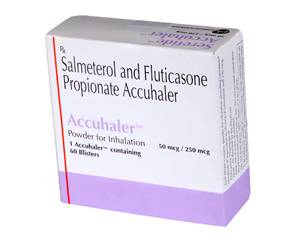
Salmeterol
View Options
This website provides general information about medicines for educational purposes only. Always consult your doctor or pharmacist before taking any medication.
Choose Your Medicine
Select dosage and quantity
Online Consultation
Reviewed by a qualified physician
Fast, Discreet Delivery
Delivered to your door
Medical Information
About This Medicine
Salmeterol is a long-acting beta-2 adrenoceptor agonist (LABA) bronchodilator used in the management of asthma and chronic obstructive pulmonary disease (COPD). It is available under the brand name Serevent and is delivered via Accuhaler (dry powder inhaler) or Evohaler (pressurised metered-dose inhaler) at a dose of 50 micrograms per actuation. Unlike salbutamol and other short-acting beta-2 agonists (SABAs), salmeterol provides prolonged bronchodilation lasting approximately 12 hours, supporting twice-daily dosing for sustained symptom control.
Mechanism and Duration of Action
Salmeterol's long duration of action is attributable to its unique molecular structure, which includes a long lipophilic side chain that anchors the molecule to a specific site within or adjacent to the beta-2 receptor, maintaining receptor activation over an extended period. Like salbutamol, salmeterol stimulates beta-2 receptors on airway smooth muscle, increasing intracellular cAMP and causing sustained bronchodilation. The prolonged receptor interaction explains why salmeterol is not suitable for acute symptom relief - it has a slower onset of approximately 10 to 20 minutes compared with the 5-minute onset of salbutamol.
Use in Asthma: Only With Inhaled Corticosteroids
A critical principle governing salmeterol use in asthma is that it must never be used as a standalone bronchodilator. Clinical trial data have demonstrated an increased risk of severe asthma exacerbations and asthma-related death when LABAs are used without concomitant inhaled corticosteroid (ICS) therapy. Salmeterol must always be prescribed alongside an ICS such as beclomethasone, budesonide, or fluticasone in asthma. Fixed-dose combination inhalers such as Seretide (fluticasone/salmeterol) simplify this requirement and improve adherence.
Use in COPD
In COPD, salmeterol is used as a maintenance bronchodilator to reduce breathlessness, improve exercise tolerance, and reduce exacerbation frequency. Unlike asthma, the mandatory ICS co-prescribing rule does not apply in COPD, though ICS is often added for patients with frequent exacerbations.
Usage & Dosage
How to Use Salmeterol
Salmeterol is taken twice daily - morning and evening - at regular intervals approximately 12 hours apart, regardless of symptoms. It is not a rescue inhaler and should not be used for sudden breathlessness. Always carry a short-acting reliever inhaler (salbutamol) separately for acute symptoms. For the Accuhaler, slide the mouthpiece cover open, grip the thumbgrip firmly, push the lever back to load the dose, breathe out gently away from the device, then place the mouthpiece in the mouth and inhale firmly and deeply. Hold breath for several seconds. Close the cover after use.
Critical Rule for Asthma Patients
Salmeterol must always be used with an inhaled corticosteroid in asthma. It should never replace or delay appropriate ICS therapy. If you are prescribed salmeterol for asthma, ensure your ICS inhaler is also being taken regularly. Many clinicians prefer fixed-dose combination inhalers (such as Seretide) over separate inhalers to guarantee that both components are taken. Salmeterol is not appropriate for patients whose asthma can be adequately controlled on an ICS alone.
The standard adult dose for asthma and COPD is 50 mcg (one actuation) inhaled twice daily via Accuhaler or Evohaler, morning and evening. For severe asthma, the dose may be increased to 100 mcg (two actuations) twice daily in some patients. Children aged 4 years and over with asthma may use 50 mcg twice daily via Accuhaler; this must always be prescribed with an ICS. For COPD, 50 mcg twice daily is the standard dose. Salmeterol should not be used more than twice daily - if additional bronchodilation is needed beyond twice-daily dosing, the overall treatment plan should be reviewed. Regular assessment of lung function and symptom control is recommended for all patients on long-term LABA therapy, and stepping down therapy should be considered if asthma is well controlled for an extended period.
Side Effects
Common Side Effects
- Tremor of the hands and fingers (beta-2 receptor stimulation in skeletal muscle)
- Palpitations and awareness of heartbeat
- Headache
- Muscle cramps
- Hypokalaemia (low potassium) with high doses
- Throat irritation or cough (dry powder inhaler)
- Paradoxically increased breathlessness if used without ICS in asthma
- Tachycardia (fast heart rate)
Serious Side Effects
- Severe bronchospasm: paradoxical worsening of airway narrowing - discontinue and use short-acting reliever
- Cardiac arrhythmias: particularly at higher doses or in patients with pre-existing cardiac conditions
- Severe hypokalaemia: risk of arrhythmia, especially in conjunction with corticosteroids or diuretics
- Asthma-related death (if used without ICS in asthma - this is the primary safety concern with LABAs as monotherapy)
- Severe allergic reactions including angioedema
Warnings & Precautions
LABA Safety in Asthma: The Critical Warning
Salmeterol must never be used as monotherapy for asthma. The Salmeterol Multicentre Asthma Research Trial (SMART) demonstrated a statistically significant increase in asthma-related deaths in patients randomised to salmeterol without ICS compared to placebo. As a result, LABAs are only approved for asthma use when prescribed alongside an ICS. Patients should be counselled clearly that salmeterol is a maintenance treatment to be taken every day, not an emergency reliever, and that they must continue their ICS alongside it. If symptoms worsen acutely, a short-acting reliever inhaler should be used and medical advice sought.
Not for Acute Attacks
Salmeterol has a slower onset of action than short-acting beta-2 agonists and is not effective for the immediate relief of acute asthma or COPD exacerbations. Do not use salmeterol during an acute attack - use salbutamol or another SABA instead. If an acute attack does not respond adequately to a SABA, seek emergency medical assistance. Patients should keep their short-acting reliever inhaler accessible at all times.
Salmeterol should be used with caution in patients with thyrotoxicosis, serious cardiovascular disorders including hypertrophic obstructive cardiomyopathy, and in those with known QT prolongation. Concomitant use of xanthines, corticosteroids, or diuretics increases the risk of hypokalaemia.
Contraindications
- Monotherapy in asthma without concurrent inhaled corticosteroid (absolute contraindication)
- Known hypersensitivity to salmeterol, xinafoate, or any component of the inhaler formulation
- Use as a reliever inhaler for acute bronchospasm
- Significant cardiac arrhythmias not adequately controlled
- Thyrotoxicosis (use with caution; relative contraindication)
- Hypertrophic obstructive cardiomyopathy
- Children under 4 years
- Use more frequently than twice daily (should not be used as required or more than prescribed)
Frequently Asked Questions
Why can't I use salmeterol on its own for my asthma?
Can I use salmeterol when I have an acute asthma attack?
Is Seretide the same as taking salmeterol and fluticasone separately?
How is salmeterol different from salbutamol?
What should I do if my asthma symptoms are getting worse despite using salmeterol regularly?
Dr. Ross Elledge
General Practitioner · General & Family Medicine
Verified Healthcare Professional
TopDoctors Profile