
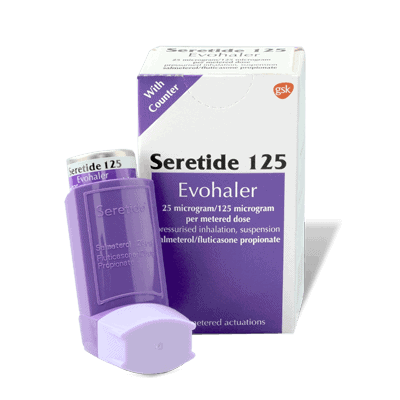
Seretide
View Options
This website provides general information about medicines for educational purposes only. Always consult your doctor or pharmacist before taking any medication.
Choose Your Medicine
Select dosage and quantity
Online Consultation
Reviewed by a qualified physician
Fast, Discreet Delivery
Delivered to your door
Medical Information
About This Medicine
Seretide is a combination inhaler containing two active substances: fluticasone propionate, an inhaled corticosteroid (ICS), and salmeterol, a long-acting beta-2 agonist (LABA). Together, these complementary mechanisms provide sustained control of asthma and chronic obstructive pulmonary disease (COPD), reducing airway inflammation while keeping the bronchial muscles relaxed over a 12-hour period.
How Seretide Works
Fluticasone propionate acts on the airway lining to dampen the inflammatory response that underlies asthma and COPD exacerbations. It reduces the production of inflammatory mediators, decreases airway hyper-responsiveness, and over time helps restore a more normal airway architecture. Salmeterol complements this by binding to beta-2 adrenoceptors on bronchial smooth muscle, producing prolonged bronchodilation that eases breathing and reduces the effort required to move air in and out of the lungs.
It is important to understand that Seretide is a preventer or maintenance inhaler, not a reliever. It must be used every day as prescribed, regardless of whether symptoms are present. For acute breathlessness or bronchospasm, a short-acting reliever inhaler such as salbutamol should always be kept at hand.
Available Strengths and Devices
Seretide is available as an Accuhaler (dry powder) and as an Evohaler (pressurised metered-dose inhaler). Strengths range from Seretide 100 (for mild-to-moderate asthma) through Seretide 250 and Seretide 500, which are used in more severe disease and in COPD management. The numeric designation refers to the fluticasone propionate dose in micrograms per dose, while salmeterol is consistently 50 mcg per actuation. Prescribers choose the strength according to disease severity and prior treatment history.
Use in Asthma and COPD
In asthma, Seretide is indicated when a patient's condition is not adequately controlled by an ICS alone. Clinical studies have shown that the ICS/LABA combination reduces the frequency and severity of exacerbations, improves lung function measurements such as FEV1, and enhances overall symptom control compared with either component used separately. In COPD, Seretide 500 Accuhaler is licensed for patients with a forced expiratory volume below 60% predicted who are experiencing recurrent exacerbations despite bronchodilator treatment.
Patients should rinse the mouth with water after each use to reduce the risk of oropharyngeal candidiasis, a common local side effect of inhaled corticosteroids. Regular inhaler technique reviews are recommended to ensure optimal drug delivery and therapeutic benefit.
Usage & Dosage
Seretide should be inhaled twice daily, approximately 12 hours apart, at the same times each day to maintain consistent drug levels in the airways. This regularity is essential because the benefits of the inhaled corticosteroid component accumulate over days to weeks rather than providing immediate relief.
Correct Inhaler Technique
The technique differs between the Accuhaler and the Evohaler. For the Accuhaler, patients should open the device, slide the lever to load the dose, breathe out gently away from the mouthpiece, place the mouthpiece between the lips, and inhale steadily and deeply. The breath should be held for approximately 10 seconds before exhaling slowly. For the Evohaler, the canister must be shaken before each actuation, and the patient should breathe in slowly and steadily as the dose is released, coordinating actuation with inhalation.
After use, rinsing the mouth thoroughly with water and spitting out (without swallowing) significantly reduces the likelihood of developing an oral fungal infection (thrush). This step is particularly important in patients using higher-strength formulations or those who are immunocompromised.
Starting and Adjusting Treatment
The lowest effective strength should always be used. Prescribers will typically start at a moderate strength and step down once good disease control is achieved, or step up if control is insufficient. Patients should not stop Seretide abruptly or adjust the dose without medical guidance, as this can lead to rapid deterioration of asthma or COPD control. If symptoms worsen or reliever use increases significantly, medical review should be sought promptly.
For asthma in adults and adolescents aged 12 and over, Seretide 100 Accuhaler is typically one inhalation twice daily; Seretide 250 Accuhaler is one inhalation twice daily for moderate-to-severe asthma; Seretide 500 Accuhaler is reserved for severe asthma and COPD. The Evohaler strengths are 50/25, 125/25, and 250/25 mcg (fluticasone/salmeterol), with the standard adult asthma dose being two actuations twice daily of the appropriate strength.
For COPD, the licensed dose is Seretide 500 Accuhaler, one inhalation twice daily.
Children aged 4 to 11 years may use Seretide 100 Accuhaler or the 50/25 Evohaler, one inhalation twice daily, under specialist guidance. Seretide is not recommended in children under 4 years. There is no dose adjustment required for elderly patients, though regular review of inhaler technique is advisable. Patients with hepatic impairment should be monitored closely at higher doses due to reduced fluticasone metabolism.
Side Effects
Common Side Effects
- Oropharyngeal candidiasis (oral thrush), rinse mouth after each use to reduce risk
- Hoarseness or voice changes (dysphonia)
- Headache
- Throat irritation or dryness
- Tremor, particularly of the hands, related to salmeterol
- Palpitations or mild increase in heart rate
- Muscle cramps
- Bruising of the skin with long-term higher-dose use
Serious Side Effects
- Paradoxical bronchospasm, immediate worsening of breathing after inhalation; stop use and seek urgent medical attention
- Adrenal suppression with prolonged high-dose use, particularly relevant during periods of stress, illness, or surgery
- Decreased bone mineral density with long-term use; monitoring and calcium/vitamin D supplementation may be recommended
- Hypokalaemia (low potassium), especially when combined with other medicines affecting potassium levels
- Severe allergic reactions including rash, angioedema, or anaphylaxis (rare)
- Growth retardation in children with long-term use at higher doses
Warnings & Precautions
Seretide must never be used as a rescue inhaler for acute asthma attacks. Patients should always carry a short-acting bronchodilator such as salbutamol for immediate symptom relief. An increase in the need for rescue medication is a warning sign that asthma control is deteriorating, and medical review should be sought without delay.
Systemic Corticosteroid Effects
Prolonged use of inhaled corticosteroids, even at moderate doses, can produce systemic effects. These include suppression of the hypothalamic-pituitary-adrenal (HPA) axis, which becomes clinically relevant during severe illness, surgery, or other physiological stressors. Patients who have been on high-dose inhaled corticosteroids for extended periods should carry a steroid warning card. Abrupt withdrawal of the corticosteroid component after long-term use may unmask adrenal insufficiency.
Bone density may decrease with long-term use. Patients at risk of osteoporosis -- including postmenopausal women, those with low body weight, or smokers -- should discuss calcium and vitamin D supplementation with their doctor.
Special Populations and Drug Interactions
Seretide should be used with caution in patients with cardiovascular disease, thyrotoxicosis, diabetes mellitus, or uncorrected hypokalaemia. Concurrent use of beta-blockers (including eye drops) is generally inadvisable as they antagonise the bronchodilator effect of salmeterol. CYP3A4 inhibitors such as ritonavir, ketoconazole, and itraconazole significantly increase plasma fluticasone levels, raising the risk of systemic corticosteroid side effects including Cushing's syndrome and adrenal suppression. Caution is warranted in pregnancy; the benefits must be carefully weighed against potential risks, and any change to asthma treatment during pregnancy should involve medical supervision.
Contraindications
- Hypersensitivity to fluticasone propionate, salmeterol, or any excipient in the formulation
- Use as a sole therapy for acute asthma attacks or acute bronchospasm
- Use in children under 4 years of age
- Not recommended as first-line therapy in mild asthma where an ICS alone would suffice
- Concurrent use of strong CYP3A4 inhibitors such as ritonavir (relative contraindication; use with extreme caution)
- Use of the 500 mcg strength in children
- Untreated tuberculosis or other severe respiratory infections (use with caution)
- Rare hereditary galactose intolerance, Lapp lactase deficiency, or glucose-galactose malabsorption (Accuhaler contains lactose)
Frequently Asked Questions
Can I use Seretide as a reliever inhaler during an asthma attack?
How long does it take for Seretide to start working?
What should I do if I forget a dose of Seretide?
Can I use Seretide during pregnancy?
Why do I need to rinse my mouth after using Seretide?
Dr. Ross Elledge
General Practitioner · General & Family Medicine
Verified Healthcare Professional
TopDoctors Profile